A methane carrier suffered a critical temperature loss in its LNG tanks after the detachment of polyurethane insulation panels. The adhesive failure, caused by extreme thermal contraction, generated dangerous thermal bridges. To map these hidden defects and prevent a major catastrophe, engineers turned to 3D infrared photogrammetry, a technique that combines thermography with volumetric modeling to inspect critical infrastructure without needing to dismantle the systems.
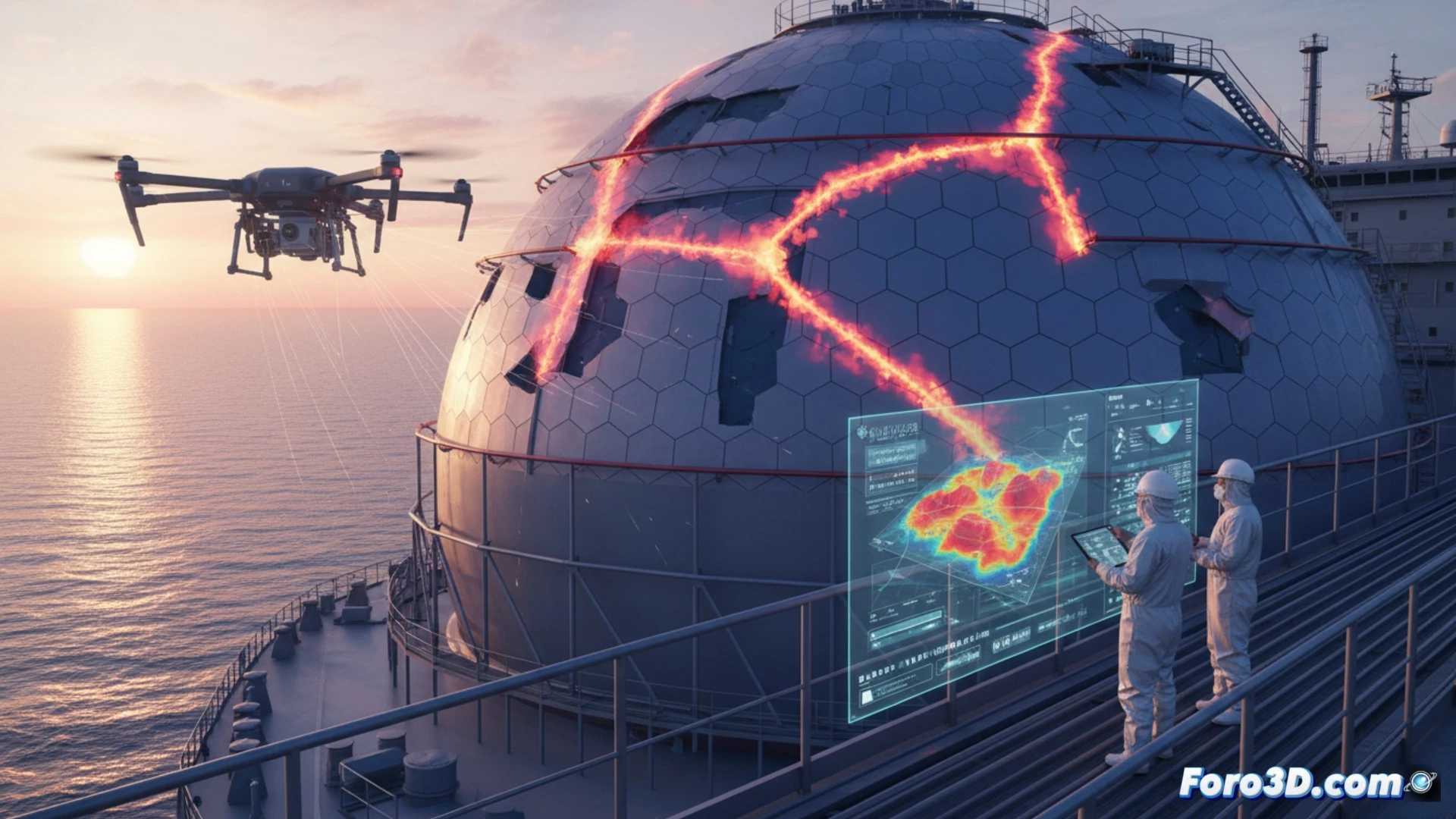
Technical workflow with Pix4D, Thermal Desktop, Rhino, and Lumion 🔥
The process began with capturing thermal images of the ship's hull, processed in Pix4D to generate a 3D point cloud with temperature data. This cloud was exported to Thermal Desktop, where heat flows through the thermal bridges were simulated, identifying the exact areas where the adhesive had failed due to cryogenic fatigue. With Rhino, the geometries of the detached panels were modeled, and the actual state of the tank was reconstructed. Finally, Lumion allowed visualizing the risk scenario, overlaying thermal gradients on the 3D structure to clearly communicate the severity of the incident to maintenance teams.
Catastrophe prevention through thermographic diagnosis 🛡️
This methodology demonstrates that 3D infrared photogrammetry is not only useful for documenting damage but also for predicting failures in cryogenic infrastructure. By detecting thermal bridges and areas of degraded adhesive before an LNG leak occurs, explosions or massive fires are prevented. In a sector where a single insulation error can trigger an environmental and human catastrophe, tools like Pix4D and Thermal Desktop become indispensable allies for industrial safety.
How 3D infrared photogrammetry can detect micro-detachments in the insulation panels of a cryogenic tank before a critical temperature loss similar to that of the stricken methane carrier occurs
(PS: Simulating catastrophes is fun until the computer melts down and you are the catastrophe.)