The detachment of a particle detector on the seabed triggered a high-level forensic investigation. The breakage of the gimbal joint, a critical component of the anchoring system, presented a dilemma: was it material fatigue from currents or biocorrosion by extremophilic microorganisms? To resolve this, an ROV equipped with high-resolution cameras was deployed. The objective was to capture the exact geometry of the fracture for subsequent virtual analysis.
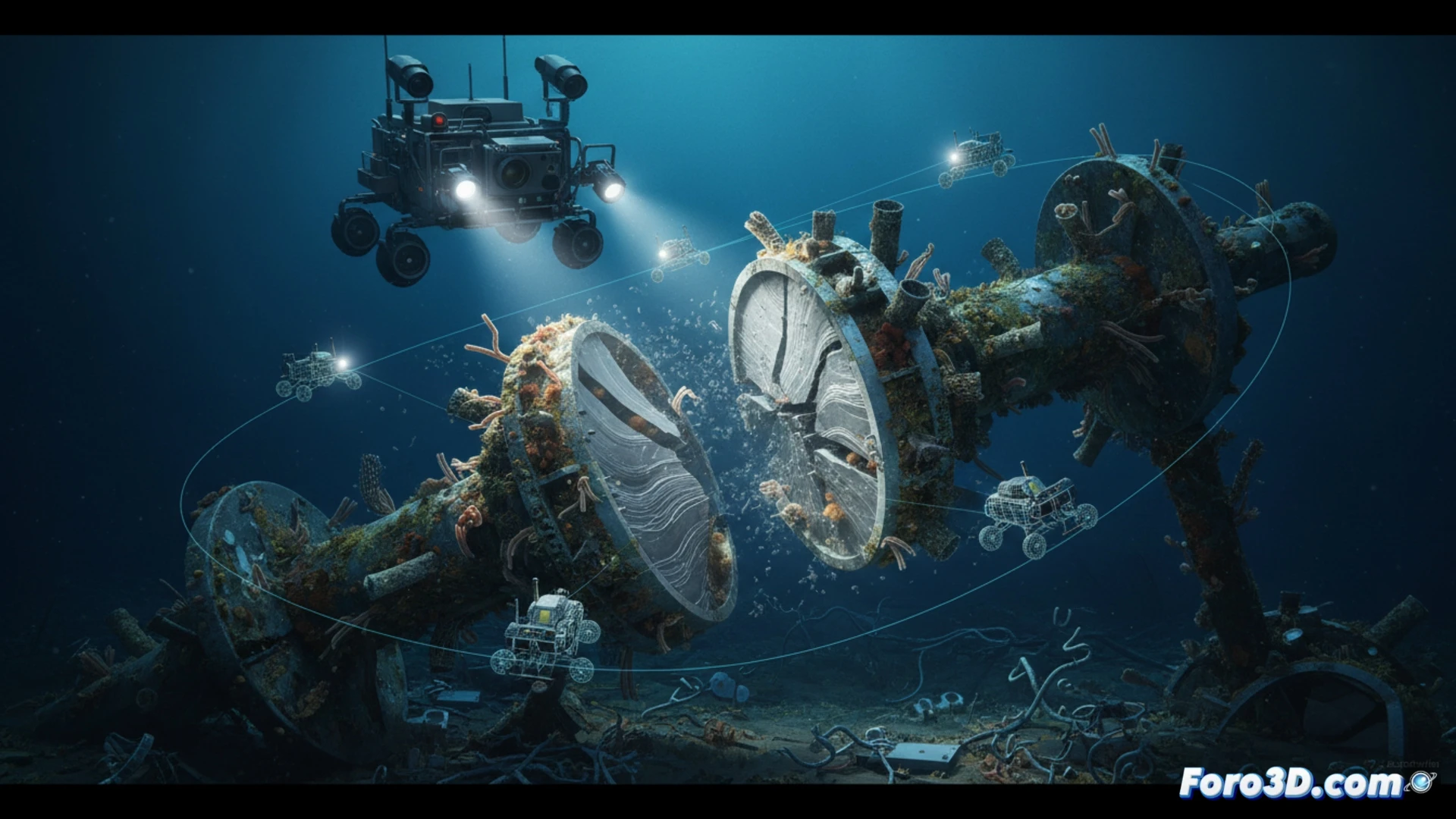
Forensic workflow: from point cloud to FEA 🔍
The process began in Agisoft Metashape with the Underwater mode activated, calibrating the light and water refraction to generate a faithful 3D mesh of the fracture. This point cloud was imported into Blender to clean up digital noise and segment the failure zone. The clean model was transferred to Solid Edge, where a finite element analysis (FEA) was applied. Two scenarios were simulated: typical mechanical stress cycles from fatigue and a surface degradation model from biocorrosion. Comparing the virtual deformations with the actual fracture geometry allowed pure fatigue to be ruled out and pointed to microbial action as the main cause.
The value of simulation in failure investigation ⚙️
This case demonstrates that material fatigue simulation is useful not only for preventing failures but also for investigating them post-mortem. The combination of underwater photogrammetry and FEA provides a technical verdict without needing to retrieve the part from the seabed. For engineers, the lesson is clear: biocorrosion must be modeled as an active stress factor in extreme environments, not just as passive wear. Forensic 3D reconstruction thus consolidates itself as an indispensable tool in materials engineering.
How the finite element simulation of the joint fatigue model influenced the interpretation of point clouds obtained through forensic photogrammetry to determine the root cause of the failure.
(PS: Material fatigue is like yours after 10 hours of simulation.)