Forensic entomology allows estimating the postmortem interval by analyzing larval development in cadaveric remains. However, traditional documentation with 2D photographs loses critical spatial information. Integrating 3D technologies such as close-range photogrammetry and laser scanning enables capturing the exact distribution of larval masses on the body surface, generating volumetric models that preserve the position, density, and orientation of each colony for subsequent expert analysis.
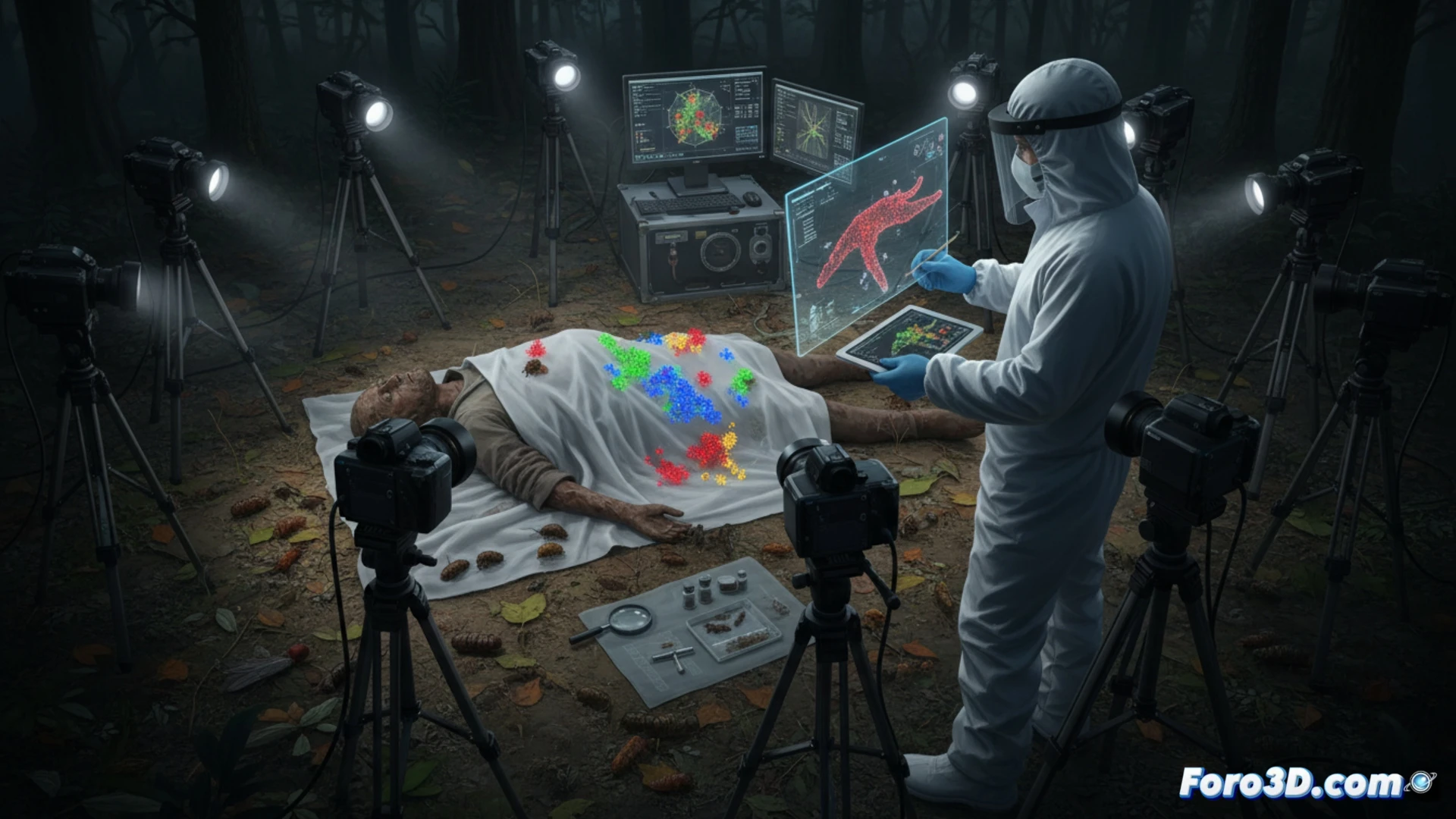
Technical pipeline for mapping larval colonies 🧬
The workflow begins with the acquisition of multispectral images of the cadaver in situ, using a calibrated camera and scale markers. These are processed in photogrammetry software such as Agisoft Metashape or RealityCapture to generate a dense point cloud and a textured mesh. On this 3D model, regions of interest where larvae of different instars are concentrated are annotated, calculating their volume and relative surface area. Laser scanning complements the model with high-precision metric data, allowing measurement of distances between colonies and the ground, a key factor for determining pre-pupal larval migration. Finally, a georeferenced model is exported, linking each point with its local temperature, essential for adjusting growth curves of species such as Calliphora vicina.
Towards a temporal reconstruction of the decomposition process ⏳
The true potential of this integration lies in the ability to generate temporal reconstructions of the decomposition cycle. By overlaying 3D models captured at different times, forensic experts can visualize larval migration and calculate the exact moment of colonization. This technique not only improves the accuracy of the postmortem interval but also allows identifying possible alterations to the scene, as any displacement of the larvae relative to the original model reveals manipulation. The 3D forensic pipeline thus consolidates itself as an indispensable tool for field entomology.
How the accuracy of 3D reconstruction through forensic photogrammetry impacts the measurement of larval growth on irregular body surfaces to estimate the postmortem interval
(PS: In the forensic pipeline, the most important thing is not to mix evidence with reference models... or you'll end up with a ghost at the scene.)