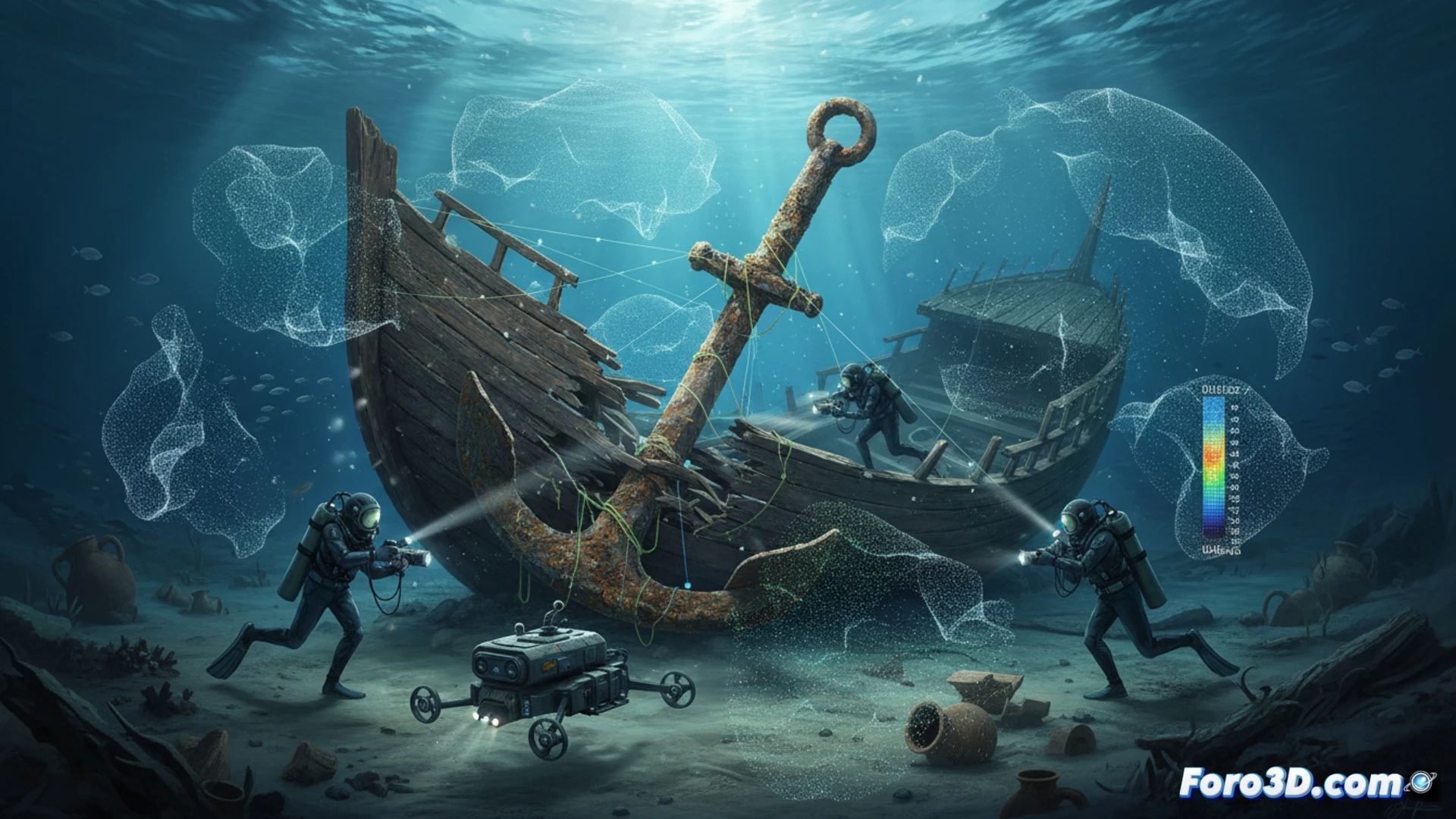
An illegal anchor has caused structural damage to a protected Phoenician shipwreck, one of the few charred wood remains from the ancient Mediterranean. To document the impact, a team of digital archaeologists has implemented a high-resolution photogrammetry workflow that allows for millimeter-precise quantification of volume loss and distortion of the submerged organic material.
Technical workflow: from point cloud to quantifiable deformation 🛠️
The process begins with capturing multiple sets of underwater images in two separate campaigns. These are processed in Agisoft Metashape to generate dense point clouds and high-fidelity mesh models of the shipwreck. Temporal comparison is performed in CloudCompare, where point clouds from both periods are aligned using the ICP (Iterative Closest Point) algorithm. The Hausdorff distance is calculated here to identify areas of greatest deformation. To isolate the charred wood from the surrounding sediment, MeshLab is used for semi-automatic mesh cleaning and segmentation tasks. Finally, Blender is used to calculate the exact volume of each section of the shipwreck through boolean operations and to generate heat map visualizations illustrating material loss. The volumetric difference between the two models reveals the exact amount of wood torn away by the anchor.
3D technology as a witness against underwater looting ⚖️
This case demonstrates that digital archaeology serves not only for passive documentation but as an active forensic tool. The ability to measure structural distortion and volume loss in protected heritage allows for presenting quantitative evidence to authorities. Without this technology, the damage from an illegal anchor would remain a mere subjective description. Now, researchers can state with precision how much history has been lost and how the remains have been deformed, setting a precedent for the legal protection of submerged sites.
Which forensic photogrammetry methodology allows for the most precise quantification of structural deformation caused by the illegal anchor on the charred wood Phoenician shipwreck?
(PS: and remember: if you can't find a bone, you can always model it yourself)