The recent description of the Uroplatus fangorn, a gecko from Madagascar named after Tolkien's Fangorn forest, represents a milestone for scientific visualization. Its skin, a perfect replica of lichen-covered bark, challenges visual detection. In this technical article, we explore how photogrammetry and 3D modeling techniques allow us to deconstruct and disseminate this extreme mimicry, offering biologists and science communicators a tool to study the evolution of camouflage without disturbing the specimen.
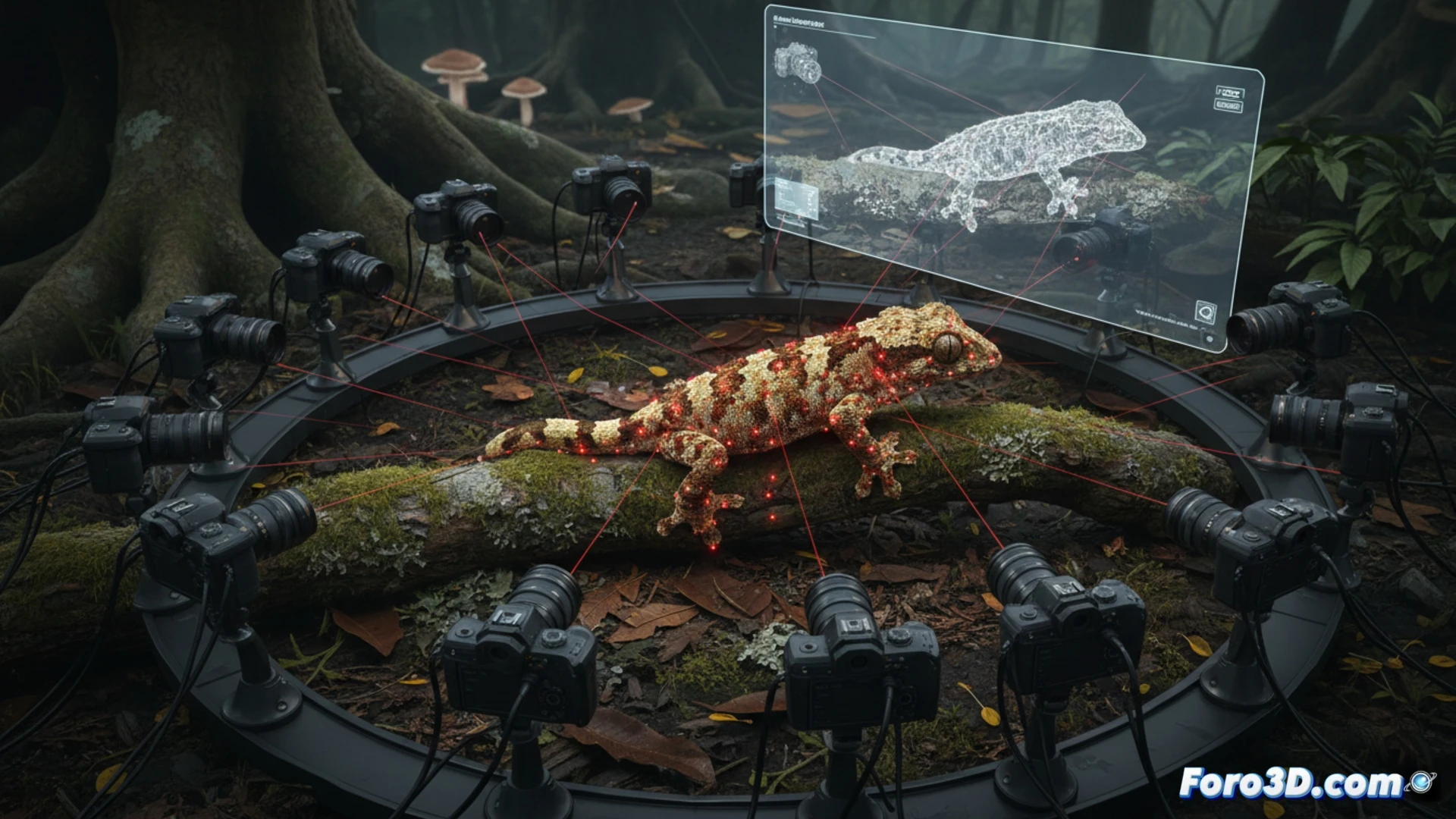
Texture reconstruction and spectral analysis of crypsis 🦎
To document the Uroplatus fangorn, a workflow based on close-range photogrammetry with cross-polarized lighting is recommended. This eliminates specular reflections and captures the microtopography of its epidermis, which mimics fissures and lichen. The resulting model, with 16-bit displacement maps, allows rendering its texture under variable lighting conditions, simulating the Madagascar understory. Furthermore, by extracting bidirectional reflectance distribution function (BRDF) maps, we can quantify how its disruptive coloration breaks the body outline, a key data point for studies in evolutionary biology and habitat conservation.
Beyond wonder: a tool for conservation 🌿
Digitally capturing this creature not only satisfies the fascination with its Tolkienesque aesthetics. By creating high-fidelity digital twins, researchers can analyze its mimicry without stressing the animal. These 3D replicas allow for the generation of animations that reveal its concealment, educating the public about the fragility of Madagascar's ecosystems. In a world where habitat loss threatens cryptic species, 3D modeling becomes an immortal archive of biodiversity, bridging science with the imagination of Middle-earth.
It is possible that the texture and coloration of the Uroplatus fangorn, designed to mimic lichens and bark, may introduce artifacts into the point cloud during photogrammetry, and if so, what lighting or post-processing strategies would you recommend to mitigate them and preserve its camouflage in the 3D model?
(PS: fluid physics for simulating the ocean is like the sea: unpredictable and you always run out of RAM)