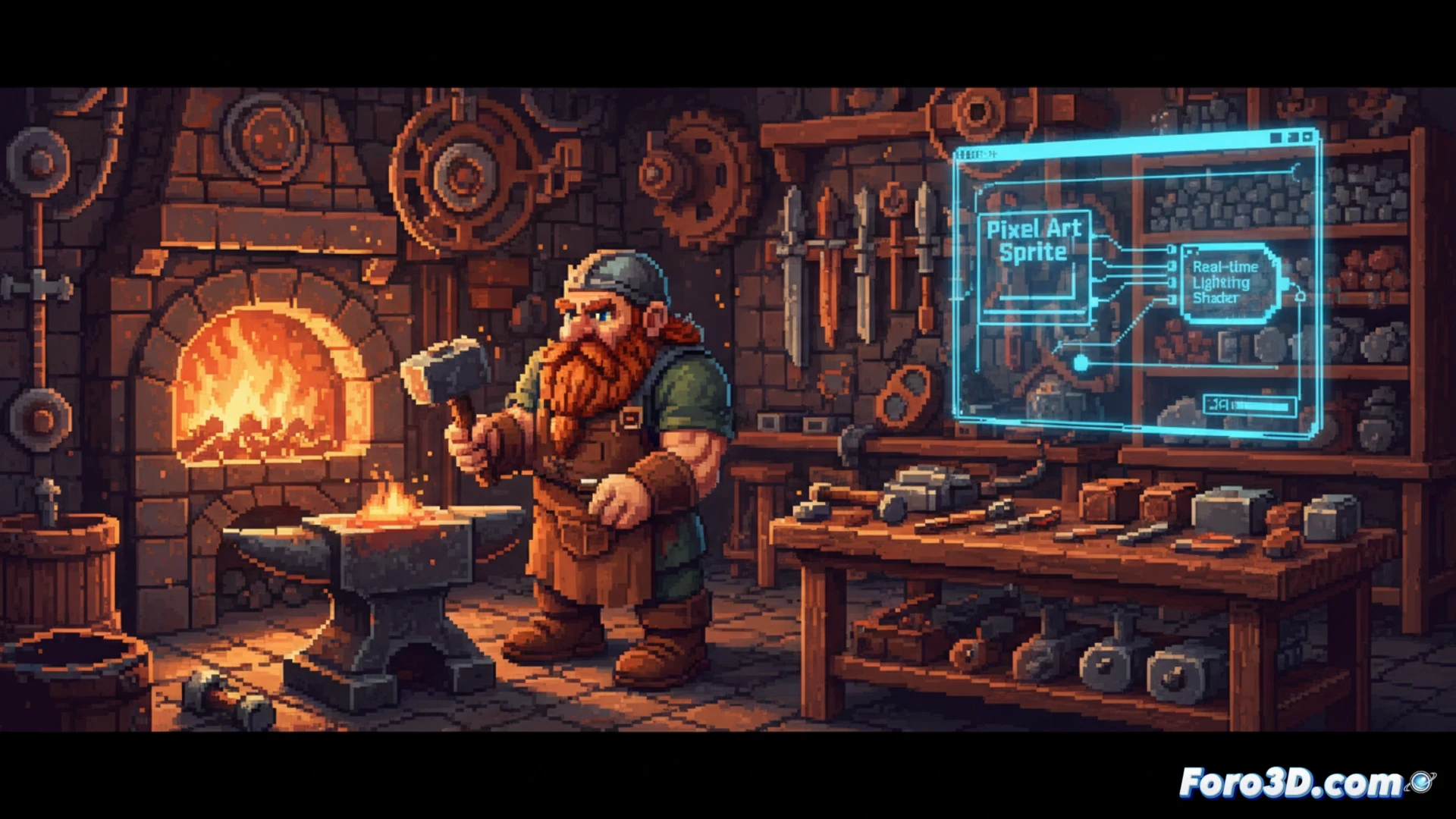
Independent game development finds in While the Iron's Hot a fascinating case study. This title, created in Unity, demonstrates how pixel art can be refined to convey complex textures and processes, such as tool forging. The key lies in the synergy between Aseprite for sprite design and Unity for real-time animation and lighting, achieving a polished finish that challenges traditional retro aesthetics. 🔥
Optimization of Sprites and Real-Time Animations ⚙️
To achieve smooth animations without sacrificing performance in Unity, the development team likely employed sprite swapping and bone rigging techniques instead of costly sprite sequences. In Aseprite, each tool and ingot is drawn with a limited but warm palette, using high-contrast shadows to simulate the glow of hot metal. In Unity, the use of Sprite Shape and modular animators allows the character to interact with the anvil and furnace reactively. Optimization focuses on the Sprite Atlas, grouping all forging frames into a single texture to reduce draw calls. Additionally, the particle system is adjusted to render sparks without saturating the GPU, maintaining a stable frame rate even in detailed workshop scenes.
The Warm Palette as a Narrative Tool 🎨
The cozy atmosphere of While the Iron's Hot is no coincidence. The color selection in Photoshop and Aseprite prioritizes amber, orange, and soft brown tones, avoiding the aggressive contrasts of classic pixel art. This palette, combined with Unity's dynamic lighting, guides the player's attention toward the creation processes. For the indie developer, this approach demonstrates that visual cohesion can be achieved without photorealistic textures; it is enough to understand color psychology and apply it to blacksmithing mechanics, transforming each hammer strike into a satisfying visual and tactile experience.
How did the While the Iron's Hot team optimize the performance of pixel art sprites in Unity to achieve smooth animations without sacrificing retro aesthetics?
(PS: optimizing for mobile is like trying to fit an elephant into a Mini Cooper)