The video editor not only cuts and assembles clips; they suffer from chronic exposure to risk factors that, seen through the Forensic Pipeline, constitute evidence of a silent occupational crime. Severe visual fatigue, repetitive wrist movements, cervical tension, and deadline stress are the fingerprints of an unhealthy workstation. Applying 3D forensic methodology allows for documenting, modeling, and virtually reconstructing these aggressions to propose evidence-based corrections.
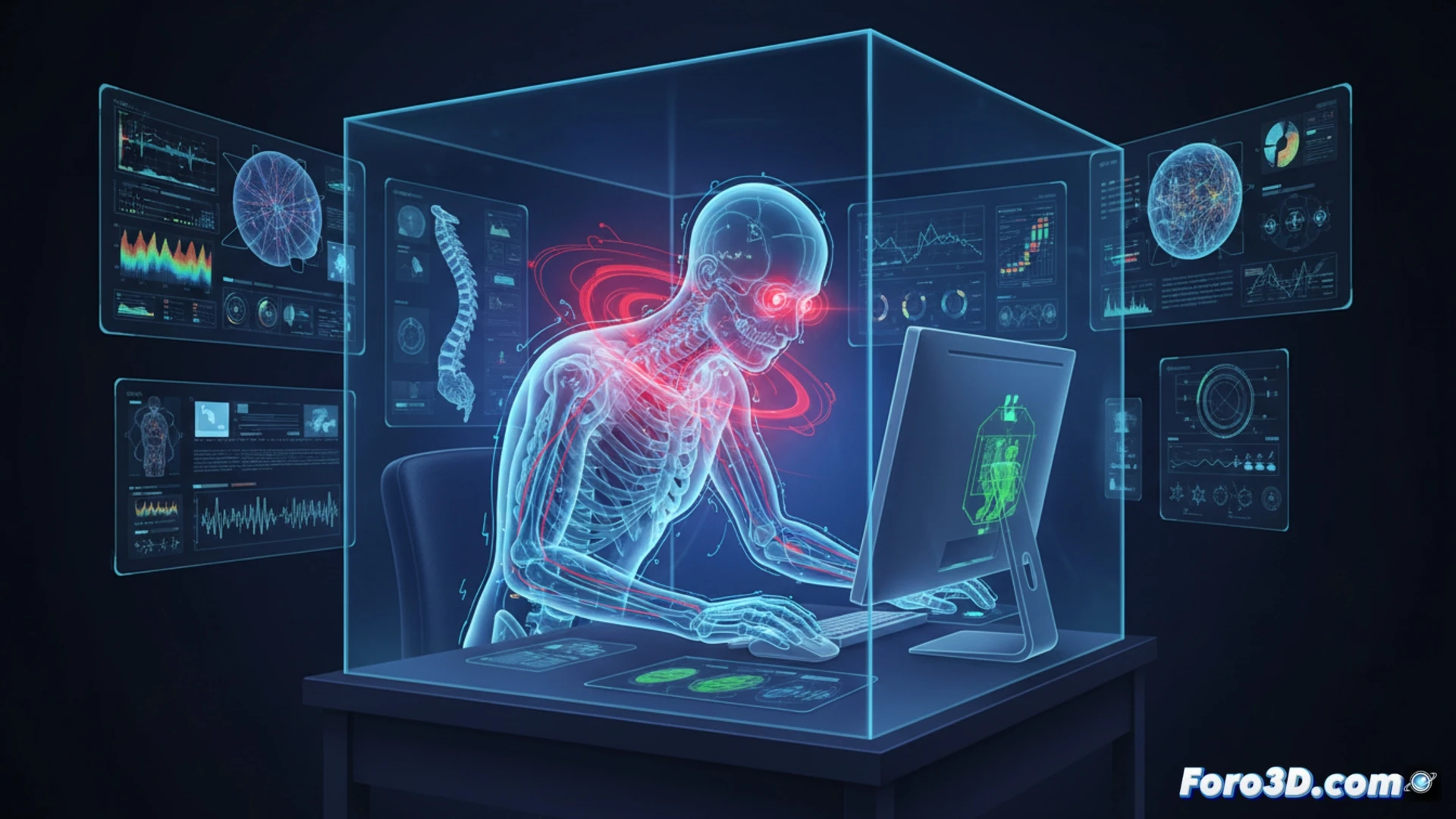
Biomechanical modeling of forced postures and repetitive load simulation 🖥️
For the technical analysis, a parametric ergonomic avatar is used that replicates the editor's typical postures: torso leaning forward, neck flexed, shoulders elevated, and wrists in forced extension over the keyboard and mouse. Through inverse dynamics simulations in 3D software, the torque moments on the cervical and lumbar vertebrae are calculated, as well as the accumulated tension on the carpal tunnel tendons. Eye-tracking heat maps, integrated into a virtual model of the monitor, reveal areas of excessive fixation that cause visual fatigue. Each piece of data becomes a layer of visual evidence for the expert report.
The ergonomic crime scene and virtual reconstruction 🔍
The 3D reconstruction of the workstation allows the forensic investigator to virtually walk through the scene: inadequate lighting, screen reflections, chair without lumbar support, and desk at incorrect height. Each element is labeled as a contributing factor to the documented pathologies. The result is not just a diagnosis, but an interactive model where corrections can be tested before implementation. In the Forensic Pipeline, 3D evidence becomes the definitive tool to demand real changes in the editor's work environment.
How can the biomechanics of the video editor, analyzed through their posture and fatigue during the workflow, serve as forensic evidence in a production pipeline to determine liability in cases of chronic occupational injuries?
(PS: don't forget to calibrate the laser scanner before documenting the scene... or you might be modeling a ghost)