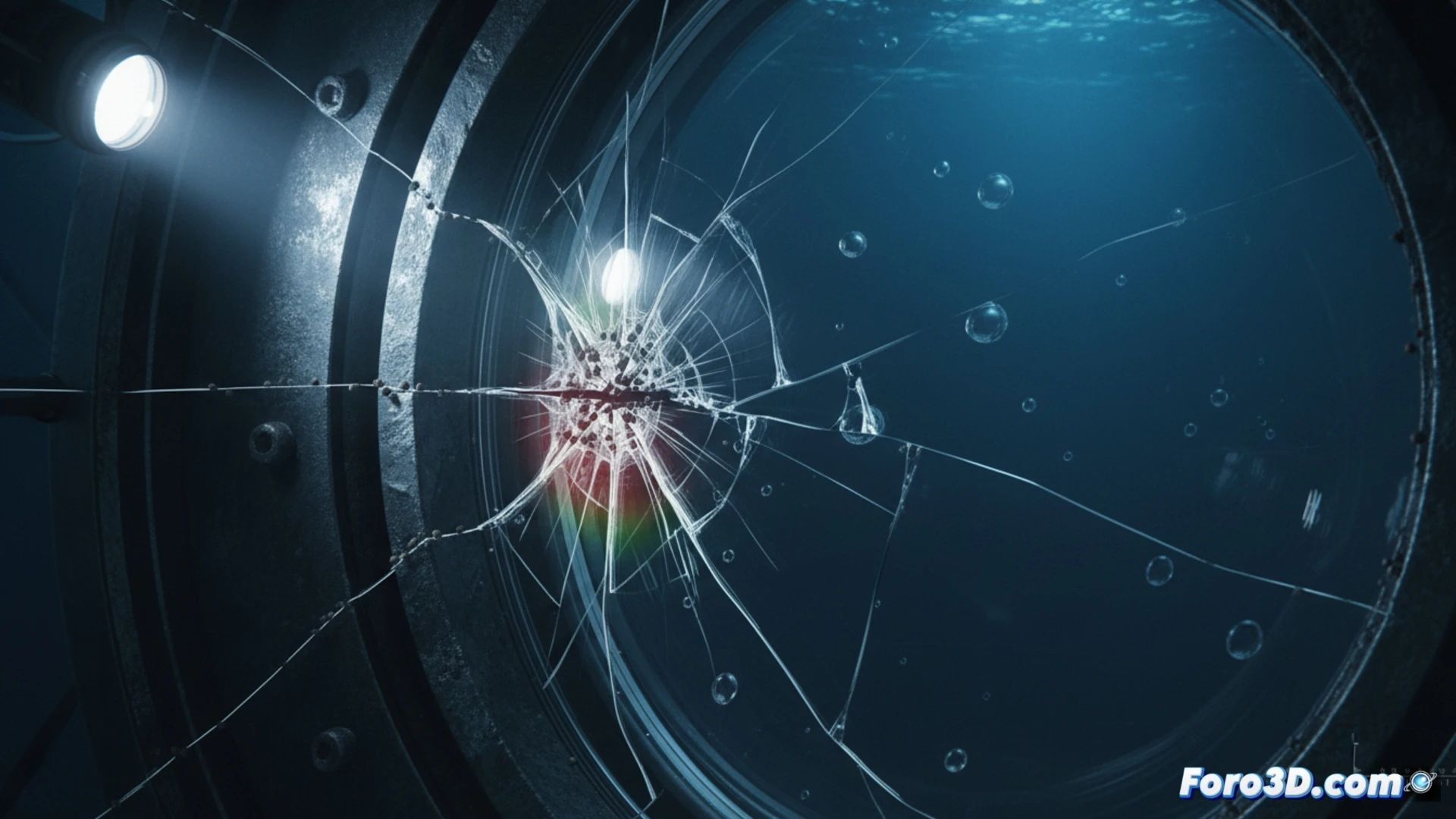
A submarine cable rescue bathyscaphe suffered a critical failure at 4,000 meters depth: a crack in its acrylic window. The incident, which could have been catastrophic, was investigated using 3D modeling of the metal-acrylic interface. The main hypothesis points to the intrusion of sand particles during assembly, acting as points of concentrated pressure that fractured the material.
Finite Element Analysis: Ansys Mechanical and Stress Concentration 🔬
To validate the hypothesis, the joint was digitally reconstructed using Rhino for CAD modeling and RealityCapture to scan the actual geometry of the damaged seal. Simulation in Ansys Mechanical under high-pressure conditions (400 atmospheres) revealed that a sand particle of just 0.5 mm at the interface generates a stress concentration factor (Kt) greater than 3.5 in the acrylic. This point exceeds the material's fatigue limit, explaining the progressive crack. Without the simulation, the failure would have been erroneously attributed to poor acrylic manufacturing.
Lessons for High-Pressure Equipment Design ⚙️
This case demonstrates that the failure was not in the material, but in the cleanliness of the assembly. 3D modeling and fatigue simulation not only identify the culprit but also allow redesigning the seal geometry to distribute stress more evenly. In extreme environments, a grain of sand can be more dangerous than a calculation error. Catastrophe prevention begins at the smallest interface of the system.
How to model the transition between metal rigidity and acrylic fragility in a finite element simulation to predict crack initiation at 4,000 meters depth?
(PS: Material fatigue is like yours after 10 hours of simulation.)