Blade & Sorcery has established itself as the technical standard in virtual reality melee combat simulation. Its success lies in a custom physics engine developed on Unity, which abandons capsule or box collisions to implement a precise polygon collision system. This architecture allows each sword, axe, or shield to interact with the enemy's real geometry, generating a level of immersion that no other title has matched in the VR market. ⚔️
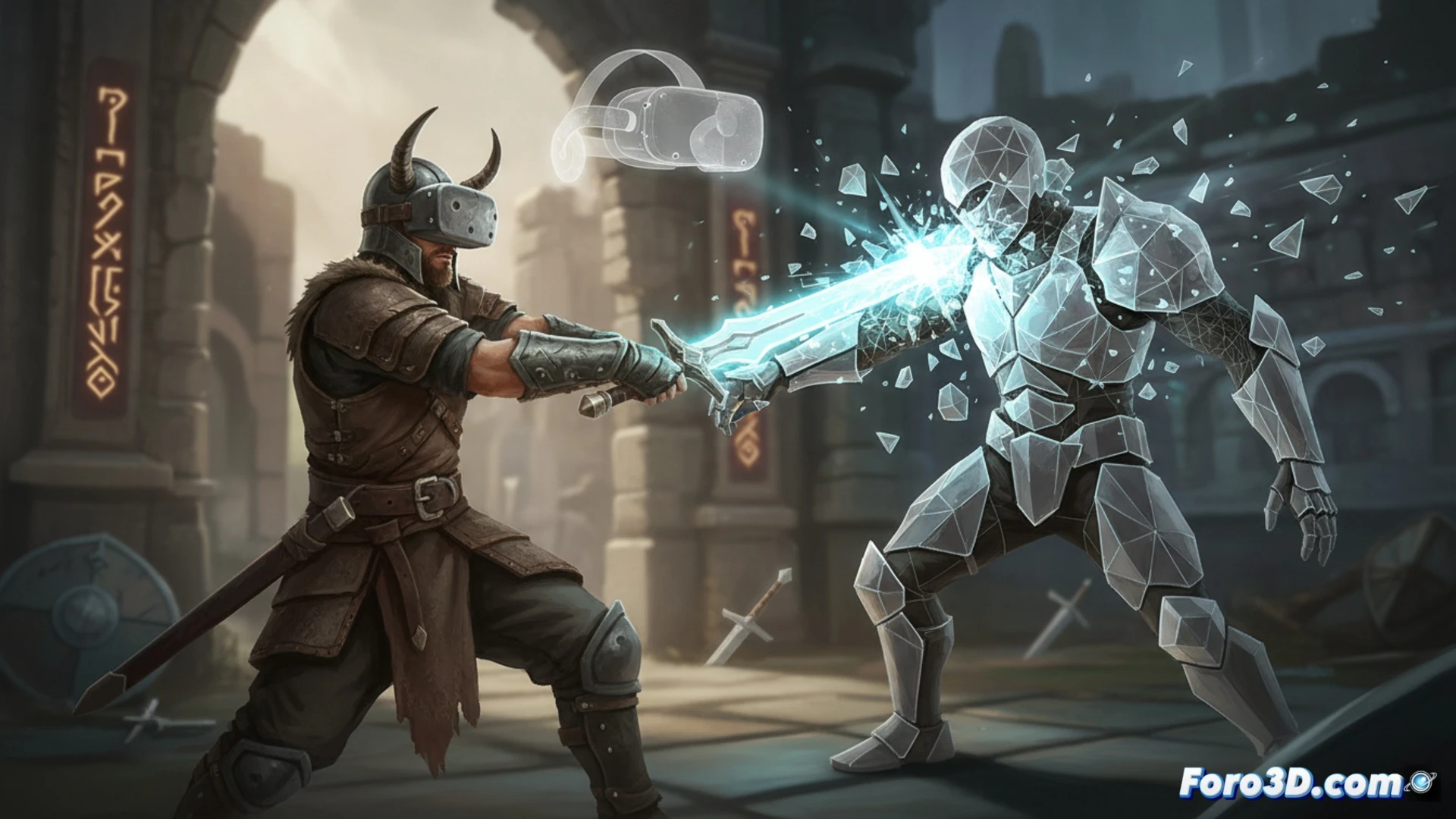
Mesh deformation and distortion shaders: the technical pipeline 🛠️
The development of the physics system in Blade & Sorcery relies on three key technical pillars. First, the polygon collision engine, programmed in C#, evaluates each vertex of the weapon against the enemy's mesh in real time, allowing a strike with a sword's edge to cut exactly where it impacts. Second, real-time mesh deformation, managed from Unity through a control point system, allows bodies to bend, crush, or tear depending on the applied force. Third, magic effects employ spatial distortion shaders that modify light projection and surrounding geometry, creating illusions of energy waves, teleportation, or gravitational fields. All 3D content is modeled in Blender, from weapons to enemy skeletons, and exported to Unity with rigging prepared to support dynamic deformation without breaking topology. Optimization for VR is critical: the engine reduces the number of active polygons in collision detection when the weapon is at rest and scales precision only during impact, avoiding frame drops on headsets like Oculus Quest or Valve Index.
Lessons for developers: why physical detail matters more than visual realism 💡
Blade & Sorcery demonstrates that, in VR, physics is the new realism. While other titles bet on 4K textures or global illumination, this game prioritizes interaction precision: a poorly aimed blow slides off armor, a shield stops the impact at the exact point of contact. For a game developer, the lesson is clear: investing in a polygon collision system and mesh deformation, even if it demands more CPU resources, generates an experience the player perceives as tangible. The combination of Unity, Blender, and C# is not only viable but necessary to build a combat sandbox where every movement has real consequences.
How the polygon physics system is implemented in Blade & Sorcery to achieve such realistic combat interactions in virtual reality and what technical challenges its real-time optimization presents
(PS: optimizing for mobile is like trying to fit an elephant into a Mini Cooper)