The Finalmouse UltralightX enters the market with a radical proposition: a wireless mouse made from carbon fiber alloy weighing from 29 grams. For the 3D modeling professional, mass reduction is not a luxury, but a technical necessity. Less inertia means less fatigue during long ZBrush sculpting sessions or precise navigation in the Blender viewport. We analyze whether this featherweight can dethrone the industry giants. 🖱️
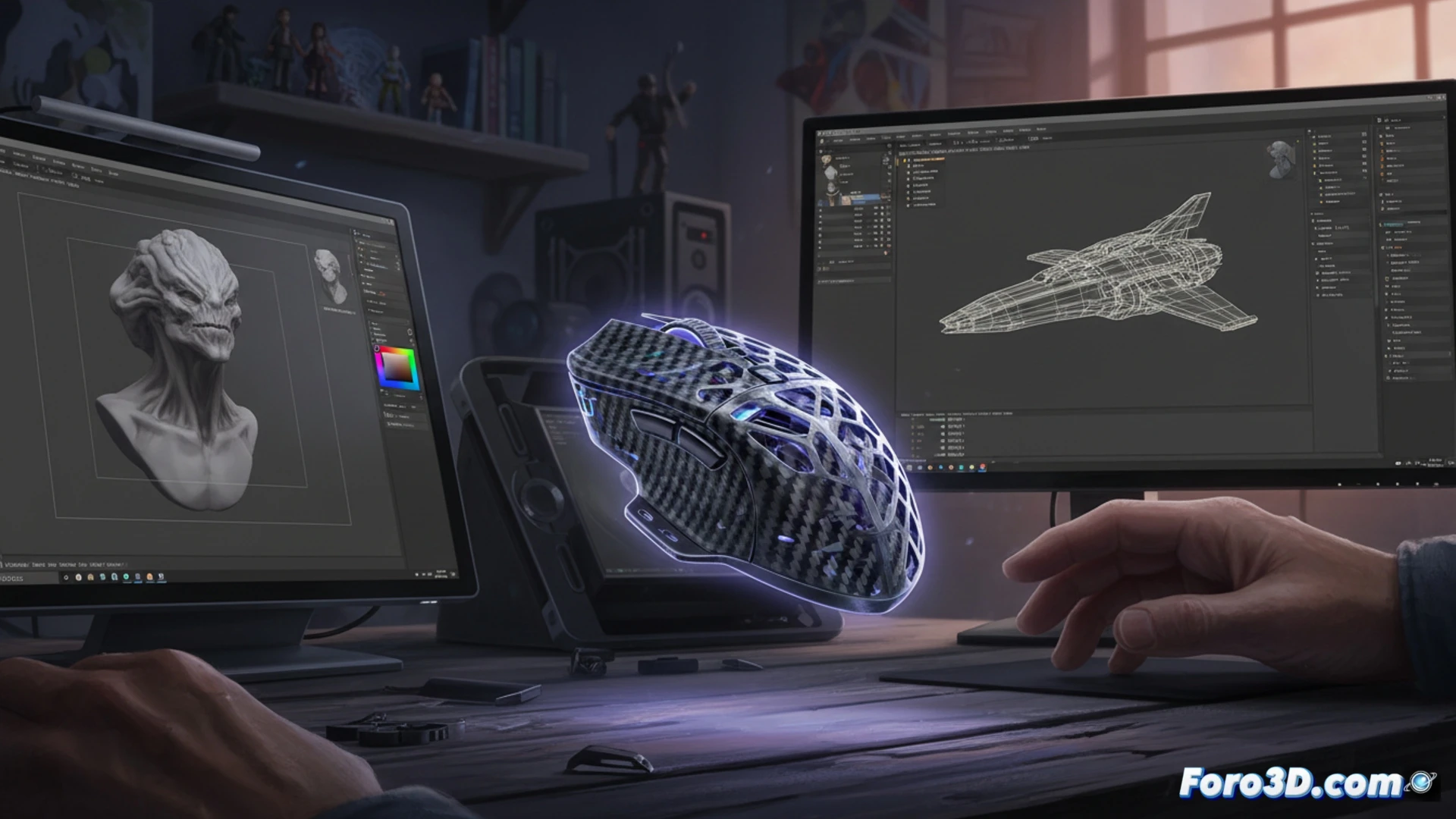
Technical Analysis: Sensor, Materials, and Latency in the 3D Workflow 🔬
The carbon fiber chassis not only lightens the assembly but also offers structural rigidity that prevents unwanted flex during rapid camera movements. The optical sensor, with a native resolution of 32000 DPI and a polling rate of 1000 Hz, provides acceleration-free tracking, crucial for box modeling and vertex extrusion. In tests with Blender 4.0, wireless latency was imperceptible compared to a Logitech G Pro X Superlight (60g). However, the absence of programmable side buttons limits its use in complex macros for Maya or 3ds Max, making it more suitable for pure navigation than command automation.
Ergonomics and Fatigue: Is It Viable for 8-Hour Rendering Sessions? 💪
The critical point is the grip. At only 29 grams, the UltralightX demands a trained hand; claw grip users will find a natural extension of their finger, while palm grip users will miss a more voluminous palm support. In four-hour digital sculpting sessions in ZBrush, the reduction in carpal tunnel tension was notable compared to an 80g mouse, but the carbon fiber surface can become slippery with sweaty hands. We recommend this mouse for 3D artists who prioritize panning and zoom speed over the number of physical shortcuts.
Is it truly viable to sacrifice the ergonomics and programmable buttons of a conventional mouse for an extreme weight of 29 grams in carbon fiber to improve precision and reduce fatigue during long 3D modeling sessions?
(PS: Your CPU heats up more than the debate between Blender and Maya)