The promise of pure, toxin-free water has made activated carbon filters a ubiquitous household item. However, the technical reality contradicts the miraculous label. A saturated filter not only stops filtering but transforms into a biological reactor. When carbon reaches its adsorption limit, it retains organic matter which, combined with constant humidity, generates a bacterial biofilm. This phenomenon turns the tap into a source of secondary contamination, worsening the water quality it aims to improve.
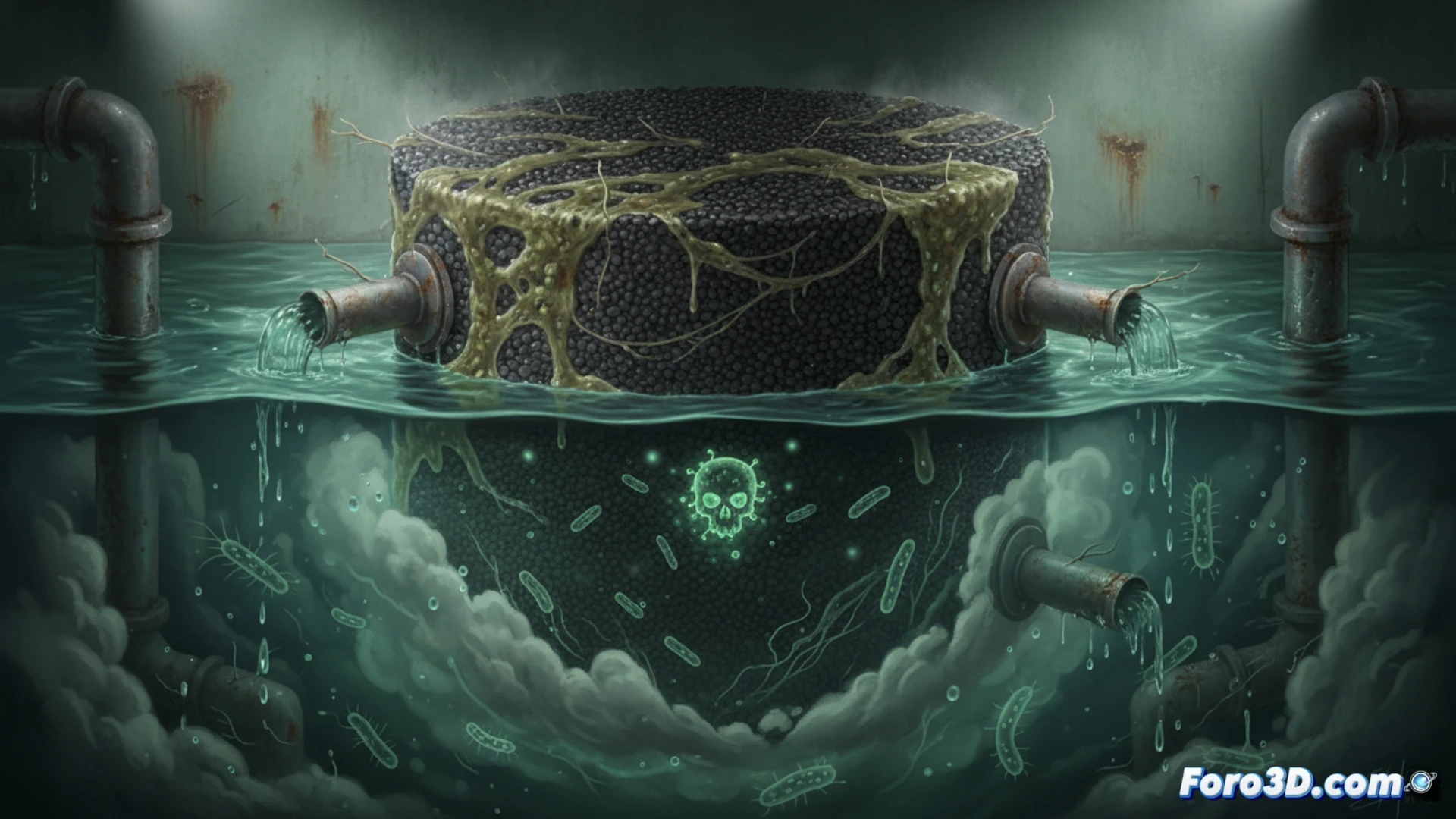
Visualization of saturation and bacterial colonization 🧫
To address this risk from a visual epidemiology perspective, we propose an animated 3D infographic modeling the filter's interior. The animation would begin with virgin activated carbon, represented as a highly porous sponge. With use, particles of chlorine, sediments, and organic compounds (modeled as colored spheres) would saturate the pores. Upon reaching the saturation point, a heat map would indicate the carbon's color change from dark gray to greenish-brown. Simultaneously, models of bacterial colonies (bacilli and cocci) would appear replicating on the surface. The final visual comparison would show two glasses of water: one filtered by new carbon (dispersed and clean particles) and another by saturated carbon (chaotically moving particles and high turbidity).
The timeline of invisible risk ⏳
The key piece of this infographic is an interactive timeline that eliminates user uncertainty. The model would calculate the optimal replacement frequency based on variables such as daily water volume (liters), source water hardness, and ambient temperature. For example, a household use of 10 liters per day from well water would require a change every 30 days, while a use of 5 liters of chlorinated water could be extended to 60. The animation would show a visual alert (a red flash on the heat map) when the filter exceeds 80% of its capacity, indicating the critical moment before bacterial colonization becomes irreversible.
What mechanisms of the microbiology of biofilm formed in domestic activated carbon filters could be associated with antimicrobial resistance and the dissemination of opportunistic pathogens in vulnerable populations?
(PS: the 3D incidence maps look so good that they almost make being sick enjoyable)