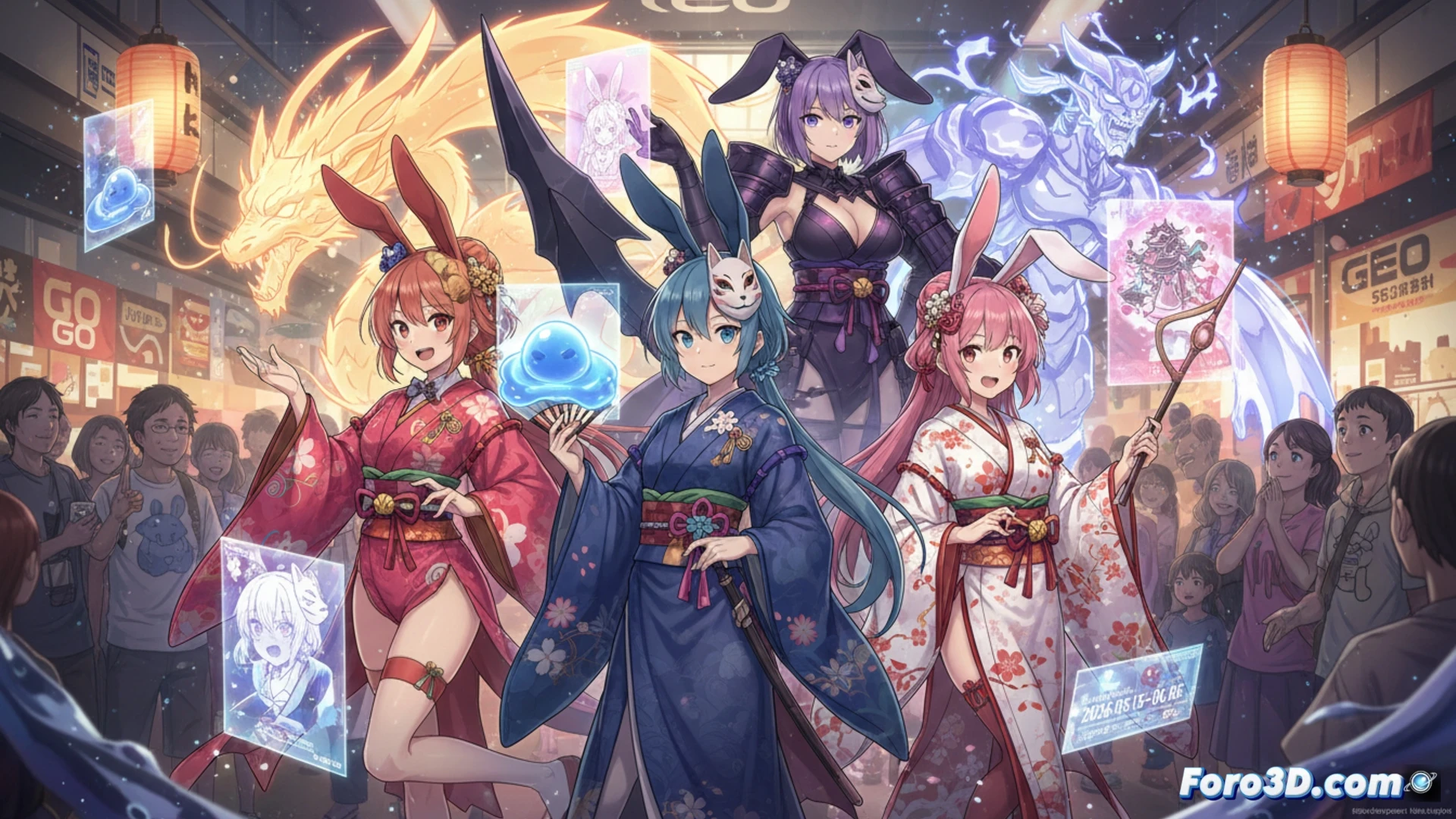
The fourth season of Tensei Shitara Slime Datta Ken will be celebrated with an exclusive fair at 100 GEO stores in Japan, from May 15 to June 5, 2026. Attendees will be able to purchase products featuring original illustrations of Rimuru, Milim, Shuna, and Shion, dressed in Japanese-style bunny outfits. This event, capitalizing on the series' success with over 56 million copies in circulation, is a perfect showcase to explore how 3D technology enhances the fan experience. 🎉
3D visualization and augmented reality at anime fairs 🚀
At events like this, 3D character models not only decorate the booths but are integrated into augmented reality (AR) applications that allow fans to interact with their favorite heroes. For example, by scanning a QR code on the products, users can display a three-dimensional figure of Rimuru or Milim on their smartphone, rotate it, and capture photos for social media. Some advanced fairs install holographic screens that project the characters dancing in their bunny outfits, generating an immediate emotional connection. Additionally, experiential marketing uses these 3D assets to create AR filters in stores, where visitors can virtually pose alongside Shuna or Shion, encouraging purchases and viral spread of the event.
3D outreach: from anime to cultural marketing 💡
This fair demonstrates that 3D modeling transcends animation to become a tool for cultural outreach. Designers reuse the original assets from the series to create immersive experiences that educate the public about digital sculpting, texturing, and rigging techniques. By interacting with these models, fans learn in a playful way how an animated character is built. Thus, a commercial event transforms into an educational window, showing that digital art and 3D technology are fundamental pillars for connecting audiences with their favorite franchises.
As an educational 3D content developer, what practical lessons about optimizing models for augmented reality in commercial environments can be drawn from this Tensei Slime fair to apply to technology outreach projects in the classroom?
(PS: Teaching with 3D models is great, until students ask to move the parts and the computer freezes.)