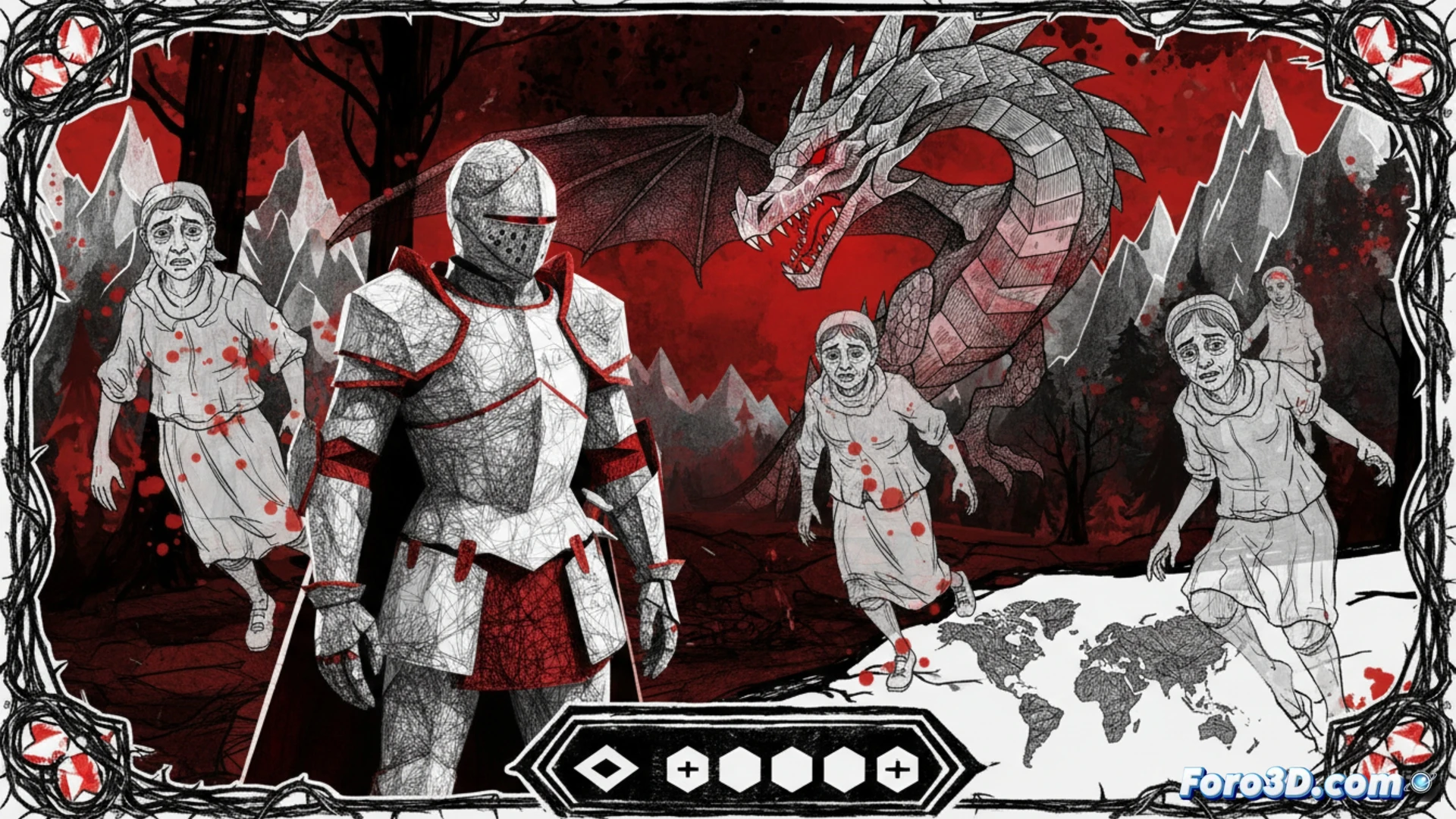
The independent scene surprises us with Felvidek, a title that challenges the visual conventions of RPG Maker MZ. This project not only uses the base engine but pushes it to its limits through custom plugins and assets generated in Blender. The result is a sketch aesthetic in black, white, and red that integrates with a low-resolution 3D world, creating a surreal representation of 15th-century Slovakia. We analyze the technical pipeline behind this visual rarity. 🎨
Technical Pipeline: Integrating 3D Assets into a 2D Engine 🛠️
The main technical challenge of Felvidek lies in forcing RPG Maker MZ, an engine designed for tile-based 2D sprites, to render three-dimensional volumes. The developers used Blender to model scenes and characters with extremely simplified low-poly geometry. Subsequently, these models were rendered as isometric sprites or exported as frame sequences for animations. Custom plugins were crucial to modify the engine's lighting system, eliminating realistic shadows and replacing them with flat shading that mimics charcoal. The color palette was limited to black, white, and red through a post-processing shader, forcing designers to rely solely on contrast and form to define depth, avoiding complex textures.
Aesthetic as Narrative: Representing the 15th Century Without Color 🖤
The decision to limit the color palette is not merely an artistic whim but a technical solution to unify disparate assets. By removing color, Felvidek avoids the visual clash between low-resolution 3D models and hand-drawn backgrounds. Red acts as a dramatic accent, guiding the player's gaze toward key narrative or interface elements. This monochrome also evokes the harshness of the era, where life was tough and visual information scarce. Instead of attempting an impossible photorealism for an independent project, the game embraces its technical limitation and turns it into its hallmark, demonstrating that aesthetic coherence can surpass graphical power.
In Felvidek, how did they manage to synchronize lighting and shadows between hand-drawn 2D sprites and low-poly 3D models within the RPG Maker MZ engine without sacrificing visual coherence?
(PS: optimizing for mobile is like trying to fit an elephant into a Mini Cooper)