A commercial spacesuit experienced a critical pressure drop during an orbital spacewalk. The failure was attributed to fatigue of the multilayer textile material after multiple pressurization cycles. To identify the origin, micro-CT and laser scanning were applied, revealing microporosities and defects in heat-sealed seams. This incident highlights the need for advanced predictive models to ensure the integrity of life support systems. 🚀
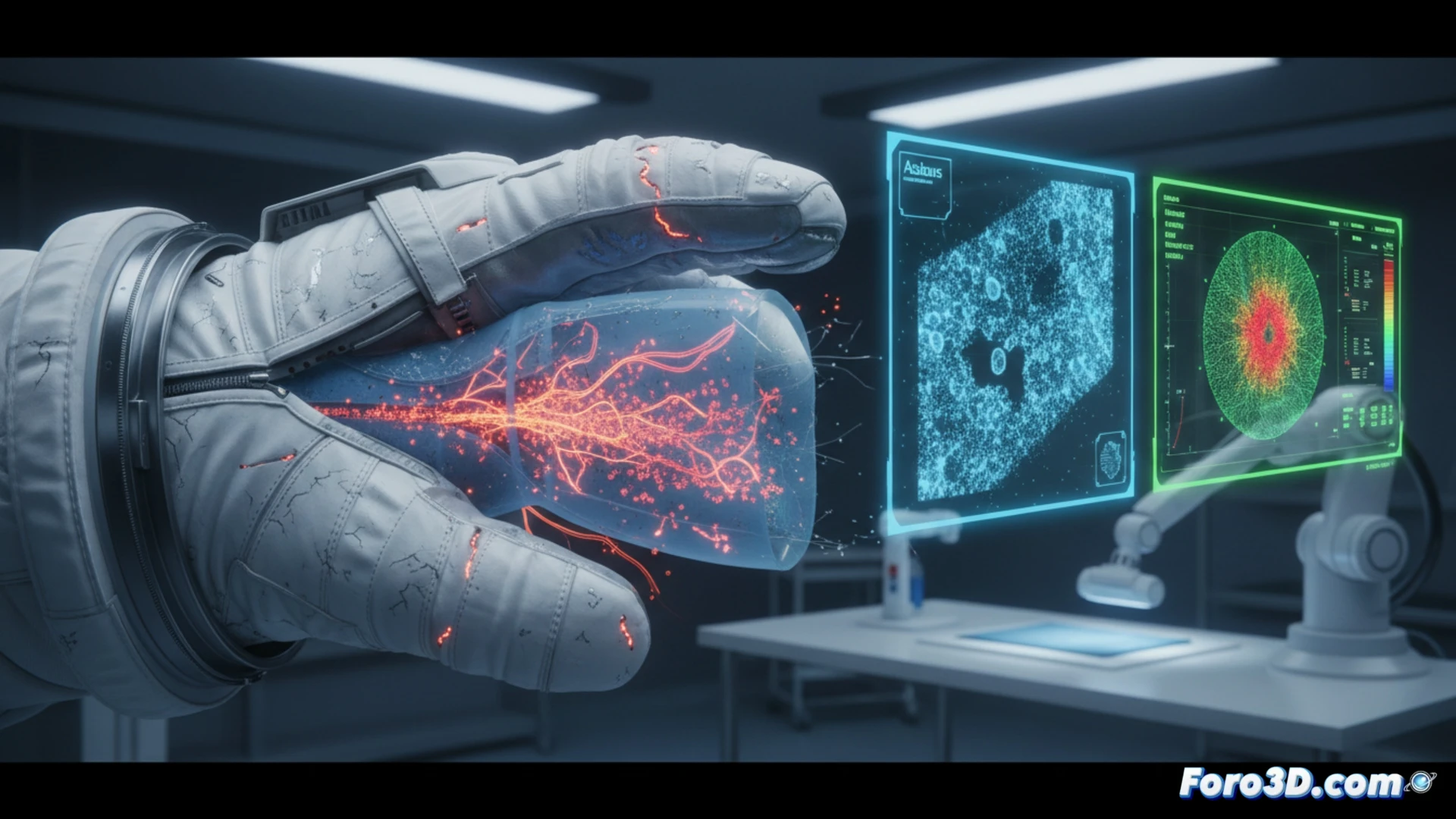
Non-destructive analysis and membrane simulation 🔬
The forensic process began with high-resolution micro-CT to obtain a point cloud of the damaged textile. In Volume Graphics VGSTUDIO MAX, the layers were segmented and pores smaller than 10 microns were identified. A complementary laser scan mapped the surface deformation. The data was imported into Siemens NX to reconstruct the geometric model of the seam. Finally, in Abaqus, the membrane behavior under cyclic pressure was simulated, applying a fatigue model that correlates crack propagation with microporosity density. The simulation predicted the exact failure location, matching the real incident.
Lessons for critical membranes in automotive and aerospace 🛰️
This case transcends the space sector. In automotive, airbags and sealing gaskets face similar challenges of fatigue from pressure cycles. The combined methodology of micro-CT with Abaqus simulation is already applied to predict the service life of turbine seals and fuel tanks. The key lies in validating fatigue models with real tomographic data. If a heat-sealed seam fails in orbit, the lesson is clear: simulation must integrate material heterogeneity from the micrometric scale.
Can the correlation between microcracks detected by micro-CT in the EVA fabric and the pressure drop simulated in Abaqus be precisely quantified to predict catastrophic failures in spacesuits?
(PS: Material fatigue is like yours after 10 hours of simulation.)