A silent failure in a cryogenic energy storage (LAES) tank triggered a 3D forensic investigation. The appearance of a crack in the main structure led engineers to suspect the insulating supports. The objective was to determine whether the drastic daily cycles of cooling to -196 degrees Celsius and subsequent reheating induced thermal fatigue in the stainless steel bolts, a critical phenomenon in renewable energy systems. 🔍
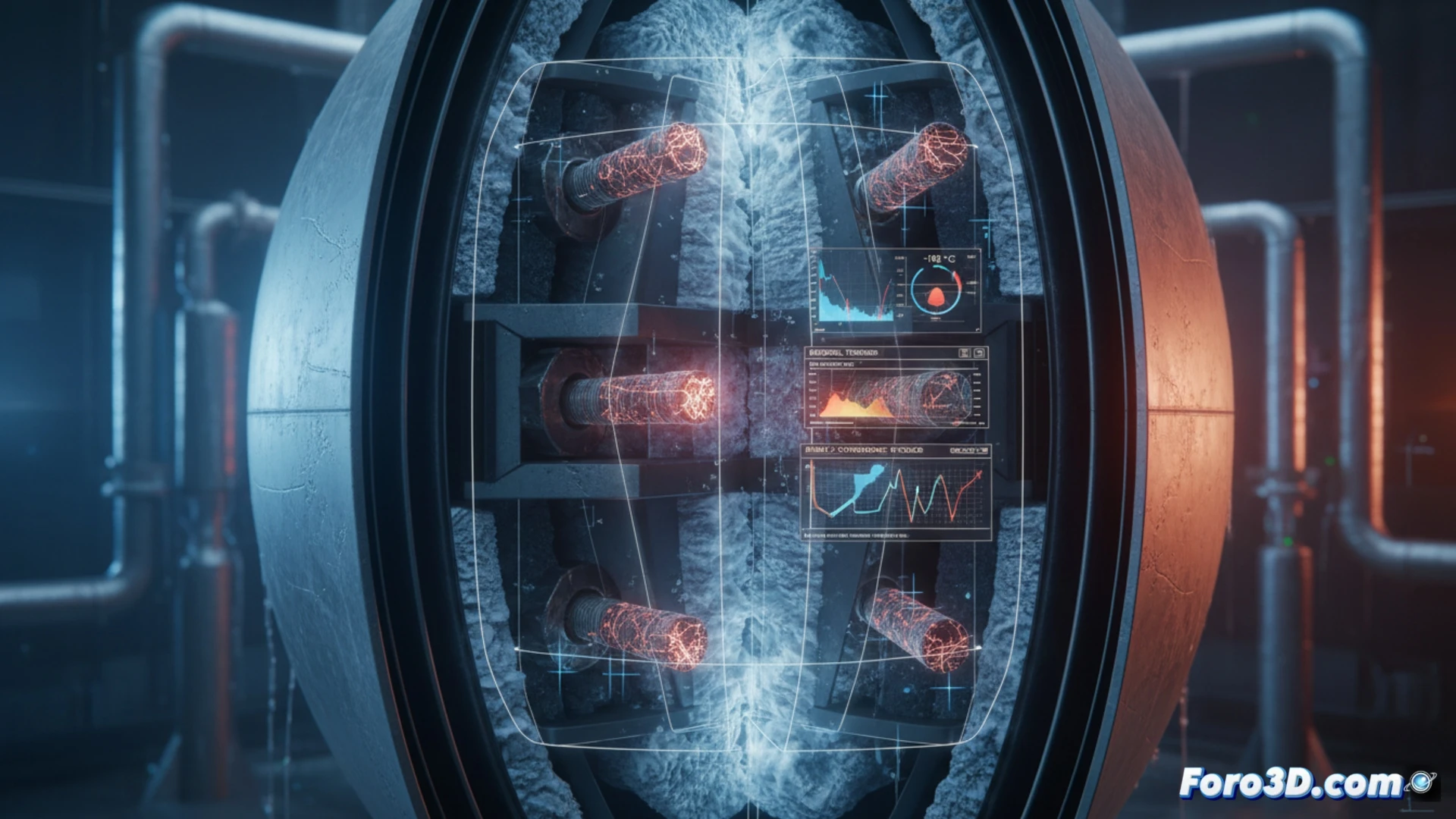
Multiphysics Modeling: SolidWorks and Abaqus in Fatigue Simulation ⚙️
The investigation began with precise digitization of the support and bolt geometry using Leica Cyclone, generating a high-fidelity point cloud. With this model, SolidWorks performed a transient thermal stress analysis. The extreme temperature gradients between the cryogenic tank (-196 degrees Celsius) and the outer structure at room temperature were simulated. The results identified stress concentration points at the root of the bolt threads. Subsequently, Abaqus executed a low-cycle fatigue simulation, applying the cyclic thermal load history (cooling-reheating) over thousands of operations. The software correlated the accumulated plastic deformation with microcrack nucleation, confirming that the differential expansion and contraction of the stainless steel, constrained by the insulator, was the root cause of the failure.
Lessons for Cryogenic System Design ❄️
This case demonstrates that thermal fatigue is a silent killer in LAES infrastructure. The 3D forensic analysis not only identified the crack but also validated the need to design supports with greater flexibility or materials with more compatible expansion coefficients. Integrated simulation (SolidWorks for thermal stress and Abaqus for cyclic fatigue) is becoming the standard methodology for predicting the service life of cryogenic components, preventing catastrophic failures in the energy storage of the future.
Which finite element simulation techniques allow for more accurate prediction of crack nucleation and propagation due to thermal fatigue in welded joints of LAES tanks subjected to extreme cryogenic cycles?
(PS: Material fatigue is like yours after 10 hours of simulation.)