A baby monitor detaches from the wall and falls onto the infant. 3D scanning of the plastic anchor reveals a material fatigue fracture. Simulation shows that the heat emitted by the device itself weakened the polymer of the mount until it could no longer support its own weight. This real case forces us to review how the design of children's products ignores thermal degradation in enclosed environments.
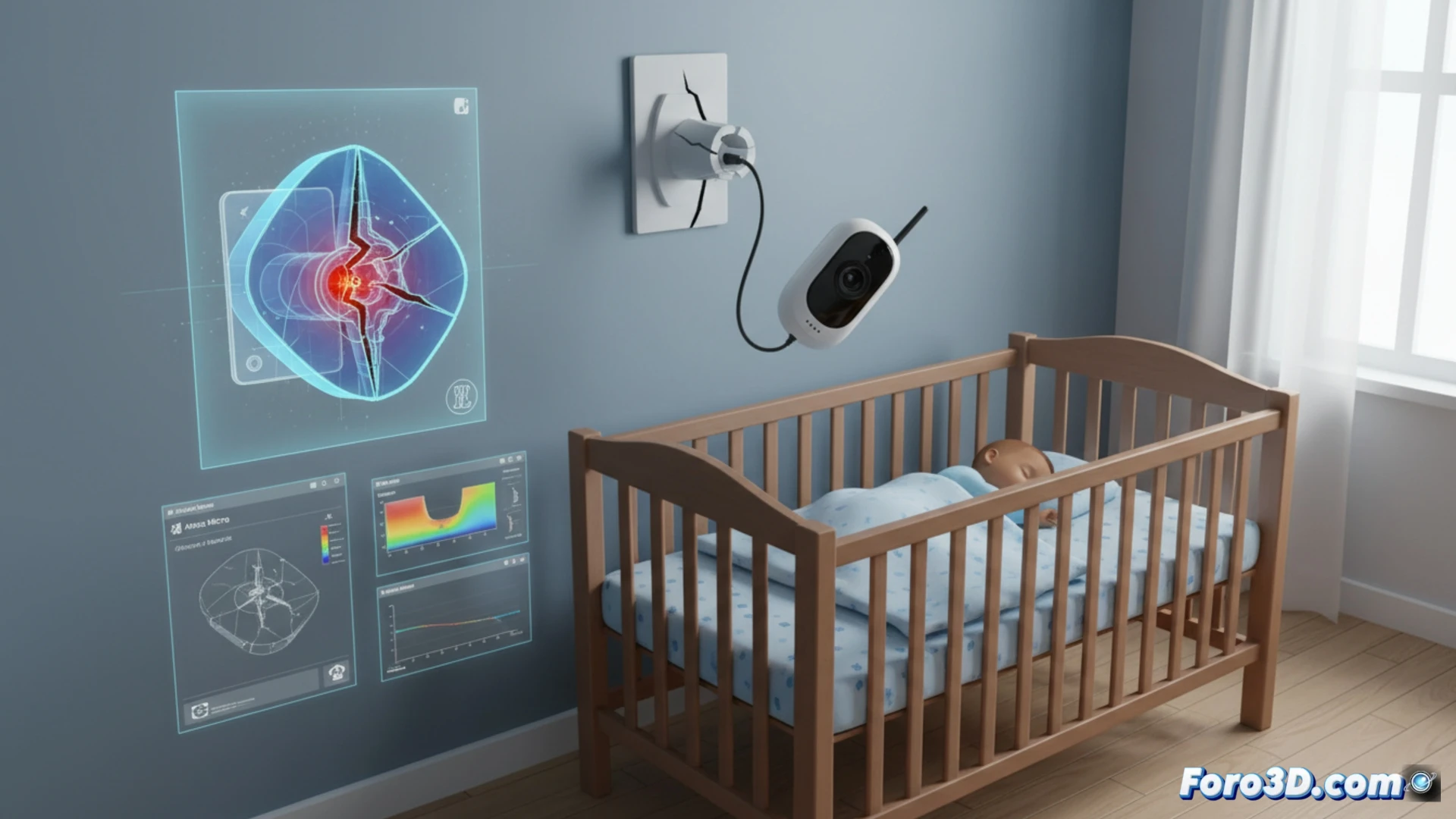
Forensic workflow: Scanning, modeling, and finite element simulation 🔬
The analysis began with scanning the fractured anchor using an Artec Micro, capturing the geometry of the break point with micron precision. The resulting model was imported into Fusion 360 to reconstruct the original part and prepare the finite element mesh. In Ansys Mechanical, a static load equivalent to the monitor's weight and a thermal profile simulating the device's residual heat (up to 60 degrees Celsius at the contact surface) were applied. The results confirmed that the temperature reduced the polymer's elastic modulus by 40 percent, concentrating stress on a pre-existing microscopic crack. The simulation exactly reproduced the fatigue fracture observed in the real part, validating the model.
Lessons for the design of children's mounts 🛠️
This case demonstrates that material fatigue depends not only on mechanical load but also on synergy with nearby thermal sources. To prevent similar failures, it is recommended to select polymers with a glass transition temperature above 80 degrees Celsius, add heat sinks to the mount, and conduct accelerated thermal aging tests on the monitor-mount assembly. A redesign with reinforcing ribs and mechanical joints instead of adhesives could have prevented the accident. Child safety does not allow for margins of error based on thermal assumptions.
How can forensic failure analysis using 3D scanning of a baby monitor mount reveal the specific thermal fatigue mechanisms that led to the fracture of the plastic anchor?
(PS: Material fatigue is like yours after 10 hours of simulation.)