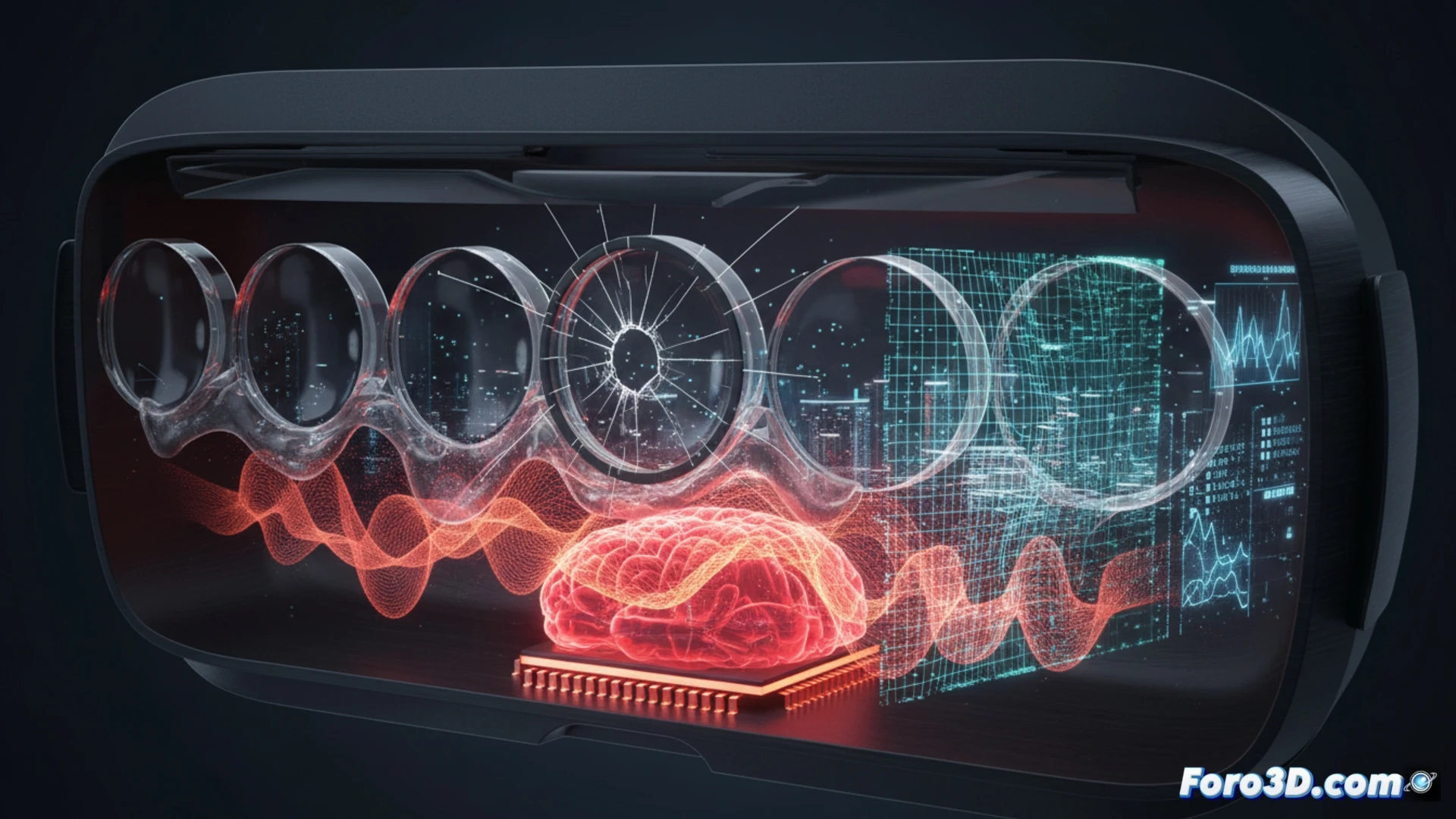
A batch of high-end mixed reality headsets has begun to show dangerous visual distortions after months of continuous use. The origin of the failure points to the degradation of the optical adhesive that bonds the micro-lens layers. The main hypothesis is that thermal radiation emitted by the processor, combined with the device's power cycles, has caused fatigue in the polymeric material, resulting in progressive delamination that alters the optical path of the passthrough image.
Thermal Cycle Modeling and Adhesive Lifetime Analysis 🔥
To validate this hypothesis, a material fatigue simulation workflow was implemented. First, processor temperature profiles were extracted using infrared thermography, feeding a MATLAB model that calculates heat distribution in the optical stack. Thermal stress data was input into Zemax OpticStudio, where micro-lens deformation was simulated by varying the adhesive's Young's modulus according to temperature cycles. In parallel, GOM Inspect was used for deformation metrology on aged prototypes, correlating actual layer separation measurements with model predictions. The resulting graphs show a clear exponential relationship between thermal cycle amplitude (delta T from 15 to 40 degrees Celsius) and adhesive lifetime reduction, dropping from 10,000 cycles to less than 500 at peak loads.
The Need to Validate Invisible Fatigue ⚠️
This case demonstrates that material fatigue is not always mechanical; cyclic thermal stress is a silent killer in multilayer optical devices. Without predictive simulation integrating optics (Zemax), metrology (GOM), and thermal analysis (MATLAB), the failure is only detected when visual distortion is already dangerous for the user. The lesson is clear: in mixed reality design, adhesive integrity must be modeled as a critical component of the optical pipeline, not merely an assembly element.
How to model the evolution of delamination at the micro-lens-substrate interface under realistic thermal cycles, considering the variation in thermal conductivity and coefficient of expansion of the polymeric materials used in high-end mixed reality headsets?
(PS: Material fatigue is like yours after 10 hours of simulation.)