A recent accident in a Hyperloop prototype has brought the focus on thermal cycle-induced material fatigue. The loss of vacuum in the transport tube revealed critical deformations in the magnetic rails and the duct structure. The forensic 3D reconstruction not only documents the failure but also allows simulating how uncompensated expansion generates stress points that, after thousands of cycles, compromise the system's integrity.
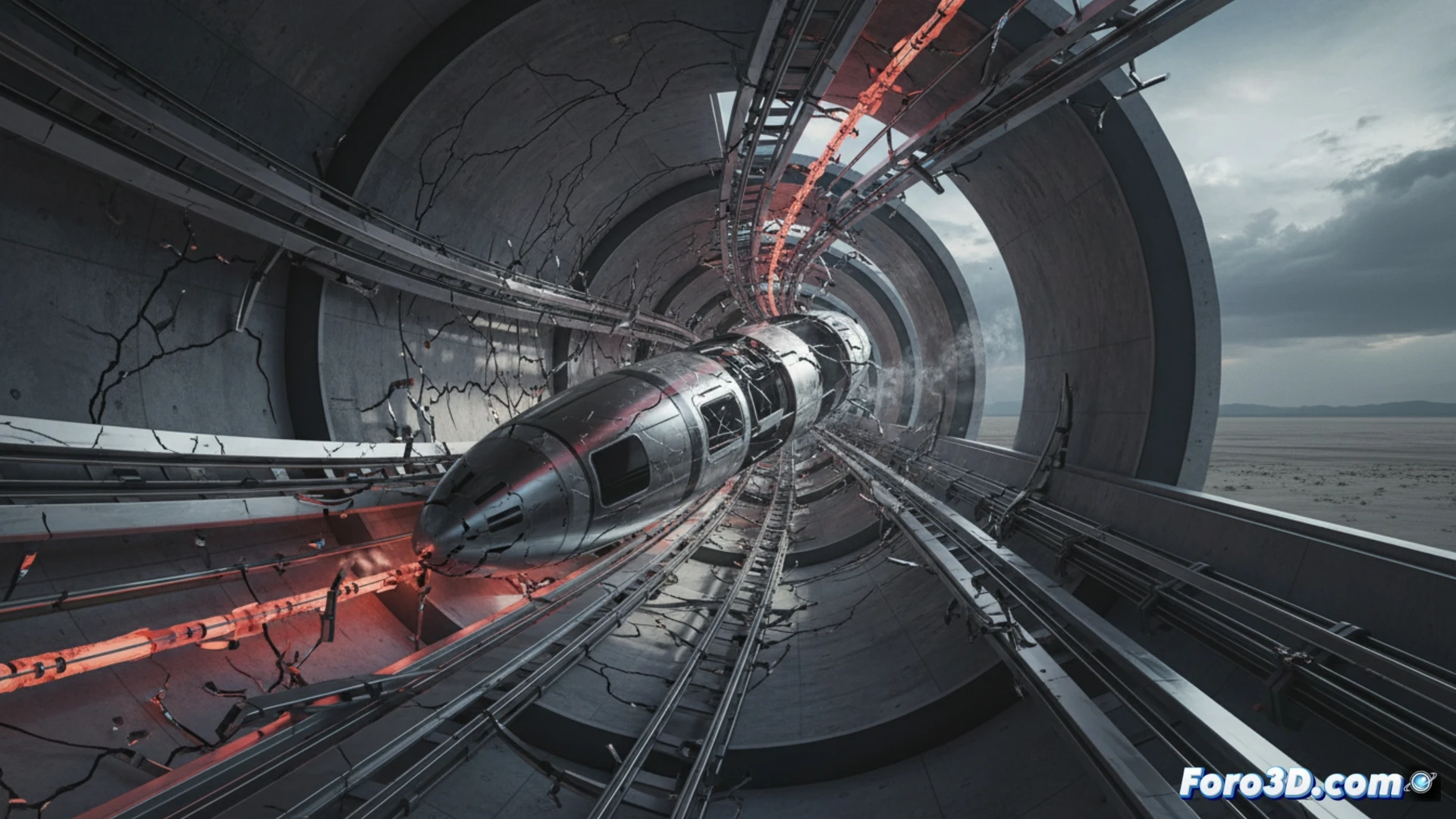
Forensic workflow: from deformation scanning to fatigue simulation 🔬
The process begins with capturing the point cloud of the deformed tube, processed in CloudCompare to quantify millimeter deviations from the original design. This data is imported into Navisworks, where it is cross-referenced with the BIM model to identify areas of structural conflict. In SolidWorks, a finite element model is generated that reproduces the thermal expansion and contraction cycles, applying cyclic loads to the magnetic rails. Finally, Maya is used to visualize the evolution of fatigue: from the initial crack to the plastic deformation that breaks the vacuum seal, showing how a difference of just 15 degrees Celsius between stations can induce catastrophic failures after 10,000 operational cycles.
Lessons for design: expansion as a silent enemy ⚙️
The case demonstrates that Hyperloop, operating under vacuum conditions, amplifies any thermal mismatch. Expansion joints and active compensation systems must be modeled with millimeter precision. 3D fatigue simulation is not a luxury but a necessity to certify that the infrastructure will withstand decades of temperature changes without losing the seal. For the forensic engineer, every deformation in the digital model tells a story of accumulated stress that, if ignored, leads to collapse.
How the evolution of accumulated plastic deformation in the Hyperloop tube under extreme thermal cycles can be modeled in 3D to predict failures similar to the recent prototype accident
(PS: Material fatigue is like yours after 10 hours of simulation.)