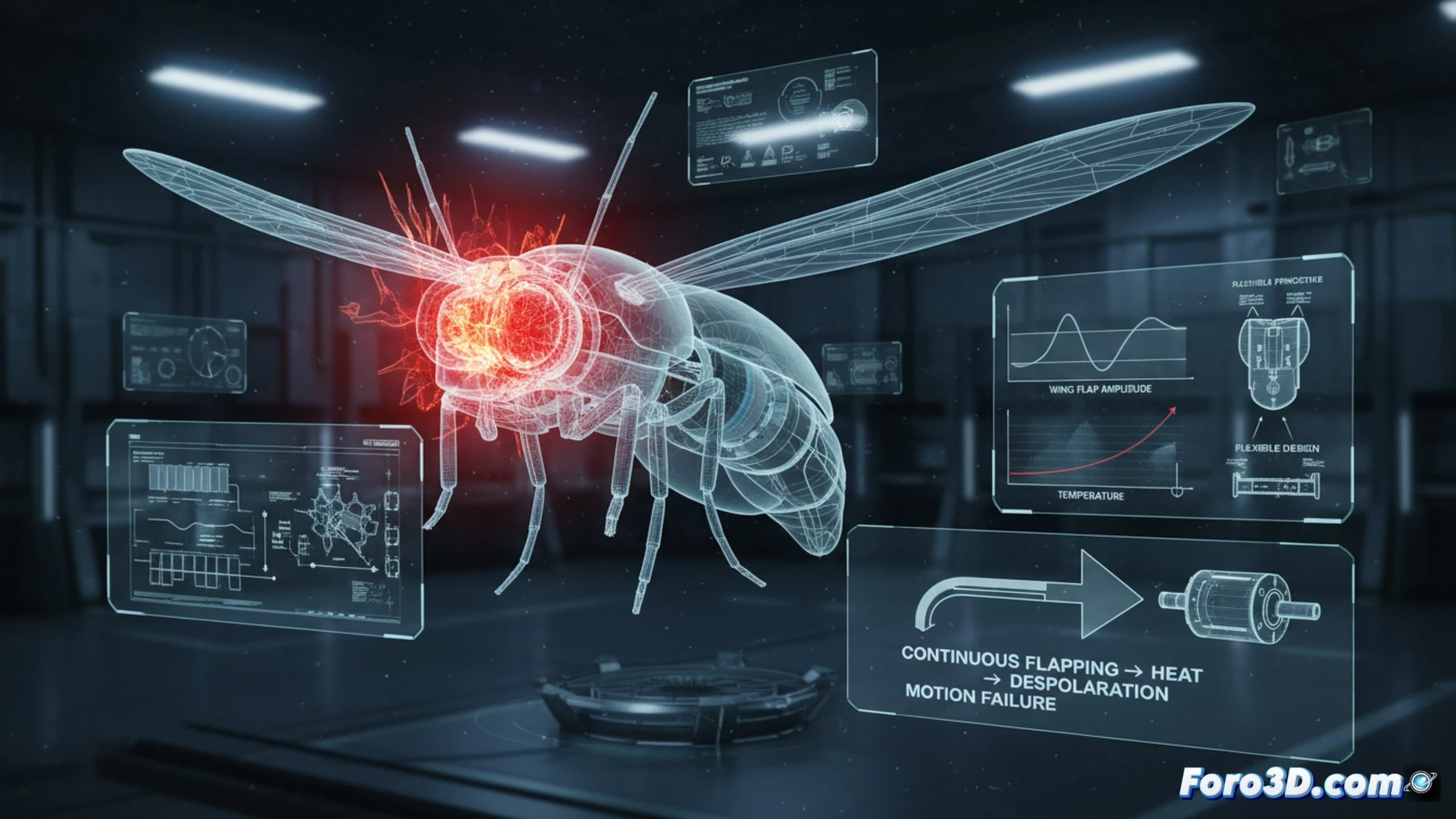
A flexible-wing micro-drone collapses during flight. The failure, apparently mechanical, hides a more subtle cause: the depolarization of its piezoelectric actuator. Using electron microscopy with Keyence Analyzer and multiphysics simulation in COMSOL, engineers reconstruct the forensic analysis to determine whether the heat generated by continuous flapping nullified the ceramic's movement capability, offering key lessons for the design of insectoid drones. 🐝
Failure reconstruction: from microscopic fracture to multiphysics simulation 🔍
The forensic analysis begins with the examination of the fractured surface on the actuator using electron microscopy. High-resolution images, processed in Keyence Analyzer, reveal microcrack patterns typical of thermal fatigue. With this data, a 3D mesh of the actuator is imported into COMSOL, using its piezoelectricity module. The model applies voltage and temperature cycles recorded during flight. The results show that, in areas of high current density, the temperature exceeded the ceramic's Curie point, causing an irreversible loss of polarization. MeshLab is used to visualize the distribution of residual stresses and the degradation of the internal electric field, confirming that overheating was the root cause of the structural collapse.
Lessons for design: simulation as a barrier against depolarization ⚙️
This case demonstrates that fatigue in piezoelectric materials depends not only on mechanical load, but also on thermal and electrical coupling. Integrating COMSOL into the design phase allows predicting the failure point before building the prototype. The combination of 3D microscopy and multiphysics simulation not only identifies the cause of the failure, but also guides the selection of alloys with a higher Curie temperature and the optimization of flapping cycles to prevent premature actuator degradation.
Which 3D simulation methodology allows for more precise distinction between a failure due to thermal fatigue and a fracture due to mechanical overload in the piezoelectric actuators of a micro-insectoid drone during a forensic investigation?
(PS: Material fatigue is like yours after 10 hours of simulation.)