A 3D-printed artificial reef has failed earlier than expected, showing cracks and surface erosion in critical areas. This real case demonstrates that material fatigue simulation is not a luxury, but a necessity. Multiscale analysis, from macro-wear to micro-deformation, allows us to understand how ocean currents accelerate structural collapse. Here we break down the technical workflow for predicting these failures. 🌊
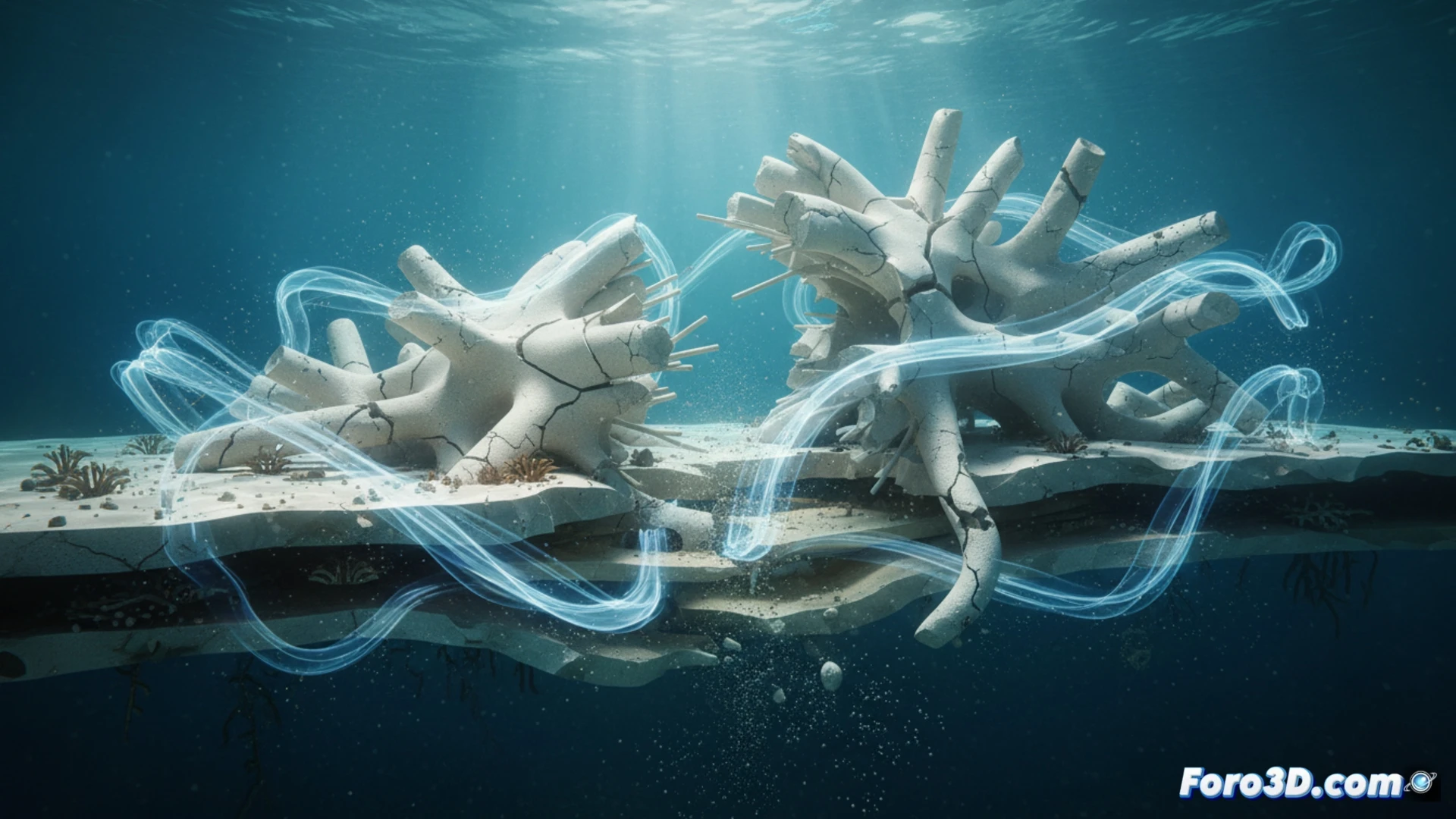
Workflow: from Bathymetric scanning to fatigue analysis 🔧
The process begins with Blueview, generating point clouds of the degraded reef. This data is imported into Agisoft Metashape to reconstruct a high-precision mesh, capturing every fracture. The resulting geometry is taken to Rhino and Grasshopper, where stress analysis algorithms are applied. Here, hydrodynamic pressure is simulated using in-situ current data. The final step is Maya, which allows visualizing progressive deformation through particle simulations and stress fields, comparing actual wear with the predictive model. The discrepancy reveals that cyclic fatigue from turbulence was underestimated in the original design.
The gap between ideal design and ocean reality 🐚
This case exposes an uncomfortable truth for designers of artificial habitats: static simulation is not enough. The ocean imposes variable loads that traditional modeling software does not capture without field data. The lesson is clear: integrating hydrodynamics into the fatigue cycle from the concept phase is vital. If models are not calibrated with real wear, every printed reef will be an expensive experiment. 3D simulation must evolve to include environmental entropy as a primary variable.
As an engineer who has modeled fatigue in marine polymers, what specific lessons about the interaction between wave frequency and material stiffness could be drawn from the crack pattern in that reef to improve design criteria in hydrodynamic fatigue simulations?
(PS: Material fatigue is like yours after 10 hours of simulation.)