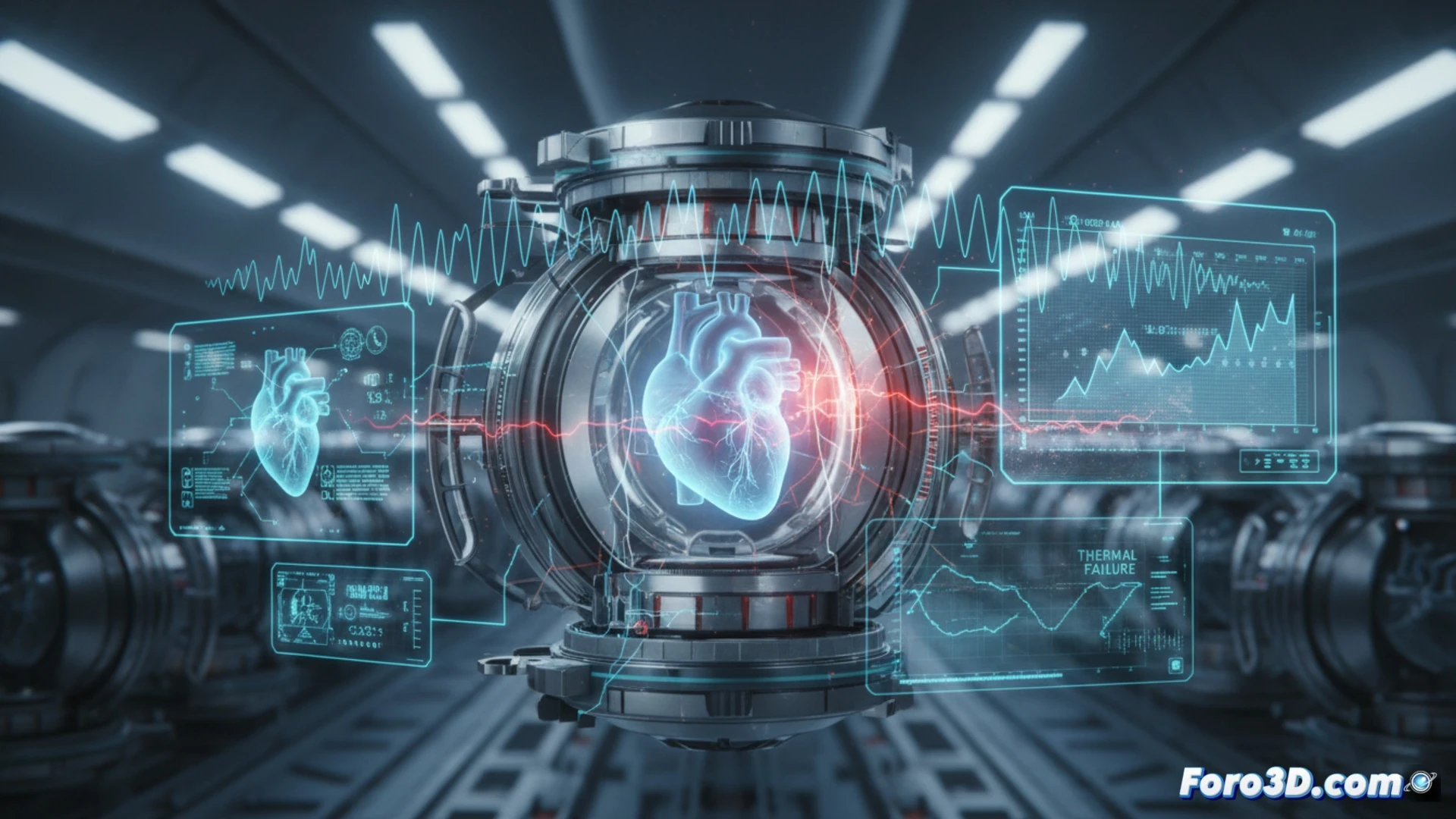
A heart destined for transplant arrived at its destination with a temperature outside the critical range, compromising its viability. Subsequent research, supported by 3D reconstruction of the casing and thermal simulation, revealed the cause: a micro-crack in the container's vacuum system. This failure was not a random accident, but the result of mechanical fatigue induced by vibrations during air transport, a problem that numerical simulation can anticipate.
Modeling micro-cracks with Star-CCM+ and SolidWorks 🛠️
The analysis began with SolidWorks to reconstruct the exact geometry of the insulating casing, including the seals and vacuum chamber. With this foundation, the model was imported into Star-CCM+ for a multiphysics simulation. First, a modal analysis was applied to identify the natural frequencies of the container. Then, a vibration spectrum typical of an airplane cargo hold was introduced. The fatigue simulation located stress concentration zones at the corners of the vacuum panel. There, the model predicted crack nucleation after load cycles equivalent to 200 flight hours, coinciding with the actual failure. Experimental validation with FLIR Tools 3D thermography confirmed the loss of insulation in that exact region.
The hidden fragility in high-risk medical equipment ⚠️
This case demonstrates that material fatigue is not an issue exclusive to bridges or aircraft; it directly affects medical devices where the margin for error is zero. The integration of SolidWorks for design, Star-CCM+ for vibration fatigue simulation, and FLIR for thermal validation creates a robust workflow. Without these tools, the micro-crack would have gone unnoticed until catastrophic failure. The lesson is clear: in organ transport, fatigue simulation is not a luxury, it is a safety requirement.
What role did the resonance frequencies of the transport system and the biocontainer mounting play in the vibration fatigue that may have caused the critical thermal deviation during the journey?
(PS: Material fatigue is like yours after 10 hours of simulation.)