A floating solar farm in the North Sea suffered a catastrophic disintegration after a moderate storm. The failure was not due to wind force, but to fatigue of the elastomeric connectors joining the panels. Subsequent analysis, using OrcaFlex to model hydrodynamics and SolidWorks Simulation for structural study, revealed that high-frequency wave action generated a combined load state of axial tension and torsion that exceeded the material's cyclic strength.
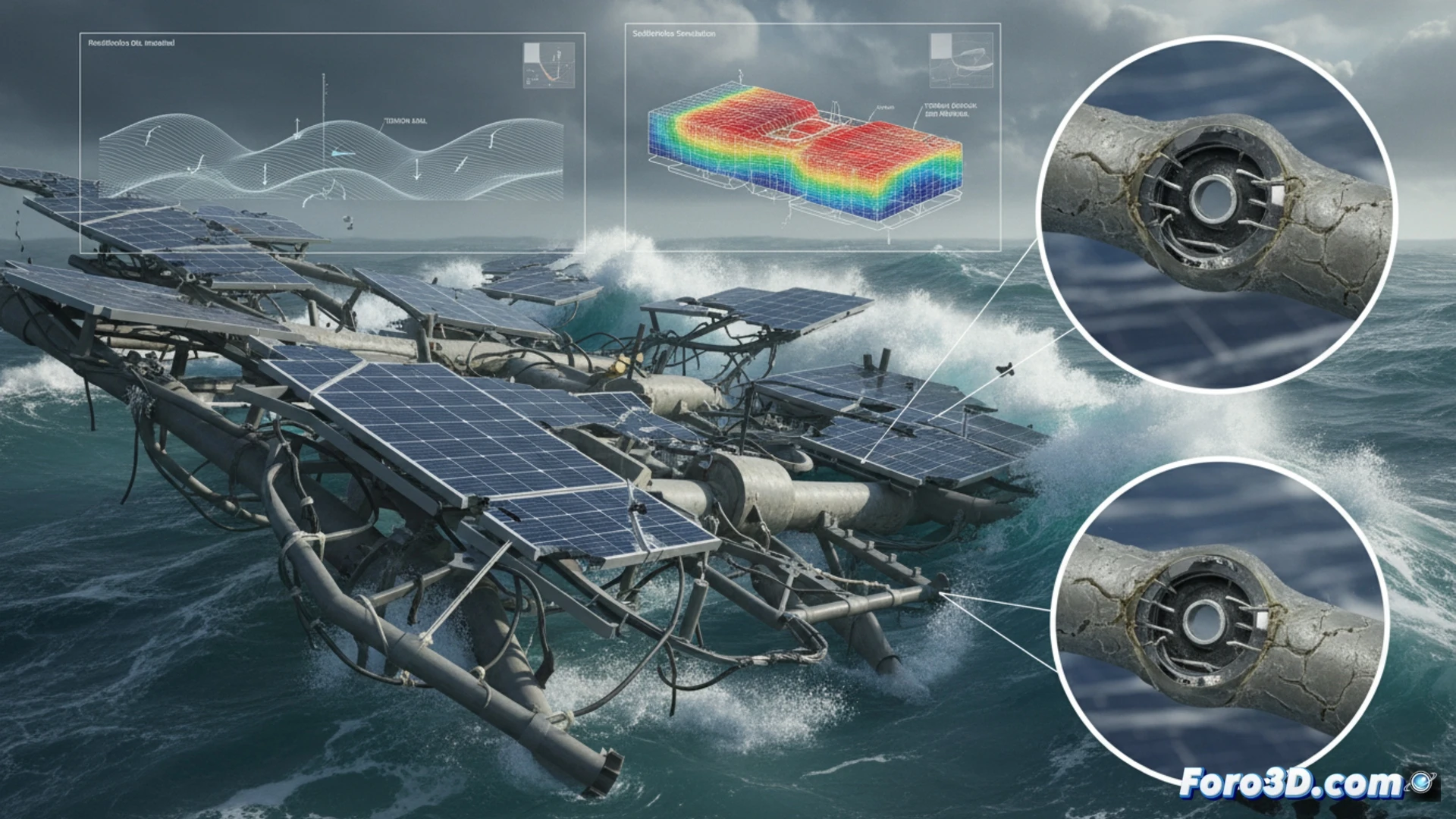
Combined load modeling and multiaxial fatigue simulation 🌊
The simulation process began in OrcaFlex, where a 3D geometry file of the solar island was imported from Rhino 3D. An irregular wave spectrum was defined with a significant wave height of 1.5 meters and a peak period of 4 seconds, simulating the storm conditions. The software calculated forces and moments at each connector, exporting time series of tension and torsion. These load curves were input into SolidWorks Simulation as inputs for a multiaxial fatigue analysis. The Soderberg Fatigue criterion for elastomeric materials was applied, generating stress maps that showed critical concentrations at the connector base. The simulation predicted a service life of only 18 months, matching physical laboratory tests that replicated the load cycle with a servo-hydraulic machine.
Lessons for offshore flexible anchor design 🔧
The failure reveals an inherent weakness in current designs: the lack of torsional fatigue analysis in connectors that, although flexible, are vulnerable to short-wave resonance. The proposed improvement includes a connector with a helical geometry that dissipates torsion along its axis, and a change in the elastomeric compound to one with greater internal damping. The validated simulation demonstrates that it is possible to predict these failures with an integrated workflow between OrcaFlex and SolidWorks Simulation, saving physical prototyping costs.
What was the root cause of the torsional fatigue failure in the offshore solar farm connectors and which design parameters should be reevaluated to avoid similar failures under moderate storm conditions?
(PS: Material fatigue is like yours after 10 hours of simulation.)