Last month, a polymetallic nodule collector suffered a critical shutdown at 4,000 meters depth due to a failure in its cooling system. The subsequent analysis, carried out using high-frequency sonar and simulation software, revealed that the cause was not a manufacturing defect, but the crystallization of salts under extreme pressure, generating microcracks in the titanium heat exchanger. This case illustrates how material fatigue simulation becomes the only viable tool for predicting failures in environments where physical inspection is impossible.
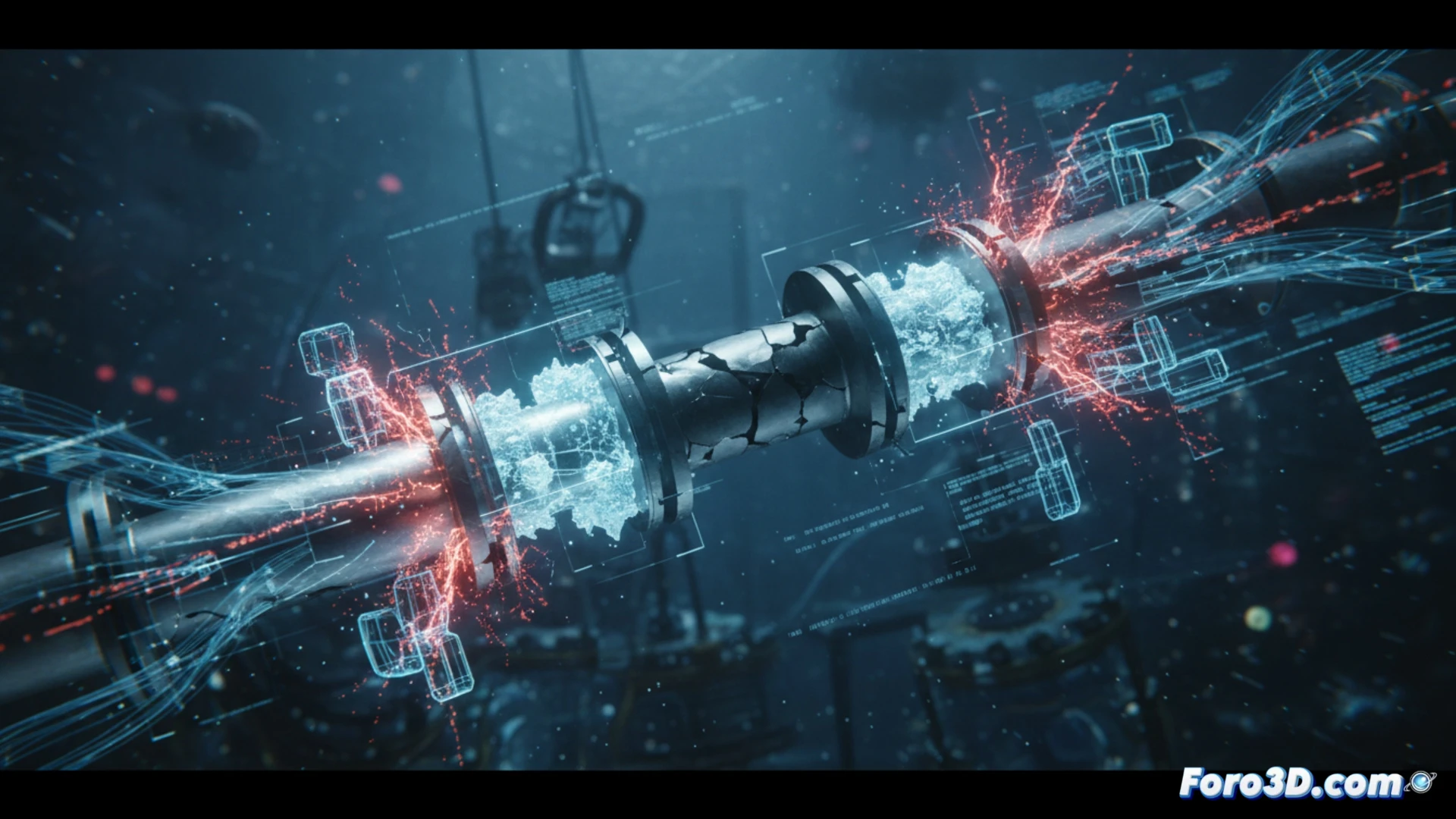
Digital twin of the heat exchanger: from point cloud to Flow Simulation 🛠️
The diagnostic process began with capturing the heat exchanger using a high-frequency side-scan sonar, processed in EIVA NaviSuite to generate a precise point cloud. With Bentley ContextCapture, the 3D model of the damaged component was reconstructed, which was subsequently cleaned and meshed in MeshLab. The core of the analysis resided in SolidWorks Flow Simulation, where the thermodynamic cycle at 400 atmospheres was reproduced. Variables of salt nucleation (chlorides and sulfates) in the cooling fluid were introduced. The results showed that crystallization not only obstructs flow but also generates localized stresses of up to 850 MPa in the titanium walls, exceeding its yield limit under cryogenic conditions.
When the failure is not in the design, but in the environment 🌊
This incident demonstrates that fatigue simulation cannot be limited to pure mechanical loads. The chemical interaction of the environment (pressure, temperature, and saline composition) accelerates material degradation in ways that no surface test can replicate. The lesson is clear: for abyssal mining, the digital twin must incorporate solid precipitation models. Only then can we anticipate incipient deformations before a 0.1 mm crack halts a multi-million dollar operation 4 kilometers beneath the sea.
Can 3D simulation accurately predict the exact nucleation point of fatigue due to crystallization in titanium subjected to abyssal pressures of 400 atmospheres?
(PS: Material fatigue is like yours after 10 hours of simulation.)