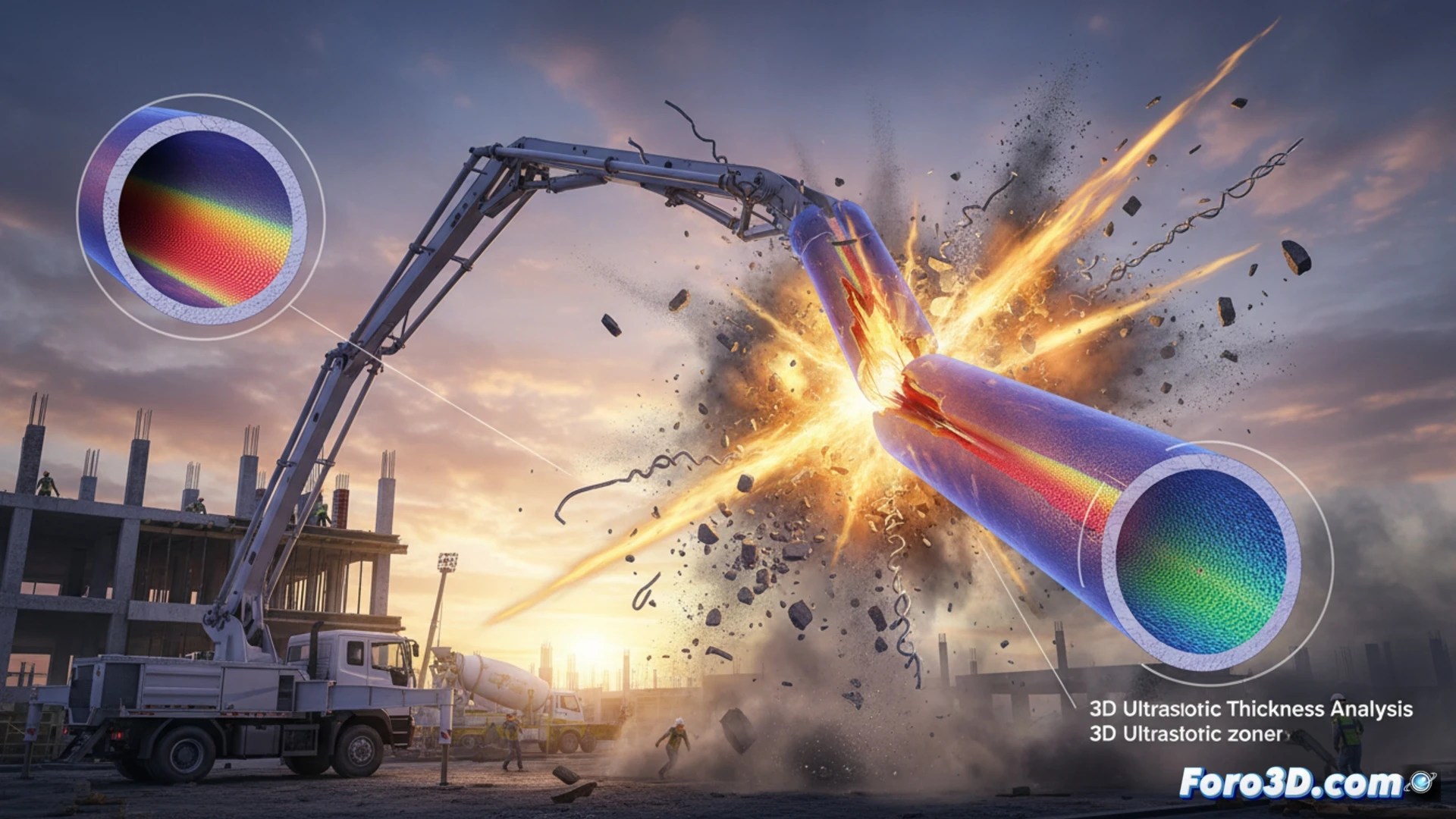
A concrete pump arm burst on site, launching debris at high speed. 3D laser scanning with Faro Focus and thickness analysis using 3D ultrasound revealed the cause: the friction of the aggregate had worn down the internal wall of the elbows beyond the safety limit. This case demonstrates how material fatigue from abrasion can be anticipated with digital technology.
3D scanning and finite elements to detect critical zones 🛠️
The process begins with laser scanning the pipe elbows, generating a point cloud that is imported into SolidWorks to reconstruct the actual worn geometry. In Ansys, a finite element analysis is applied that compares the actual thickness of each section with the nominal design thickness. The visual simulation shows the progressive thinning of the internal wall, identifying zones where stress exceeds the yield limit. This allows predicting the remaining useful life and scheduling replacements before failure. In this case, the elbows showed a 40% reduction in minimum thickness, well below the safe threshold.
Lessons for structural safety on site ⚠️
The explosion was not a random accident, but the inevitable consequence of unmonitored wear. Integrating periodic 3D scanning with fatigue simulations in Ansys transforms prevention: it shifts from reacting to failures to predicting them months in advance. For the construction sector, this methodology is key to avoiding incidents that put lives and equipment at risk. Blender can be used to animate the thinning process and the final explosion, facilitating technical communication to the maintenance team.
ANSYS or Abaqus for this analysis?