The failure of a tidal energy underwater kite has highlighted a critical problem in composite materials engineering: fatigue due to friction with sediments. After breaking free from its mooring, the technical investigation focused on the Kevlar cable, whose rupture was initially attributed to a manufacturing defect. However, analysis using underwater photogrammetry revealed a pattern of localized wear inconsistent with a sudden failure. The main hypothesis points to the abrasive action of specific micro-sands, trapped between the cable fibers during tension cycles.
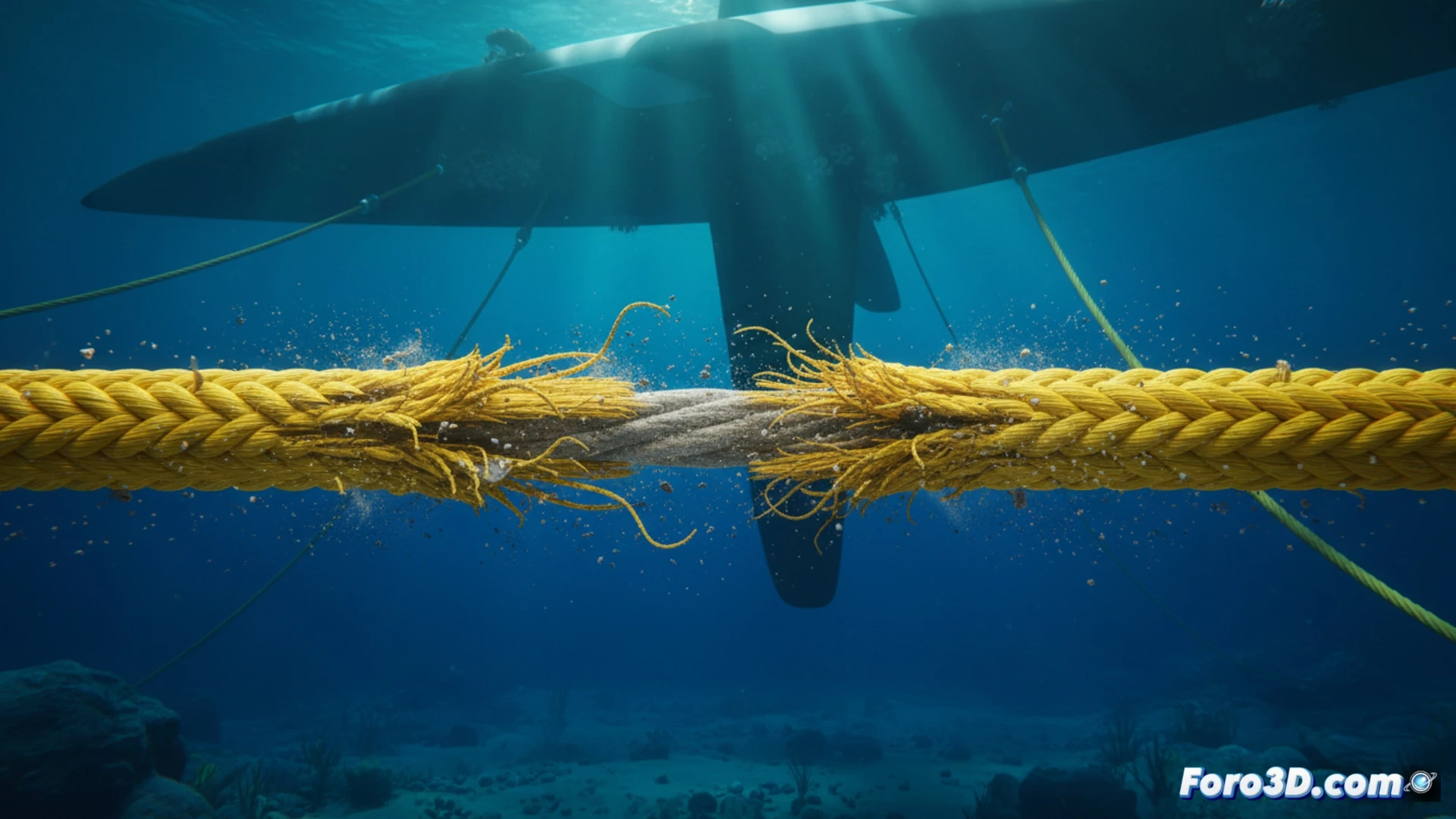
Digital recreation of wear: from photogrammetry to OrcaFlex 🛠️
The investigation process began with capturing the mooring and the residual cable using underwater photogrammetry, employing Bentley ContextCapture to generate a high-precision digital twin. This model allowed the identification of abrasion marks in the failure zone, characterized by a pattern of micro-scratches parallel to the current direction. With this data, the geometry was imported into OrcaFlex, where the dynamic behavior of the cable under cyclic tidal loads was simulated. The software recreated friction with sediment particles, modeling the micro-sands as discrete elements interacting with the Kevlar surface. The results confirmed that the combination of fluctuating tension and particle abrasion generated a localized fatigue concentration, drastically reducing the cable's service life in the contact zone with the seabed.
Lessons for fatigue simulation in composite materials 🔬
This case demonstrates that fatigue in materials like Kevlar depends not only on cyclic loading but also on the microscopic environment. Friction with sediments acts as a failure catalyst that traditional fatigue models overlook. The combination of underwater photogrammetry, digital twins in ContextCapture, and dynamic simulations in OrcaFlex offers a replicable workflow for analyzing failures in marine environments. For engineers, the lesson is clear: in composite materials exposed to abrasion, fatigue wear must be evaluated as a synergistic phenomenon, not as an isolated parameter.
Which accelerated testing methodology allows for the most faithful replication of the interfilamentary abrasion wear observed in Kevlar cables subjected to cyclic loads in real marine environments?
(PS: Material fatigue is like yours after 10 hours of simulation.)