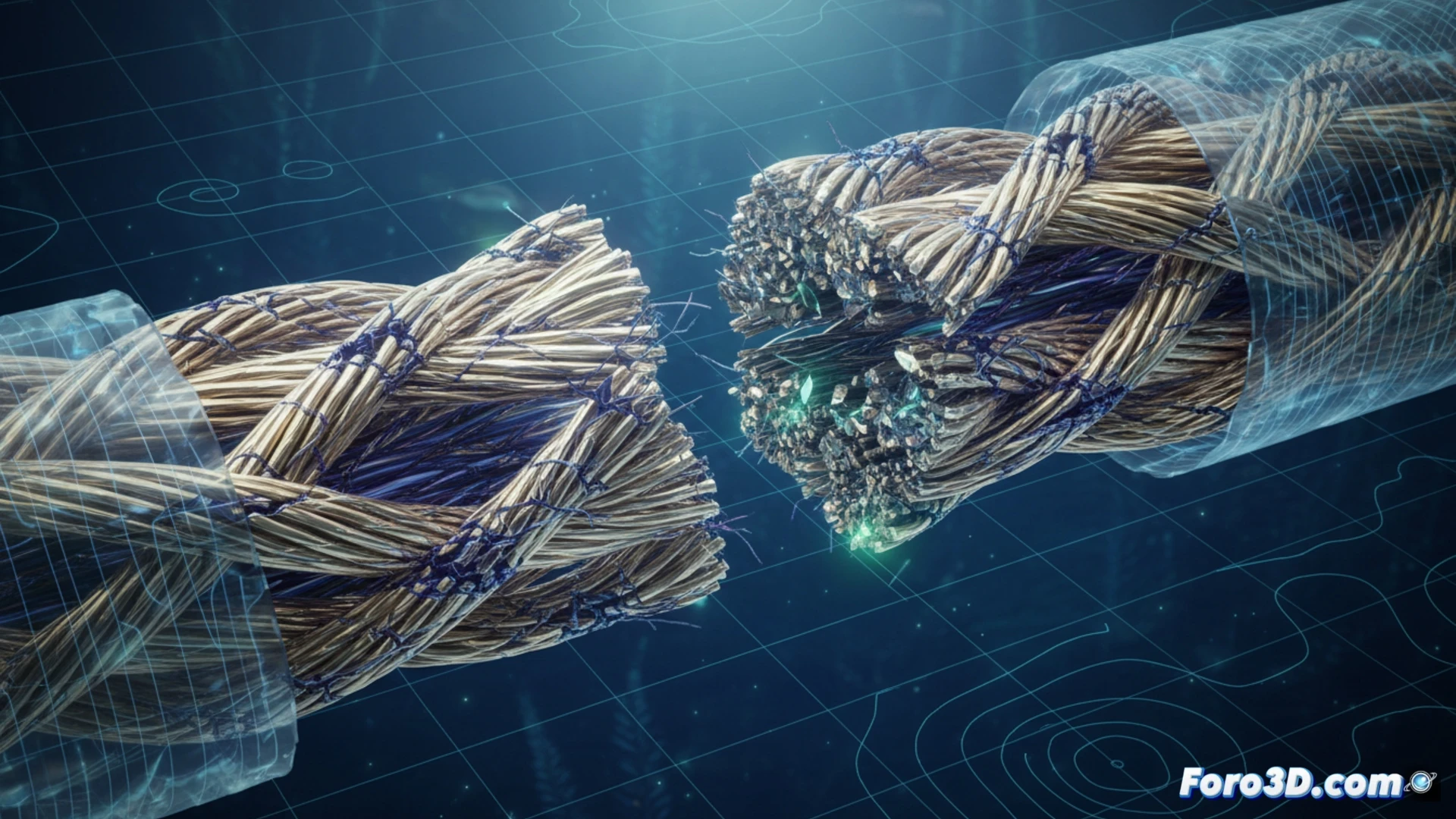
The recent breakage of a carbon fiber cable in an underwater particle detector has jeopardized the integrity of ultra-high-strength materials. The failure was not immediately catastrophic, but rather the result of progressive wear at the atomic scale. Engineers suspect a phenomenon known as fretting fatigue, where individual cable filaments rub against each other under cyclic load, generating microcracks that propagate until total rupture.
Visualizing Degradation: From Optical Scanner to Mathematical Model 🔬
To confirm the hypothesis, a multidisciplinary workflow was employed. First, a Keyence VK Analyzer microscope performed a 3D scan with atomic resolution of the fracture surface, capturing the wear marks from friction between filaments. Using MATLAB, this data was processed to generate a roughness and residual stress map, identifying the exact points where fretting had been most severe. Finally, GOM Inspect allowed overlaying the digital model of the intact cable with the post-fracture scan, calculating the accumulated plastic deformation and simulating crack progression under underwater stress conditions.
The Hidden Cost of Microfriction in Critical Applications ⚙️
This case demonstrates that, in high-tech materials, the enemy is not always the maximum load, but cyclic friction at the nanoscale. The ability to simulate and visualize fretting fatigue with 3D tools allows engineers to redesign cable braiding to minimize contact between filaments. Without this analysis, underwater detectors, subject to extreme currents and pressures, would be doomed to silent failures that would compromise years of research in particle physics.
How can 3D analysis of nanometric fatigue in composite materials predict the breakage of underwater cables before a catastrophic failure occurs?
(PS: Material fatigue is like yours after 10 hours of simulation.)