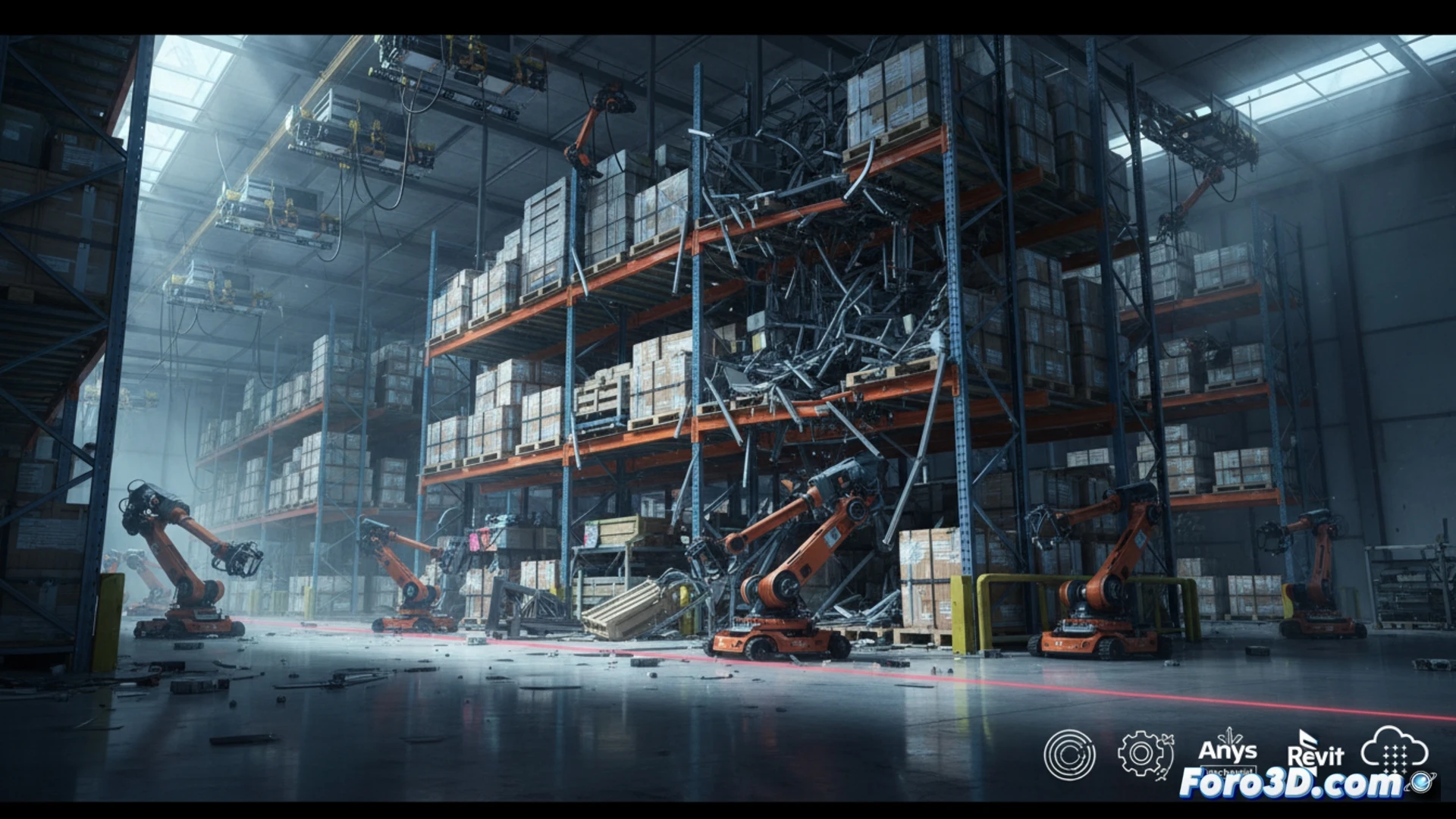
A catastrophic failure in an automated warehouse could have been predicted with simulation software. Floor scanning revealed a minimal tilt, imperceptible to the human eye, which slightly deviated the robots' path. Over months, they repeatedly struck the same section of the rack, inducing microcracks that, under cyclic stress, led to the total collapse of the structure.
Integration of Simio and Ansys Mechanical for fatigue analysis 🏗️
The key to the analysis lies in combining two tools. First, Simio models the warehouse logistics as a discrete event system, quantifying the exact frequency with which each robot passes through the critical point. That frequency is translated into a load history that is imported into Ansys Mechanical. There, using finite elements, the cumulative effect of each impact is simulated: residual stresses, plastic deformation, and crack propagation. The simulation not only confirms the failure but also allows identifying the floor tilt threshold that triggers fatigue. CloudCompare comes into play by comparing the point cloud from the initial scan with that of the collapsed state, visually validating the deformation predicted by Ansys. Revit, for its part, serves to reconstruct the original geometry of the rack and generate the precise mesh for the analysis.
Lessons for the design of robotic infrastructures ⚙️
This case demonstrates that material fatigue in automated environments depends not only on the strength of the steel but on the dynamic interaction between the floor, the structure, and the machines. A millimeter slope can be catastrophic if the complete load cycle is not simulated. The lesson is clear: integrating discrete event simulation with structural analysis is not a luxury but a necessity to ensure the safety and longevity of the warehouses of the future.
How does the accuracy of floor scanning affect the reliability of structural fatigue predictions in automated racks subjected to repeated impacts?
(PS: Material fatigue is like yours after 10 hours of simulation.)