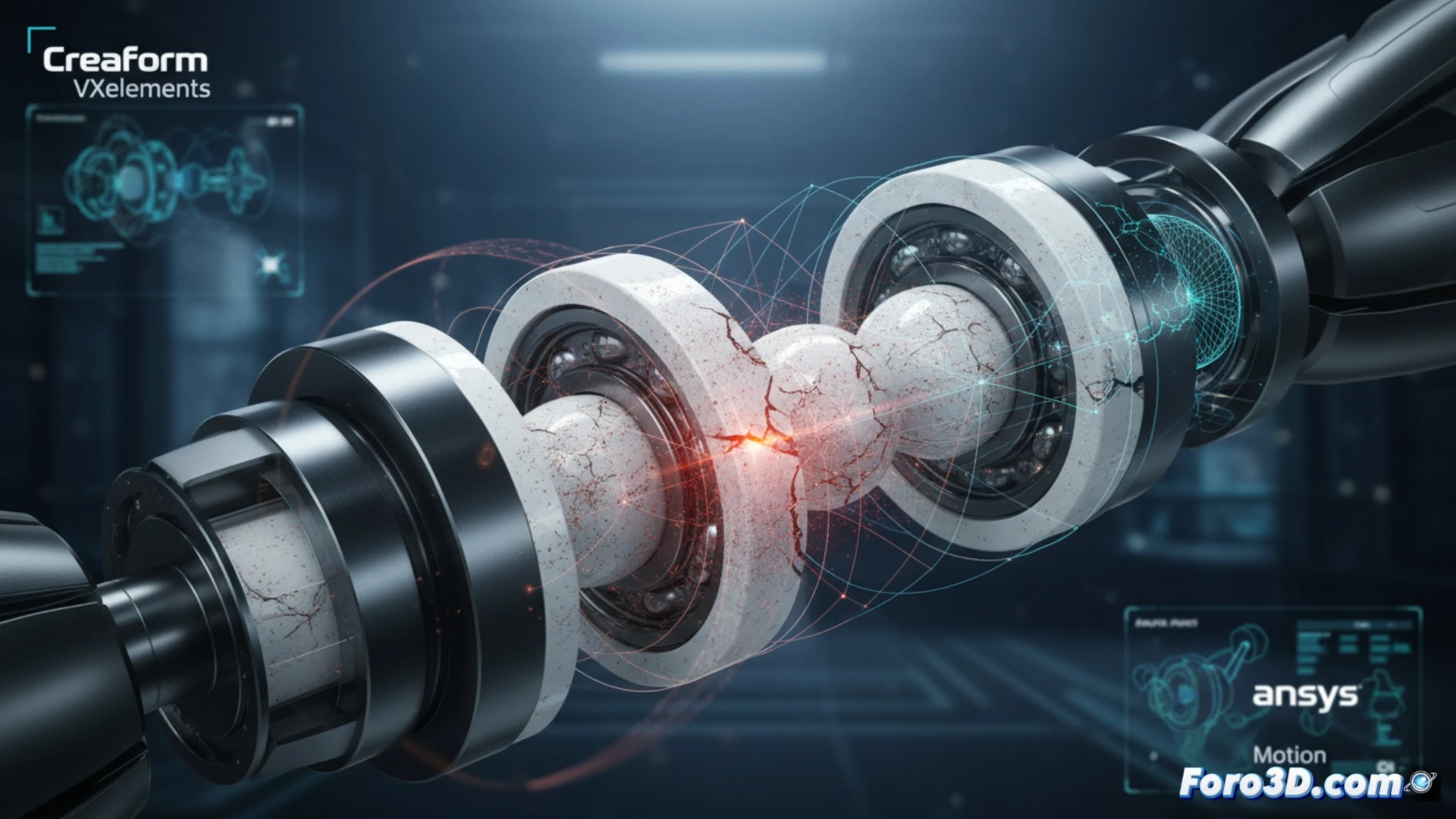
The joint failure in a demining exoskeleton revealed a critical problem: the ingress of metallic dust into ceramic bearings caused premature locking. This phenomenon, documented through 3D scanning with Creaform VXelements, represents a classic case of accelerated fatigue due to environmental contamination. We analyze how the dust acts as an abrasive, degrading the raceway surfaces and generating microcracks that compromise the structural integrity of the component.
Simulation in Ansys Motion and modeling in SolidWorks 🛠️
The initial modeling in SolidWorks allowed defining the exact geometry of the ceramic bearing and its cage. Subsequently, two scenarios were introduced in Ansys Motion: ideal conditions (without contamination) and real conditions (with metallic particles from 10 to 50 microns). The simulation revealed that metallic dust increases the coefficient of friction by 340%, generating localized stress peaks at the Hertzian contacts. These peaks, repeating with each motion cycle, initiate fatigue cracks that evolve until complete locking. Kinematic analysis showed that the joint fails after approximately 2,300 cycles under demining load, compared to the estimated 15,000 cycles under clean conditions.
Validation with 3D scanning and lessons for design 🔍
The scan with Creaform VXelements of the failed joint allowed quantifying the actual wear: a material loss of 0.12 mm on the inner race and indentation marks from trapped particles. These data, when compared with the Ansys Motion simulation, validated the predictive model with an error margin below 7%. The lesson is clear: in extreme environments like demining, ceramic bearings require dynamic seals and lubrication with a particle barrier. Fatigue simulation, combined with 3D documentation, becomes an indispensable tool for redesigning joints that withstand metallic dust and extend the exoskeleton's operational life.
What is the mechanism of fatigue crack initiation in zirconia ceramic bearings when ferrous metallic particles act as stress concentrators under cyclic loads in a high-humidity environment?
(PS: Material fatigue is like yours after 10 hours of simulation.)