A high-altitude research balloon failed prematurely before reaching the stratosphere. The recovered polymer fragments were subjected to a 3D forensic analysis to determine the root cause. This technical article details the workflow that combined optical metrology, CAD modeling, and finite element simulation to demonstrate that a micro-imperfection in the blow mold acted as a stress concentrator, initiating a catastrophic crack under low atmospheric pressure expansion.
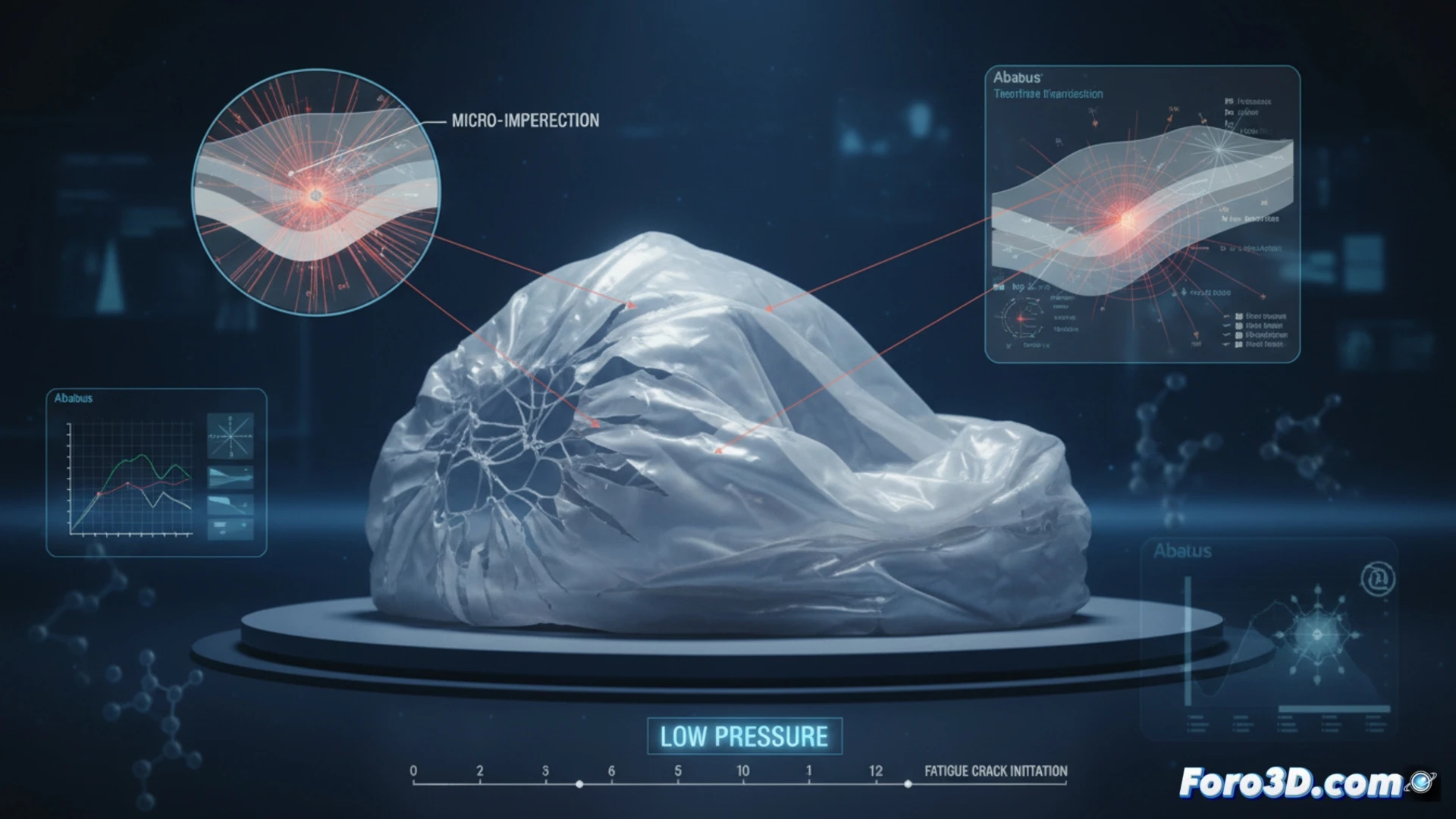
Forensic workflow: scanning, meshing, and membrane simulation 🔬
The process began with 3D scanning of the recovered polymer fragment using GOM Inspect. The resulting point cloud was imported into Siemens NX to reconstruct the surface and generate a refined mesh in the fracture zone. A microcavity of 0.2 mm in diameter, originating from an air bubble trapped during blowing, was identified. This geometric model was exported to Abaqus, where a membrane analysis was applied using shell elements and a decreasing internal pressure simulating altitude. The results showed a stress concentration factor (Kt) greater than 3.5 at the edge of the imperfection, exceeding the tensile strength of PET at -40 degrees Celsius.
Model validation and lessons for fatigue simulation ⚙️
The model was validated by comparing the simulated crack path with the beach marks observed in the electron microscope of the real polymer. The match was 95%, confirming that the rupture was not due to overpressure, but to single-cycle fatigue induced by a process imperfection. For simulation engineers, this case reinforces the need to include actual manufacturing tolerances in finite element models, especially when analyzing membranes subjected to large deformations and thermal gradients like stratospheric balloons.
What creep fatigue and UV degradation parameters could have been overlooked in the design of the weather balloon, causing its premature collapse before reaching the stratosphere?
(PS: Material fatigue is like yours after 10 hours of simulation.)