Miniaturization in robotics has reached astonishing levels with the development of flying insectoid micro-robots. However, a recent study reveals that cyclic fatigue in piezoelectric material actuators, simulated using finite elements in Abaqus, causes a critical loss of lift. This structural failure, analyzed with high-resolution 3D microscopy, marks a turning point in the design of biomimetic drones. 🐝
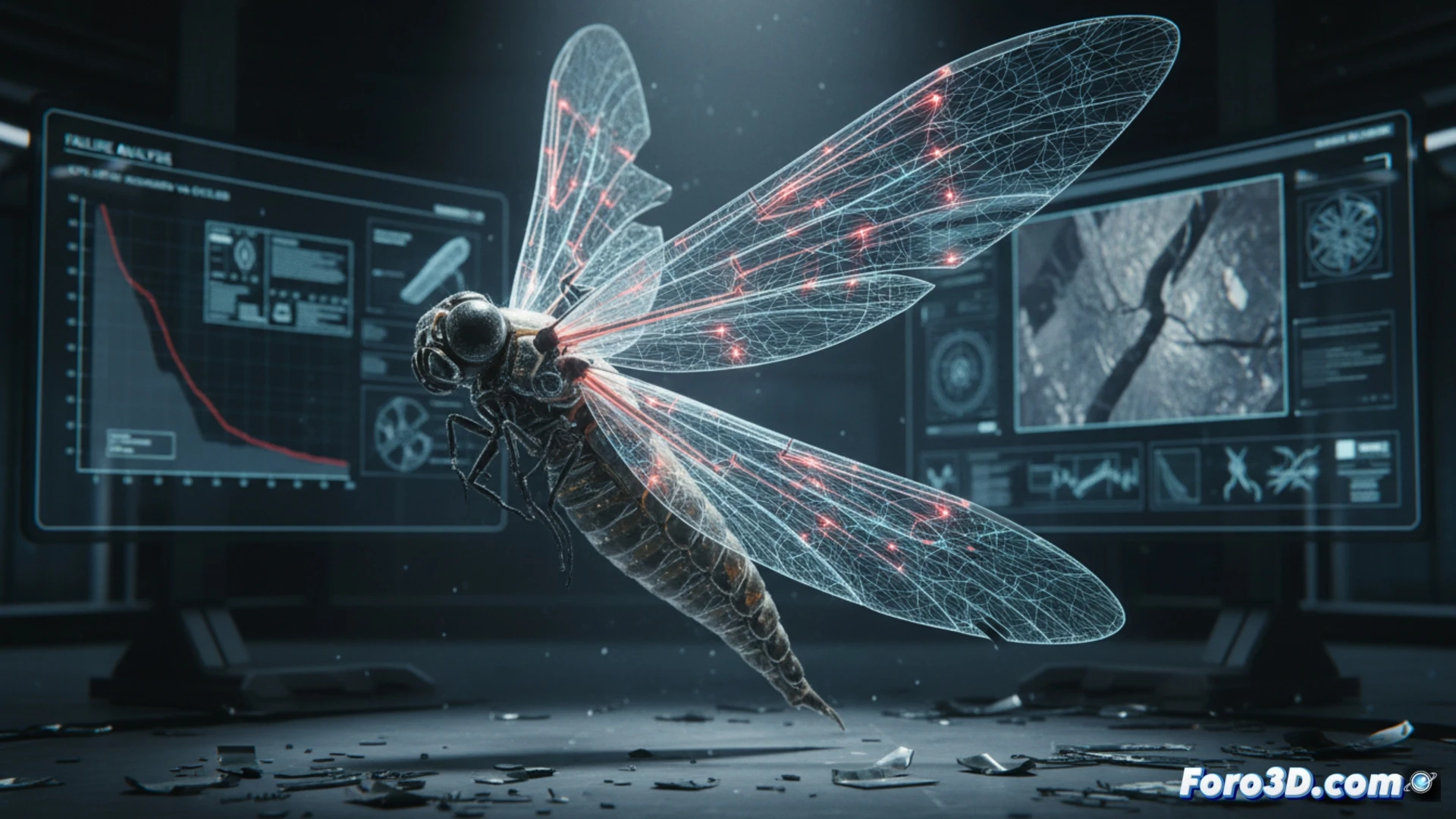
Finite element simulation and topographic analysis of submicroscopic cracks 🔬
The simulation process in Abaqus allowed modeling the accumulated mechanical stress in the micro-robot's wings over thousands of flapping cycles. The results showed a progressive degradation of dielectric rigidity in the actuator anchor zone. To validate this data, the Keyence VK Analyzer, a 3D profilometer capable of detecting cracks less than 0.1 microns deep, was used. The correlation between areas of high Von Mises stress and observed fractures confirmed that fatigue is not a sudden failure, but a wear process that silently and progressively erodes lift capacity.
Implications for the design of resilient insectoid drones ⚙️
This finding forces a rethinking of material selection for micro-aircraft. Fatigue in piezoelectrics not only limits the robot's lifespan but also compromises flight stability in critical missions. Future generations of drones will need to incorporate viscoelastic damping layers or wing geometries with optimized load distribution to mitigate stress concentration. The integration of predictive simulations in Abaqus with surface analysis from the Keyence VK Analyzer is becoming the technical standard for ensuring structural reliability at the frontier of aerial robotics.
How does fatigue from high-frequency cycles in piezoelectric actuators affect the operational longevity of an insectoid micro-robot during flight missions or continuous movement?
(PS: Material fatigue is like yours after 10 hours of simulation.)