An emergency portable water treatment plant suddenly stopped filtering salt, compromising the water supply in a critical area. The failure was not gradual but catastrophic: the graphene membrane lost its ion rejection capacity in seconds. To understand the mechanism, atomic force microscopy was combined with computational fluid dynamics in ANSYS Fluent.
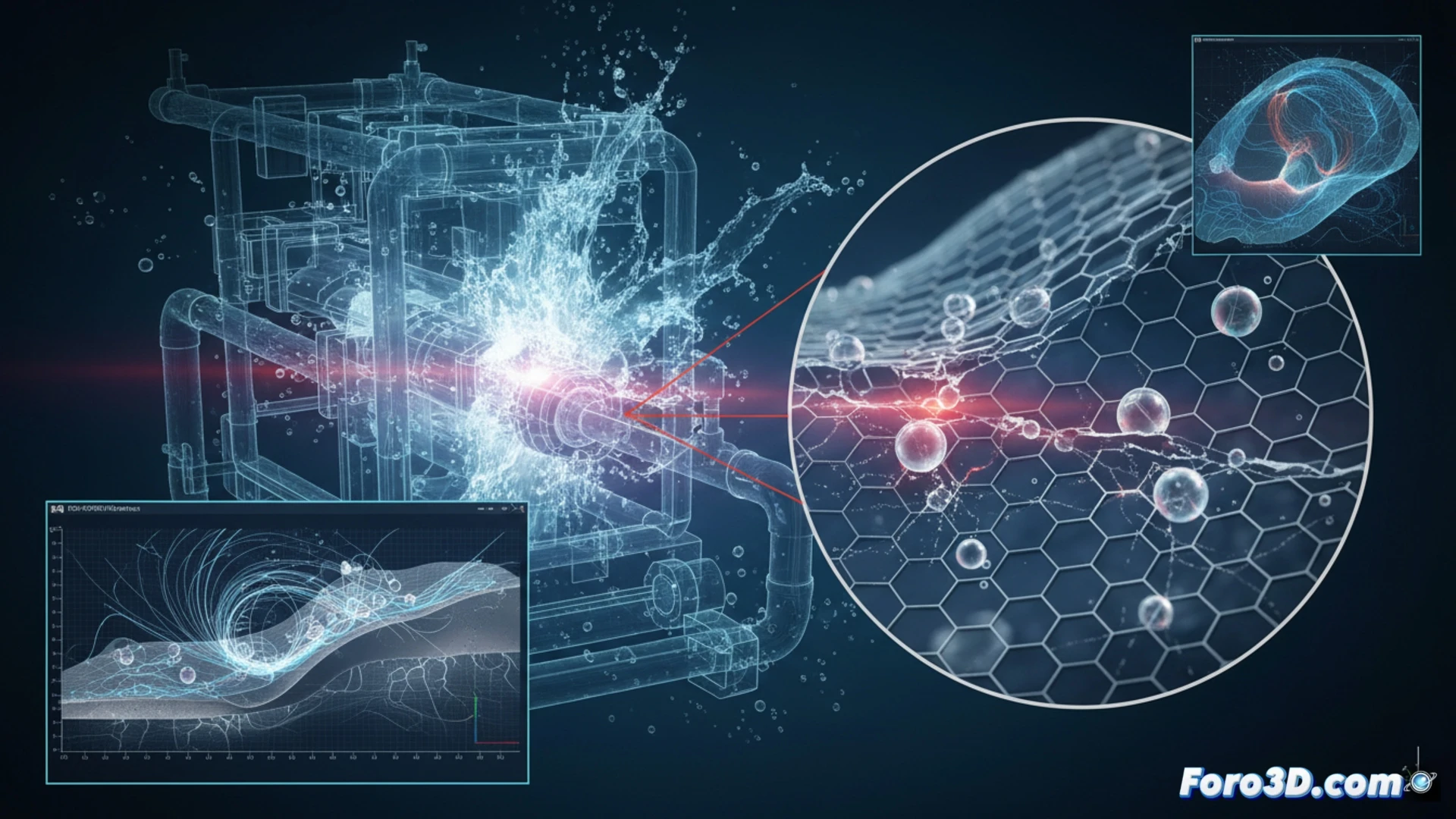
CFD simulation and 3D topography of fatigue failure 💧
3D analysis revealed that a microscopic air bubble became trapped between the graphene layers during startup. As the system pressure increased, the bubble collapsed, generating a localized pressure peak that exceeded the mechanical strength of the 2D material. Using ANSYS Fluent in microfluidics mode, the collapse dynamics were modeled and the stress on the sheets was quantified. The CFD results were correlated with atomic force microscopy images, where concentric tears typical of cyclic fatigue from hydraulic impact were observed. Materialise Magics allowed reconstructing the 3D topography of the fracture to validate the failure initiation point.
Lessons for membrane design in critical environments 🔬
This case demonstrates that fatigue in 2D materials depends not only on mean pressure but also on micro-events such as trapped bubbles acting as stress concentrators. CFD simulation and 3D characterization make it possible to predict these weak points before a field failure occurs. For future portable plants, it is recommended to include pre-air purge systems and model water hammer scenarios during the design phase.
As the nucleation and collapse of nanometric bubbles within a graphene membrane subjected to cyclic loading could have triggered the catastrophic rupture and sudden loss of filtration capacity in the emergency water treatment plant.
(PS: Material fatigue is like yours after 10 hours of simulation.)