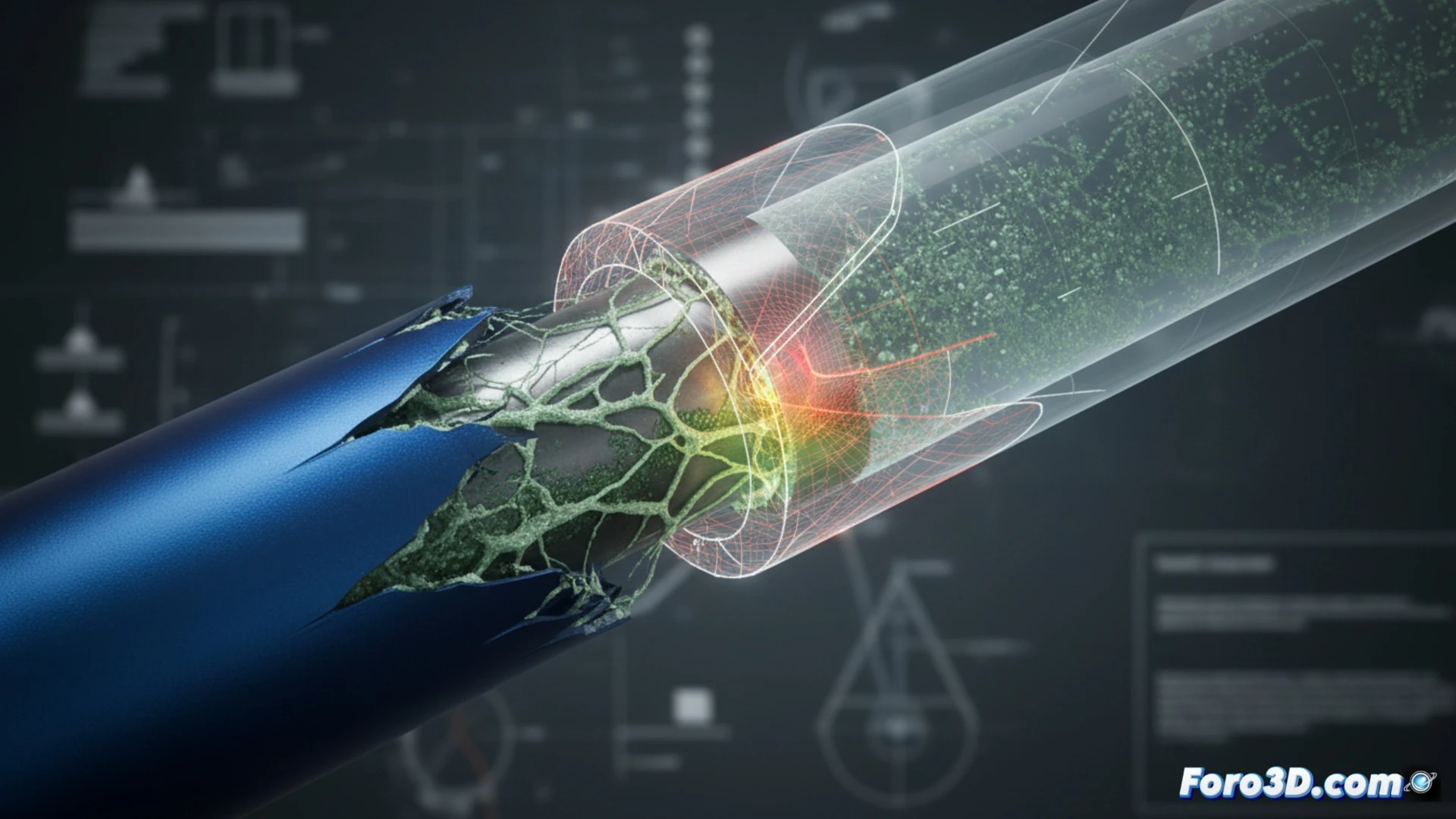
In the world of competitive cycling, the pursuit of lightness meets an unexpected limit when a magnesium frame fractures during a descent. Forensic analysis using micro-CT not only confirmed material fatigue but also discovered internal galvanic corrosion between the magnesium and aluminum inserts, a defect completely invisible under the paint. This case demonstrates how advanced simulation techniques are vital for understanding complex mechanical failures.
Forensic Analysis with Volume Graphics, Abaqus, and GOM Inspect 🛠️
The research protocol combined three key tools. First, micro-CT scanned the frame with a resolution of up to 5 microns, generating a point cloud that Volume Graphics processed to reconstruct the 3D volume of the material. This reconstruction revealed galvanic corrosion cavities at the joints, where magnesium, acting as an anode, degraded in the presence of aluminum and moisture. Subsequently, a finite element mesh was exported to Abaqus, where cyclic loads simulating a mountain descent were applied. The software accurately predicted that residual stress, combined with section loss due to corrosion, exceeded the fatigue limit of magnesium by 30%. Finally, GOM Inspect validated the virtual deformations against the actual fractures, confirming that failure initiated in the corroded areas and not at weld points.
Implications for Material Design and Simulation ⚡
This case underscores a critical lesson: fatigue depends not only on geometry or load but also on the electrochemical compatibility of materials in contact. For engineers, ignoring galvanic corrosion in fatigue simulations can lead to optimistic predictions and catastrophic failures. Integrating micro-CT data into finite element models allows capturing real internal defects, improving the accuracy of analyses. In the design of competition frames, the use of dielectric insulators between dissimilar metals or the selection of alloys with similar galvanic potentials becomes as crucial as mechanical strength itself.
To what extent could microtomography redefine current non-destructive inspection criteria in the magnesium bicycle frame industry for competitive cycling?
(PS: Material fatigue is like yours after 10 hours of simulation.)