The detachment of the covering in a laminated wood wind turbine has brought to light a critical problem of material fatigue. Moisture, penetrating through unsealed edges, degrades the internal adhesive bonds. This process, invisible to the naked eye, causes a progressive loss of stiffness that ultimately overloads the metal anchors until catastrophic failure. We analyze the case using advanced simulation tools.
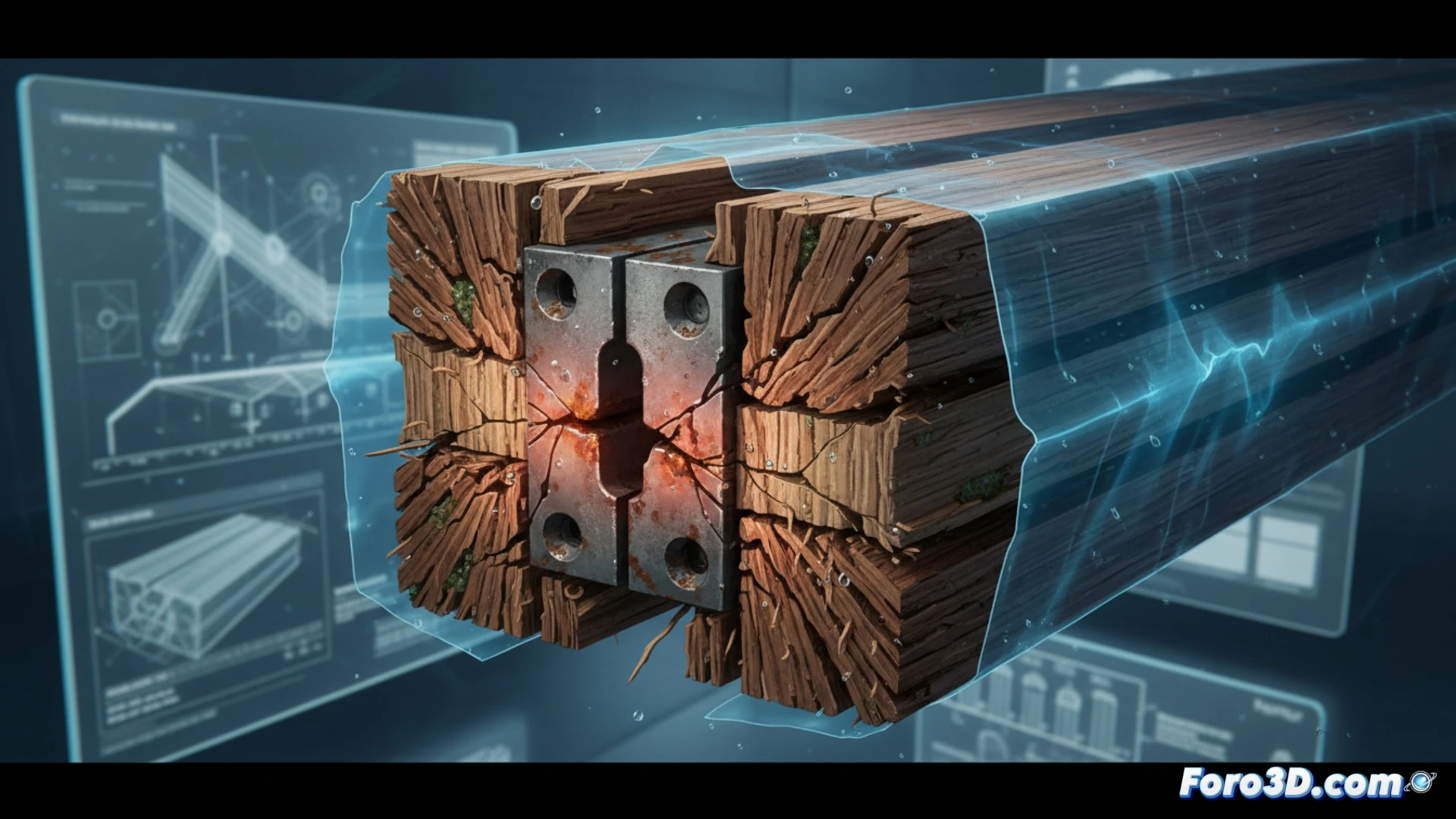
Modeling of progressive damage with RFEM and CloudCompare 🛠️
To understand the failure sequence, Dlubal RFEM was used to model the blade in a healthy state and with induced delamination at the edges. The simulation shows that a 15% reduction in interfacial adhesion generates a 40% increase in cyclic stresses on the anchor bolts. Complementing the analysis, CloudCompare allows aligning point clouds from LiDAR scans (obtained with Leica Cyclone) to compare the actual deformation of the damaged blade against the virtual model. The geometric deviation detected in the joint area confirms localized fatigue.
Lessons for the design of joints in laminated wood 📐
The case demonstrates that fatigue in wood composite materials depends not only on wind loads but also on the internal microclimate. Engineers must prioritize the perimeter sealing of edges and use adhesives with improved hydrolytic resistance. Additionally, monitoring with periodic 3D scanning allows detecting millimeter deviations that anticipate degradation. Not sealing an edge is, essentially, inviting moisture to destroy the structure from within.
In a laminated wood wind turbine, exposure to the moisture cycle at the edges of the metal joint generates differential stresses that accelerate material fatigue, but this could be mitigated through a specific anchor design or a barrier surface treatment, what approach do current fatigue models recommend to predict and prevent this failure under real service conditions.
(PS: Material fatigue is like yours after 10 hours of simulation.)