A 400-ton autonomous mining truck lost traction on a ramp and overturned, causing an operational catastrophe. The subsequent analysis revealed that the cause was not a driving error, but a fatigue failure in the constant velocity joint of the drive shaft. Through high-resolution 3D scanning and multibody simulation, engineers identified an internal forging defect that propagated under the extreme load cycles typical of mining. 🚛
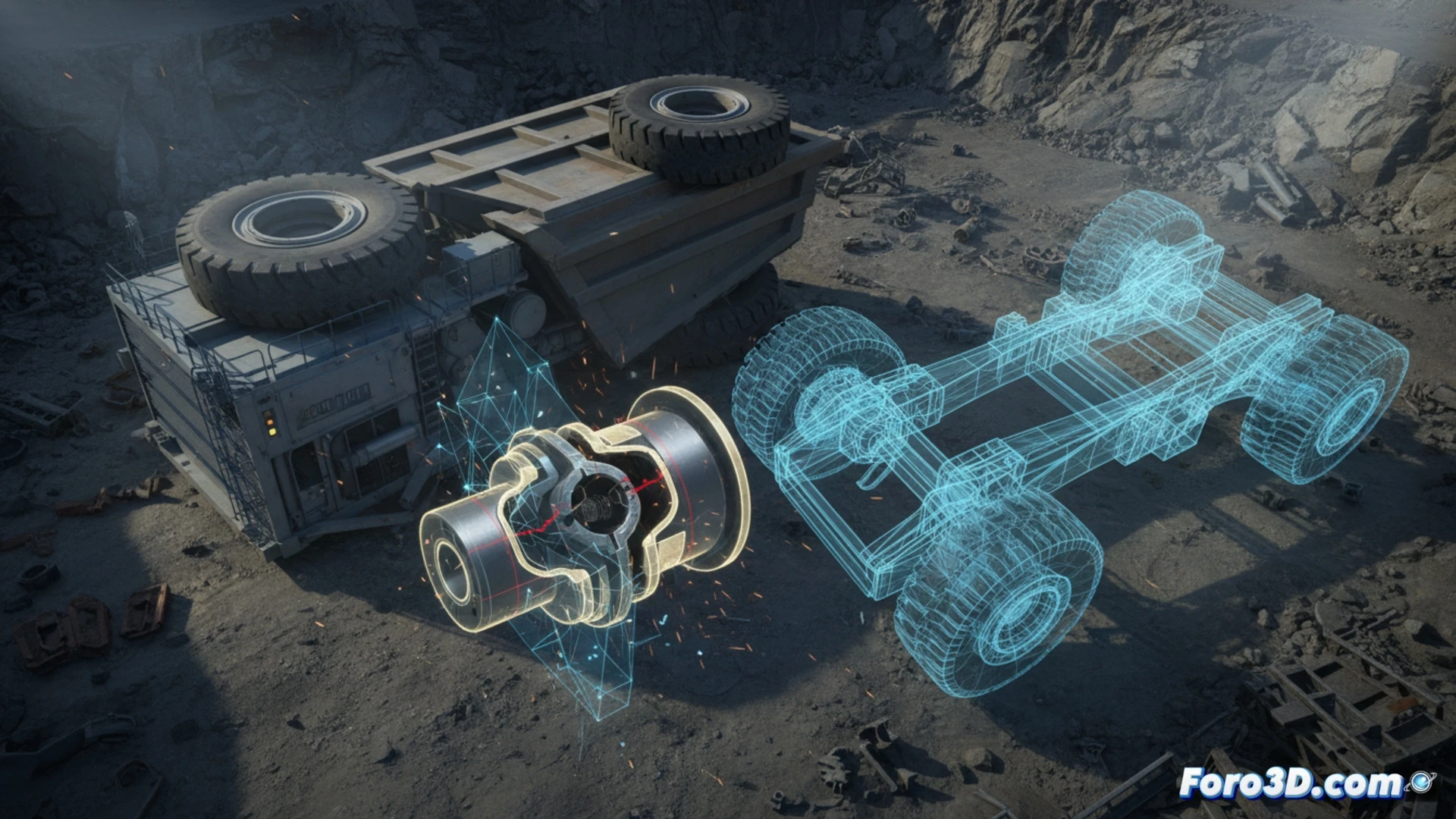
3D scanning and simulation: digital twin to detect hidden failures 🔍
The team used GOM Inspect to digitize the fractured joint with micrometer precision, generating a point cloud that revealed internal microcracks not visible to the naked eye. These anomalies originated during the forging process, where non-metallic inclusions acted as stress concentrators. Using the scan data, a dynamic model was built in MSC Adams to replicate the load conditions on the ramp, and subsequently a finite element analysis was performed in SolidWorks Simulation. The results confirmed that the defect exceeded the material's fatigue limit after thousands of combined torsion and bending cycles.
Lessons from a catastrophe: fatigue as a silent enemy ⚠️
This case demonstrates that material fatigue in critical components is not a theoretical risk, but a real threat that can bring down a machine weighing hundreds of tons. The integration of digital twins based on 3D scanning and multibody simulation allows these failures to be anticipated before they occur. For simulation engineers, the lesson is clear: no forging defect should be underestimated, and component validation must include load cycles representative of the real mining environment.
How transient loads and torsional effects influence the fatigue life prediction of constant velocity joints in 400-ton autonomous mining trucks
(PS: Material fatigue is like yours after 10 hours of simulation.)