The LST telescope, designed to detect Cherenkov radiation, suffered a critical misalignment after the collapse of its adaptive mirror support. The origin of the failure was located in the carbon fiber joints, where cyclic fatigue caused microcracks and permanent deformation. To understand the phenomenon, a digital forensic analysis was performed combining 3D scanning, CAD modeling, and finite element simulation.
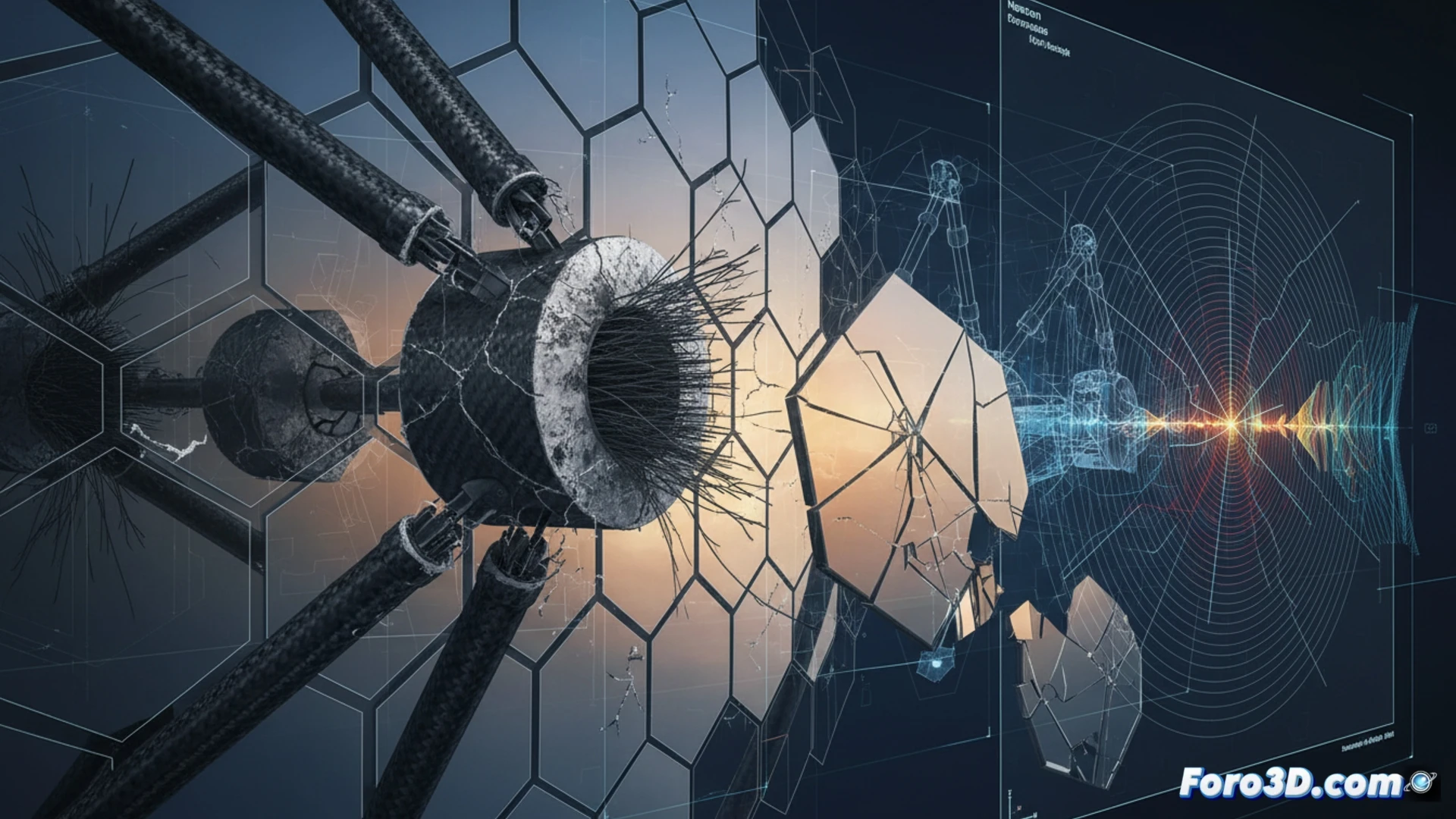
Forensic workflow: from RealityCapture to MSC Nastran 🔧
The first step was to document the actual geometry of the collapsed support using photogrammetry in RealityCapture. This point cloud model was imported into Siemens NX to reconstruct the original CAD design and compare it with the deformed part. With the clean geometry, the assembly was exported to MSC Nastran for a multiaxial fatigue analysis. Typical telescope operational loads (variable gravity, wind, and thermal vibration) were applied to the carbon joints. The SOL 101 solver allowed identifying residual stresses in the joint area, while the fatigue module (SOL 111) predicted a service life of only 2.3 years, well below the expected 10 years.
Lessons for composite structure design 💡
This case demonstrates that carbon fiber, although lightweight and rigid, is vulnerable at joints if interlaminar degradation is not modeled. The Nastran simulation revealed that the failure was not due to overload, but to damage accumulation in the epoxy matrix under low-amplitude cycles. For future iterations, it is recommended to redesign the joints with metallic inserts and validate the model with real fatigue tests. The combination of RealityCapture, Siemens NX, and Nastran offers a complete workflow to prevent similar collapses.
In the context of the LST mirror support collapse, what fatigue simulation parameters in carbon fiber joints with Nastran are critical to predict misalignment induced by cyclic thermal and gravitational loads?
(PS: Material fatigue is like yours after 10 hours of simulation.)