An anomalous vibration detected in the primary mirror support of a giant ground-based telescope has halted astronomical observations. The cause was not an obvious mechanical failure, but concrete fatigue in the structural base. To diagnose the problem without disassembling the system, a temporary laser scan was implemented that captured micro-displacements imperceptible to the naked eye, opening the door to an in-depth analysis of material integrity.
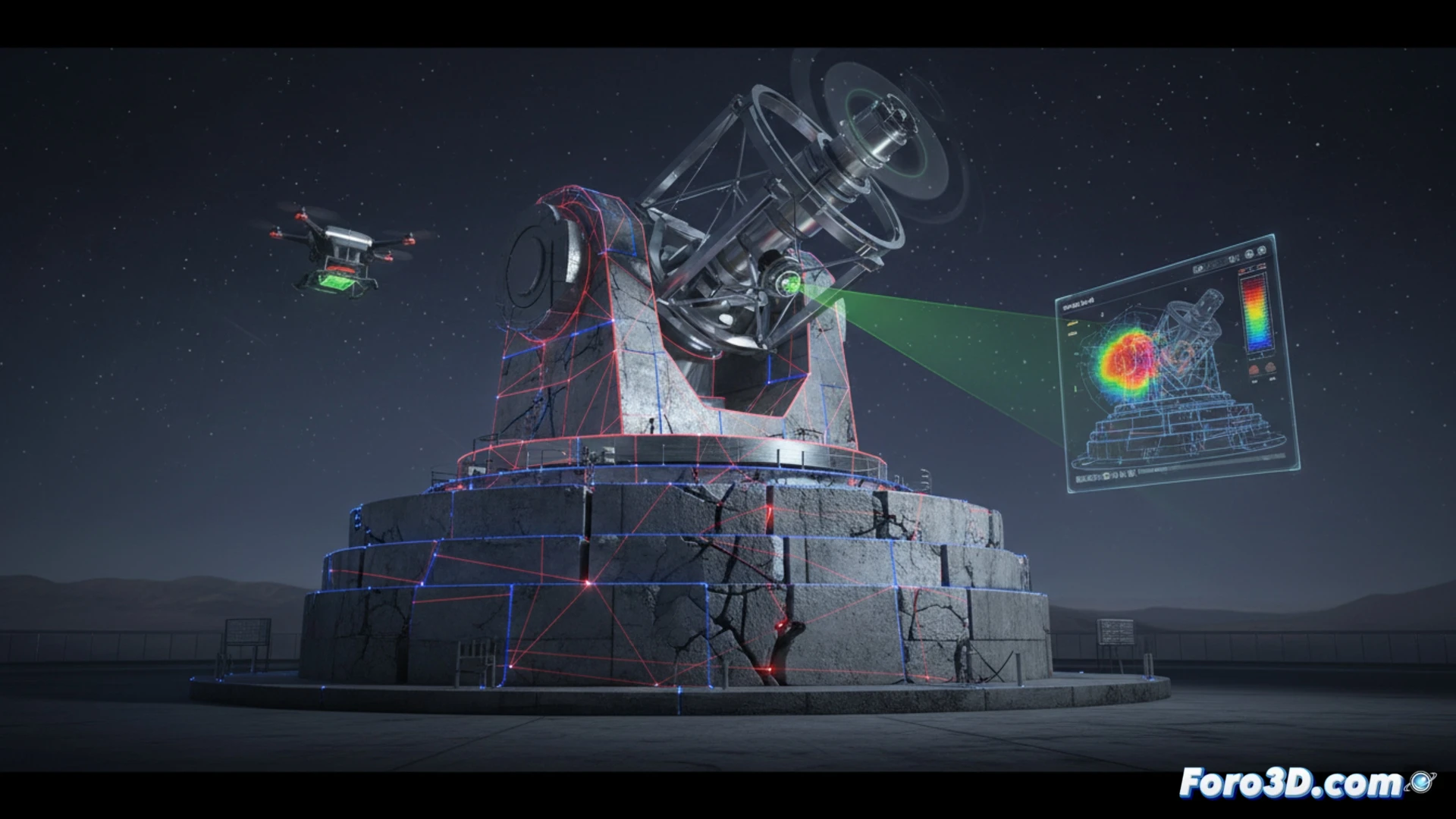
Technical workflow: from point cloud to FEM analysis 🔧
The process began with capturing the geometry using high-precision laser scanning. The resulting point clouds were processed in Trimble RealWorks to align the temporary scans and filter out environmental noise. Subsequently, CloudCompare allowed calculating the differences between successive scans, revealing displacements of up to 0.2 mm in the anchor zone. These vector data were exported to SAP2000, where the behavior of the concrete under cyclic loads was modeled. The finite element analysis confirmed that the accumulated fatigue had exceeded the material's yield limit, generating microcracks that altered the support's stiffness. Finally, NVIDIA Omniverse integrated the structural simulation results with the original point cloud, generating a 4D visualization showing the evolution of deformation over time.
Implications for predictive maintenance of infrastructure 🏗️
This case demonstrates that the combination of temporary laser scanning and finite element software is not only viable for astronomy but establishes a replicable protocol for any critical infrastructure subjected to constant vibrations. Early detection of micro-displacements due to concrete fatigue allows scheduling interventions before a catastrophic failure occurs. Tools like SAP2000 and Omniverse transform point cloud data into predictive models, turning material fatigue simulation into a cornerstone of proactive maintenance in civil and industrial engineering.
Is it possible to correlate the micrometric variations in concrete topography, captured via 3D laser scanning, with the history of cyclic loads to predict the exact point of fatigue crack initiation in the base of the primary mirror support?
(PS: Material fatigue is like yours after 10 hours of simulation.)