The catastrophic failure of a loading arm on a methane logistics rover has tested the capabilities of digital forensic analysis. The part, subjected to repetitive stress cycles, presented a clean fracture that did not correspond to a single overload event. The engineering team employed a multidisciplinary workflow to determine whether the cause was classic fatigue or a vibrational resonance phenomenon amplified by the arm's natural frequency.
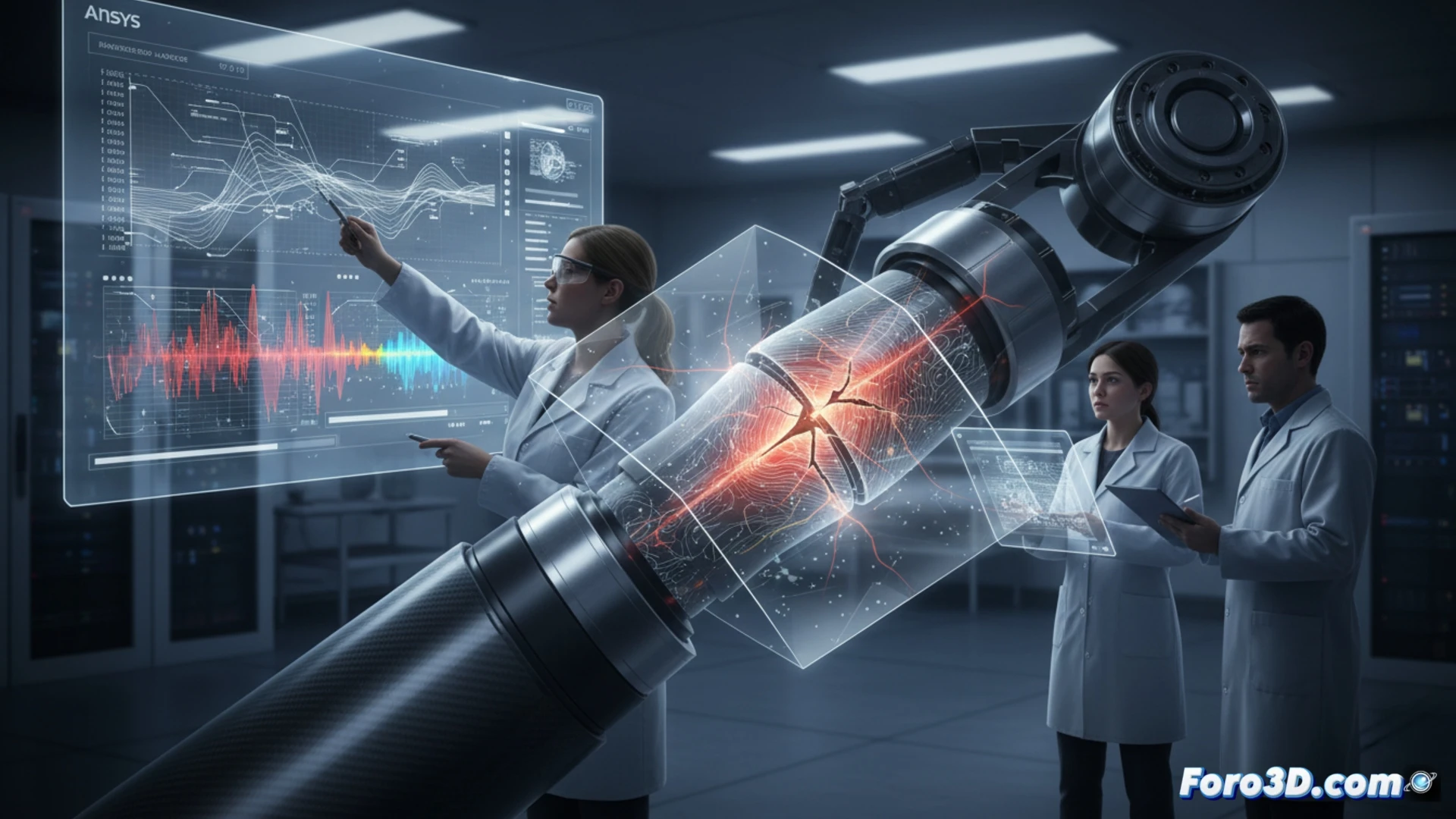
Forensic workflow: from scanning to modal simulation 🔍
The process began with scanning the fracture surface using Creaform VXelements. This equipment captured the micro-topography with micron precision, generating a high-density mesh that revealed the propagation striations and beach marks characteristic of fatigue. However, the presence of a wavy, uniformly spaced pattern in the initiation zone suggested external excitation. To validate this, the complete arm geometry was imported into Ansys, where a fatigue analysis combined with a harmonic modal study was executed. The results showed that the operating frequency of the methane motor coincided with the second vibration mode of the arm, generating a resonance state that accelerated crack growth. Finally, VGSTUDIO MAX was used to perform a volumetric inspection of the rest of the arm, detecting internal micro-cracks not visible on the surface that confirmed the resonant fatigue failure pattern.
The silent lesson of broken surfaces ⚙️
Beyond finding the culprit, this case demonstrates that the micro-topography of a fracture is an indelible mechanical record. The combination of high-precision 3D scanning with finite element simulation allows engineers to read the failure history. In the design of future robotic arms for extreme environments, this forensic methodology becomes indispensable to prevent a part's natural frequency from becoming its death sentence.
In the digital forensic analysis of the resonance fracture of the methane logistics rover's robotic arm, which 3D simulation methodology allowed for the most precise identification of the critical excitation frequency that triggered the catastrophic failure?
(PS: Material fatigue is like yours after 10 hours of simulation.)