During a magnetic field test on a prototype fusion reactor, a Niobium-Tin coil suffered a catastrophic short circuit. The failure was not electrical, but mechanical: the Lorentz force deformed the winding until the ceramic insulation fractured. A 3D pipeline, integrating CST Studio Suite, Siemens NX, and COMSOL, allowed reconstructing the fatigue cycle that led to the collapse of the superconductor.
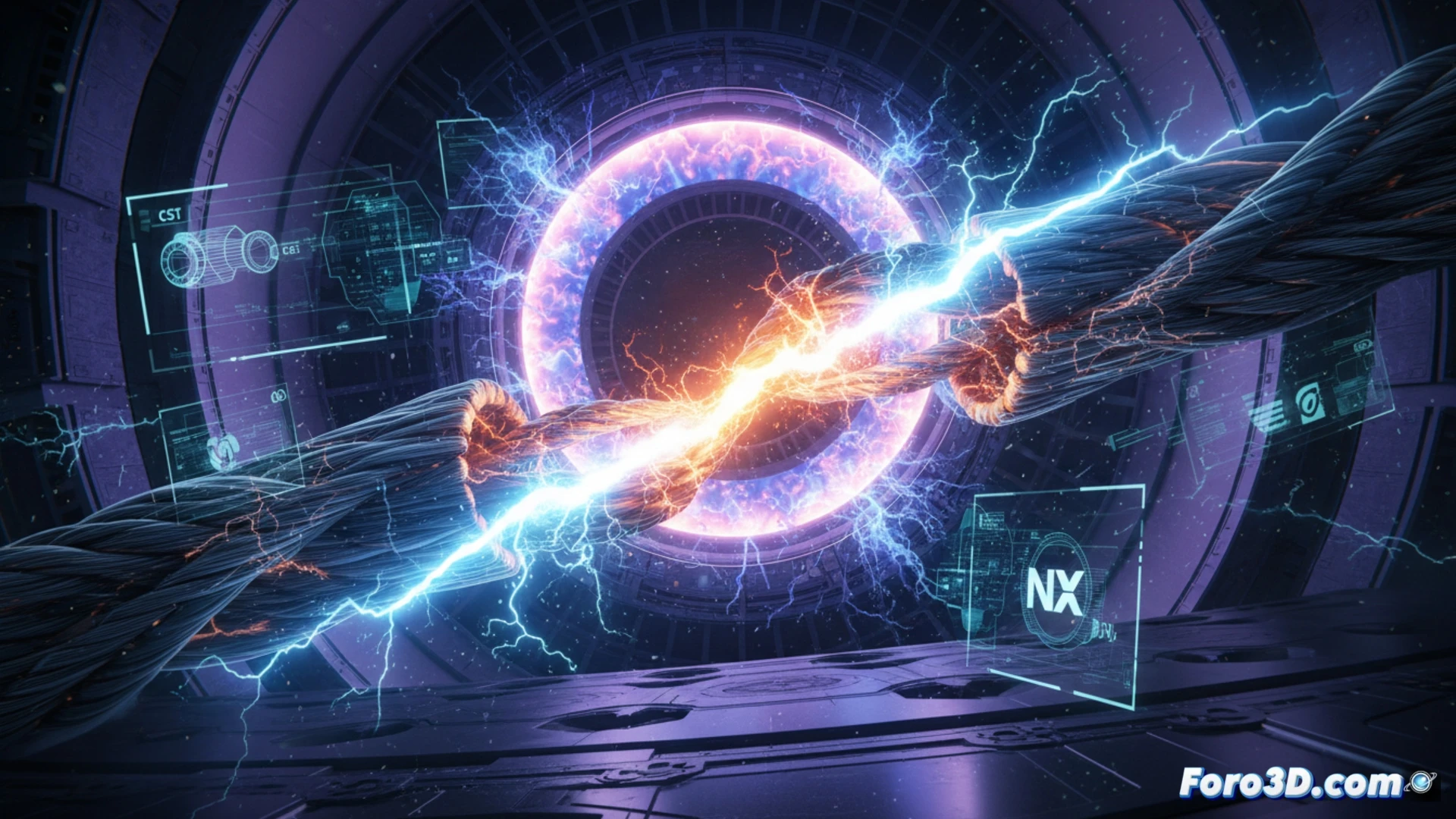
3D Pipeline: from electromagnetic force to ceramic insulation fracture ⚡
The analysis began in CST Studio Suite, where the magnetic field distribution was simulated and the Lorentz forces acting on each winding strand were calculated. This data was transferred to Siemens NX to model the actual geometry of the winding, including microscopic imperfections in the insulation. Finally, COMSOL executed a multiphysics analysis that coupled cyclic mechanical stress with the degradation of the ceramic material. The simulation visualized how, after 1,200 load cycles, microcracks in the niobium-tin matrix propagated, causing a localized short circuit and subsequent conductor melting.
The lesson for fusion reactors: simulate fatigue before building 🔧
This case demonstrates that the viability of fusion reactors depends not only on plasma physics, but on the mechanical strength of its components. The 3D pipeline revealed that the original design underestimated stress concentration in the winding curves. Without this fatigue analysis, the failure would have been unpredictable until the actual test. The industry now demands integrating these simulations into the design phase to prevent a superconducting coil from becoming the weak link in the energy of the future.
What predictive modeling strategies allow anticipating the exact initiation point of a fatigue crack in Nb3Sn superconducting coils during electromagnetic load cycles in fusion reactors
(PS: Material fatigue is like yours after 10 hours of simulation.)