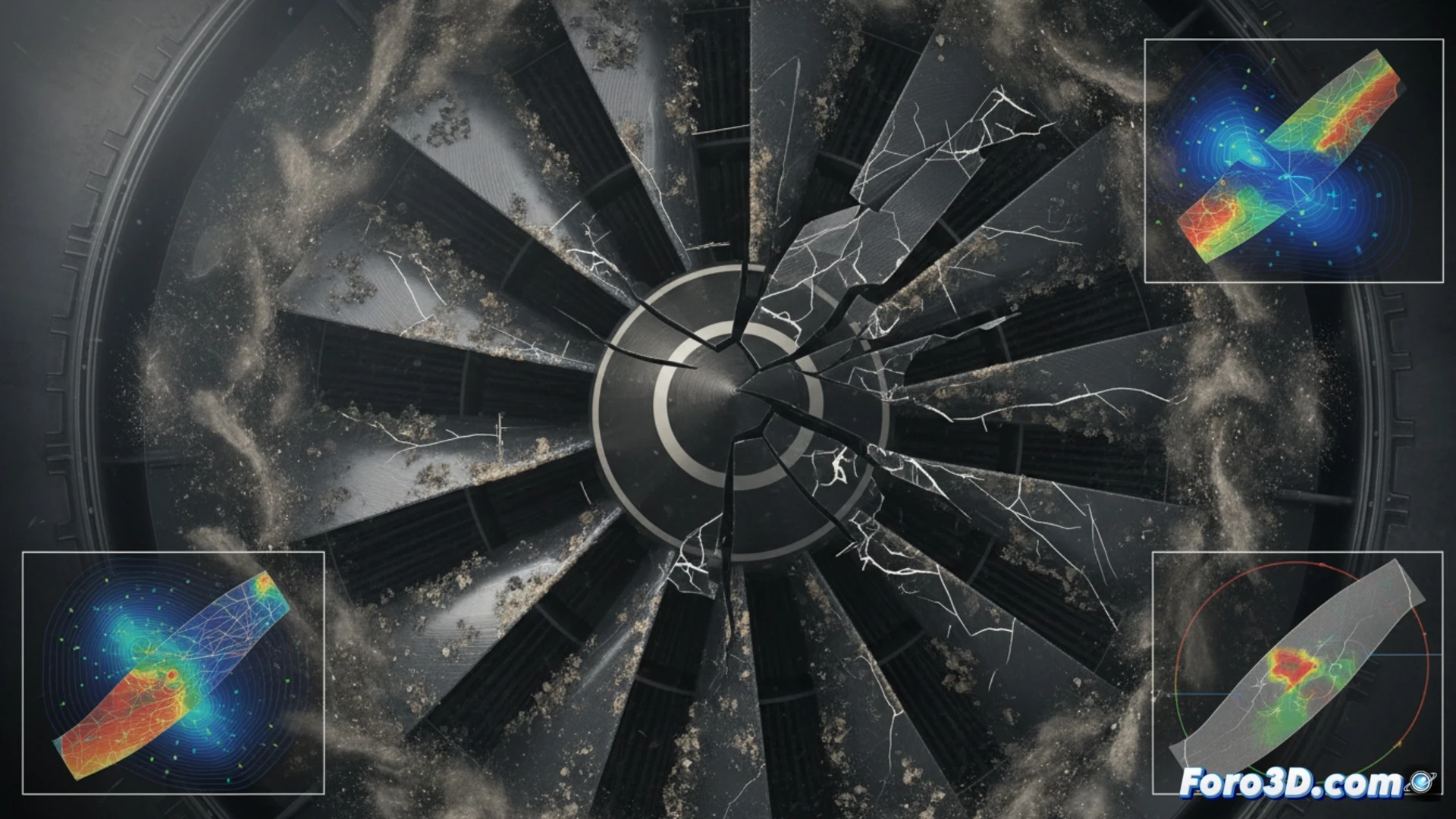
The recent collapse of a Direct Air Capture (DAC) turbine has brought to light a silent problem in composite materials engineering. A giant fan, designed to move huge volumes of air and extract CO2, burst during operation. The cause, according to initial reports, points to a mass imbalance induced by the accumulation of atmospheric pollutants on the surface of the blades. This incident is not a simple mechanical failure; it is a lesson on how the operating environment can degrade the structural integrity of critical components.
3D forensic analysis: from metrology to fatigue simulation 🔍
The investigation process relied on a precise digital workflow. First, GOM Inspect was used to scan the blade fragments and compare them with the original CAD model from Siemens NX, revealing plastic deformations and corrosion zones. Subsequently, this data was imported into Ansys Fluent for a detailed CFD analysis. The simulation showed that the accumulation of particles, such as salts and fine dust, created an asymmetric mass imbalance at the blade tip. This imbalance generated harmonic vibrations that, coinciding with the composite's natural frequency, initiated a fatigue crack in the area of highest stress concentration, precisely at the blade's junction with the central hub.
Lessons for design: composite is not immune to the environment ⚙️
Using Blender to generate the collapse animation allowed visualizing the crack progression in slow motion, confirming that the failure was not instantaneous but progressive. The main conclusion is that traditional fatigue models, based solely on aerodynamic loads, are insufficient. It is necessary to incorporate variables such as the pollutant deposition rate and its impact on blade mass. For future DAC turbine designs, it is recommended to integrate vibration sensors and a real-time mass monitoring system, as well as non-stick coatings that minimize particle accumulation. Fatigue in composites depends not only on the load cycle but also on the dust carried by the air.
How can current fatigue simulation models for composite materials predict catastrophic failures like that of the DAC fan if they do not adequately consider microcracks induced by cyclic loads under variable temperature conditions?
(PS: Material fatigue is like yours after 10 hours of simulation.)