The programmatic collapse of a retractable roof is not always structural; sometimes it is a millimeter misalignment in motion control. After the collision of the two halves of a 500-ton roof during an event, the forensic analysis focused on the synchronization of the servomotors. The 3D reconstruction using laser scanning with FARO Scene and the mechanism simulation in Siemens NX revealed that accumulated fatigue in the guide rails, combined with a software error, generated an imperceptible but lethal asymmetry in the advance.
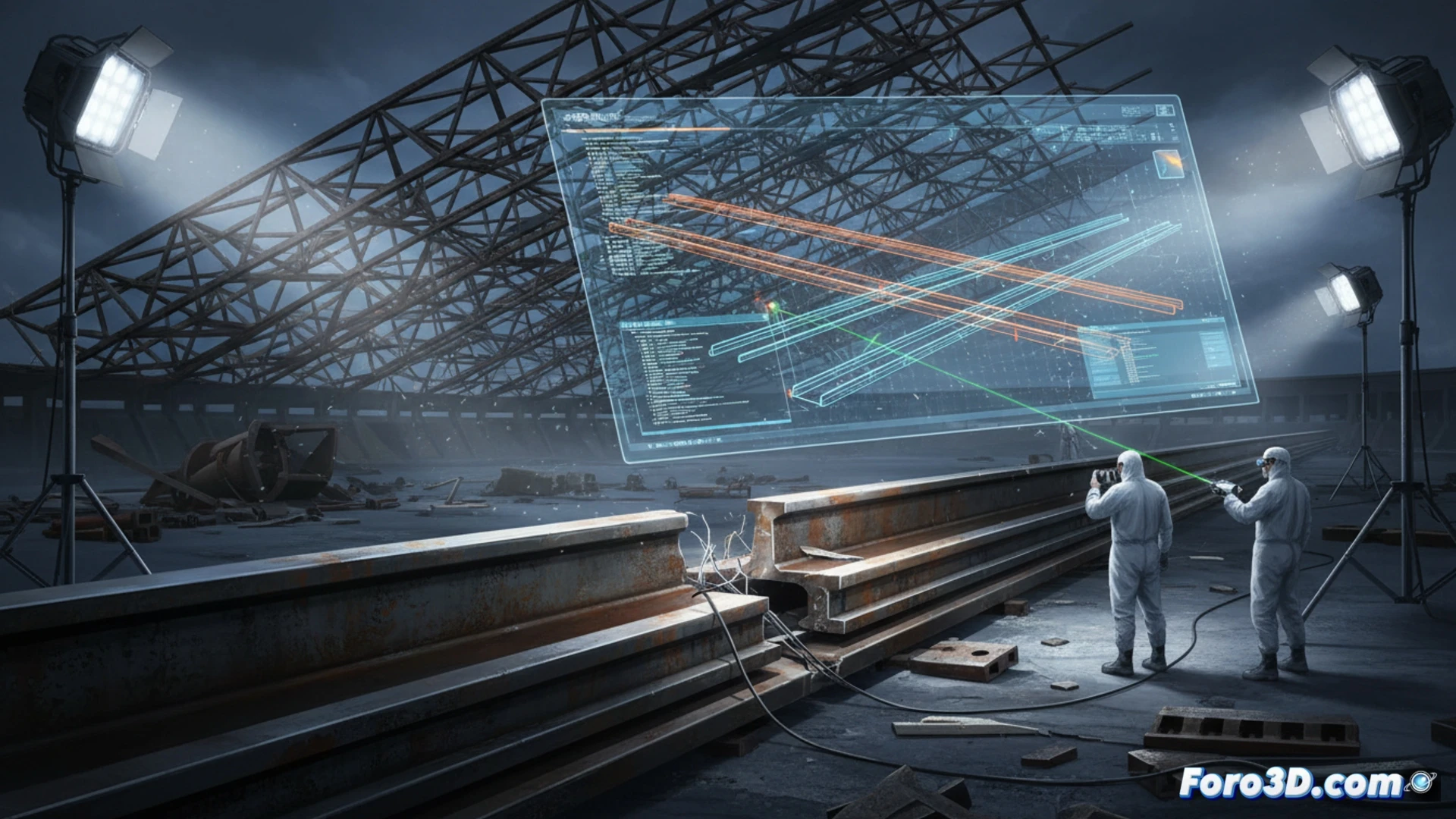
3D Reconstruction and Mechanism Simulation: The Autopsy of Motion 🔧
The forensic process began with high-density scanning of the steel rails using FARO Scene. The resulting point cloud was imported into Siemens NX to build an exact digital twin of the structure. The mechanism simulation allowed recreating the opening and closing cycle, applying real load conditions. The results indicated a plastic micro-deformation in the rails, detected by the millimeter difference between the original CAD model and the scanned one. This deformation, a product of cyclic fatigue, altered the friction coefficient unevenly on each side, causing one servomotor to advance 3.2 mm more than the other. In SAP2000, it was validated that the 500-ton load, by not being distributed symmetrically, generated a torsional moment that exceeded the elastic limit of the guide supports.
The Millimeter as a Safety Limit in Critical Infrastructure ⚠️
This case demonstrates that material fatigue simulation is not a theoretical luxury, but an operational necessity. The error was not a catastrophic material failure, but the accumulation of micro-deviations that the control software could not compensate for because its algorithm did not account for the mechanical degradation of the rails. The lesson is clear: critical infrastructure requires continuous monitoring through 3D scanning and periodic fatigue simulations to update control parameters. The millimeter difference was not a manufacturing error; it was the silent sum of thousands of stress cycles that no standard algorithm could predict.
Is it possible to predict and correct a millimeter misalignment in the actuators of a 500-ton retractable roof through multiaxial fatigue simulation before it manifests as a programmatic structural failure?
(PS: Material fatigue is like yours after 10 hours of simulation.)