The catastrophic failure at a water treatment plant, which discharged tons of microplastics into the river, has been attributed to a defect in the backwash system of the ultrafiltration membranes. Forensic analyses, conducted using CFD simulations and 3D photogrammetry, revealed that pressure spikes uncontrolled by the PLC valves induced accelerated fatigue in the polymeric material, causing microscopic cracks that led to a massive failure of the filtration system.
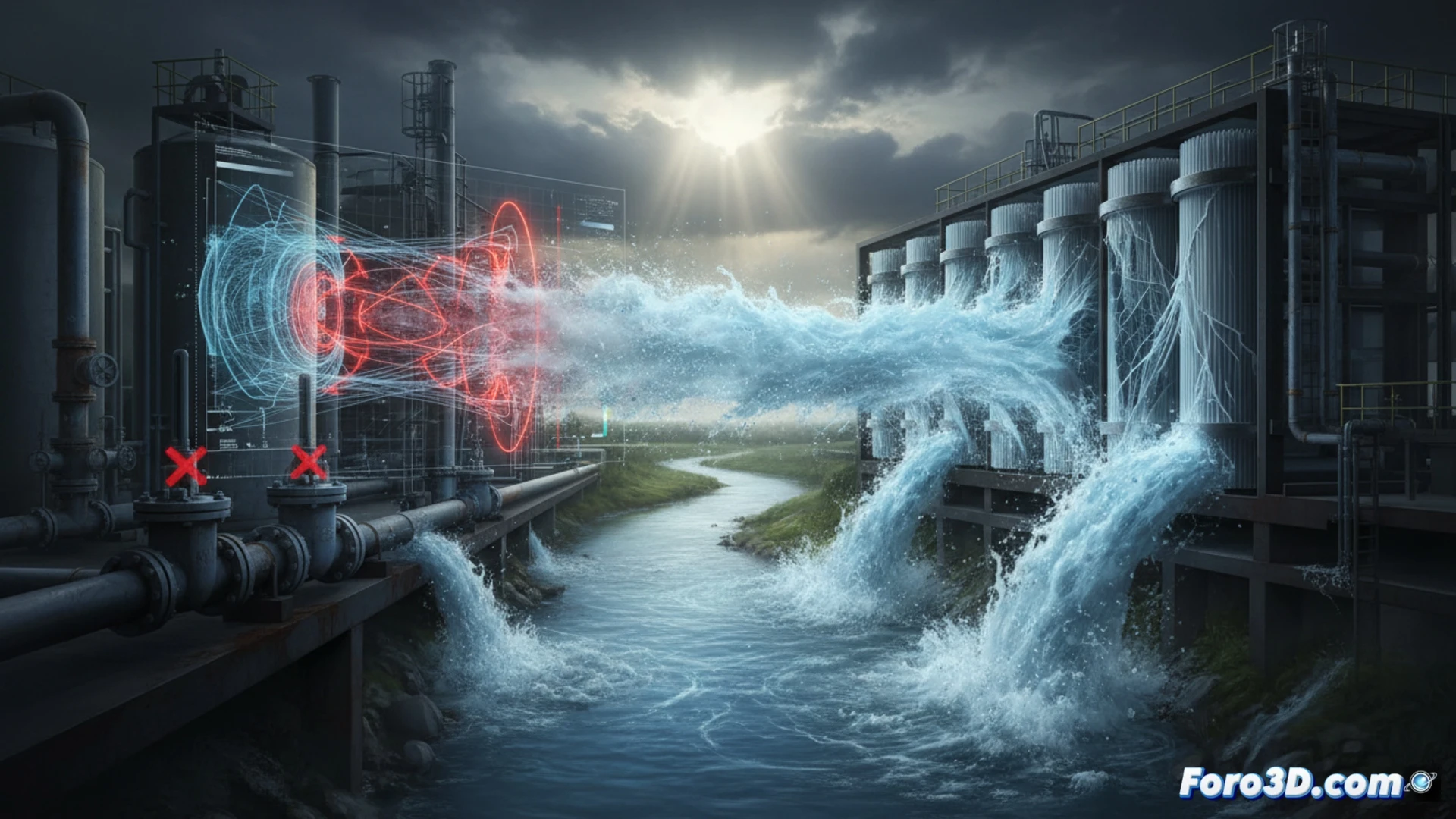
Multiphase simulation and accumulated stress mapping 🧠
The engineering team used Star-CCM+ to model the water-air multiphase flow during the reverse backwash cycle. The simulations identified transient pressure waves that exceeded the membrane design limit by 40%, generated by the synchronous opening of defective PLC valves. This data was imported into Autodesk CFD for a detailed structural analysis, where accumulated von Mises stress maps were calculated over 10,000 cycles. The results showed a stress concentration at the anchor points of the hollow fibers, exactly coinciding with the fractures observed in the physical membranes, digitally reconstructed using RealityCapture.
Lessons for control system design 🔧
The root of the problem was not the material, but the control logic. The pressure spikes originated from a delay in the signal from the PLC valves, which failed to dampen the water hammer. The proposed solution integrates a digital twin model that, through real-time simulation with Star-CCM+, dynamically adjusts the valve opening curves. This not only prevents fatigue but also optimizes the system's energy consumption, demonstrating that 3D simulation is the ultimate tool for failure engineering in critical infrastructure.
Considering that the failure originated from an undetected manufacturing defect, which finite element fatigue simulation methodology would be most effective for predicting crack nucleation in polymeric membranes subjected to cyclic hydraulic pressure spikes, where the initial defect is modeled as a submillimeter notch?
(PS: Material fatigue is like yours after 10 hours of simulation.)