The trade of a floor tile layer involves physical and mechanical risks that often go unnoticed until they materialize in injuries or tool failures. Cuts from tiles, forced postures of the knees and back, falls on wet floors, and constant exposure to cement dust and adhesives not only affect the worker but also the integrity of the materials they handle. From the perspective of material fatigue simulation, each tile, each trowel, and each repetitive load tells a story of degradation that deserves to be analyzed in 3D environments.
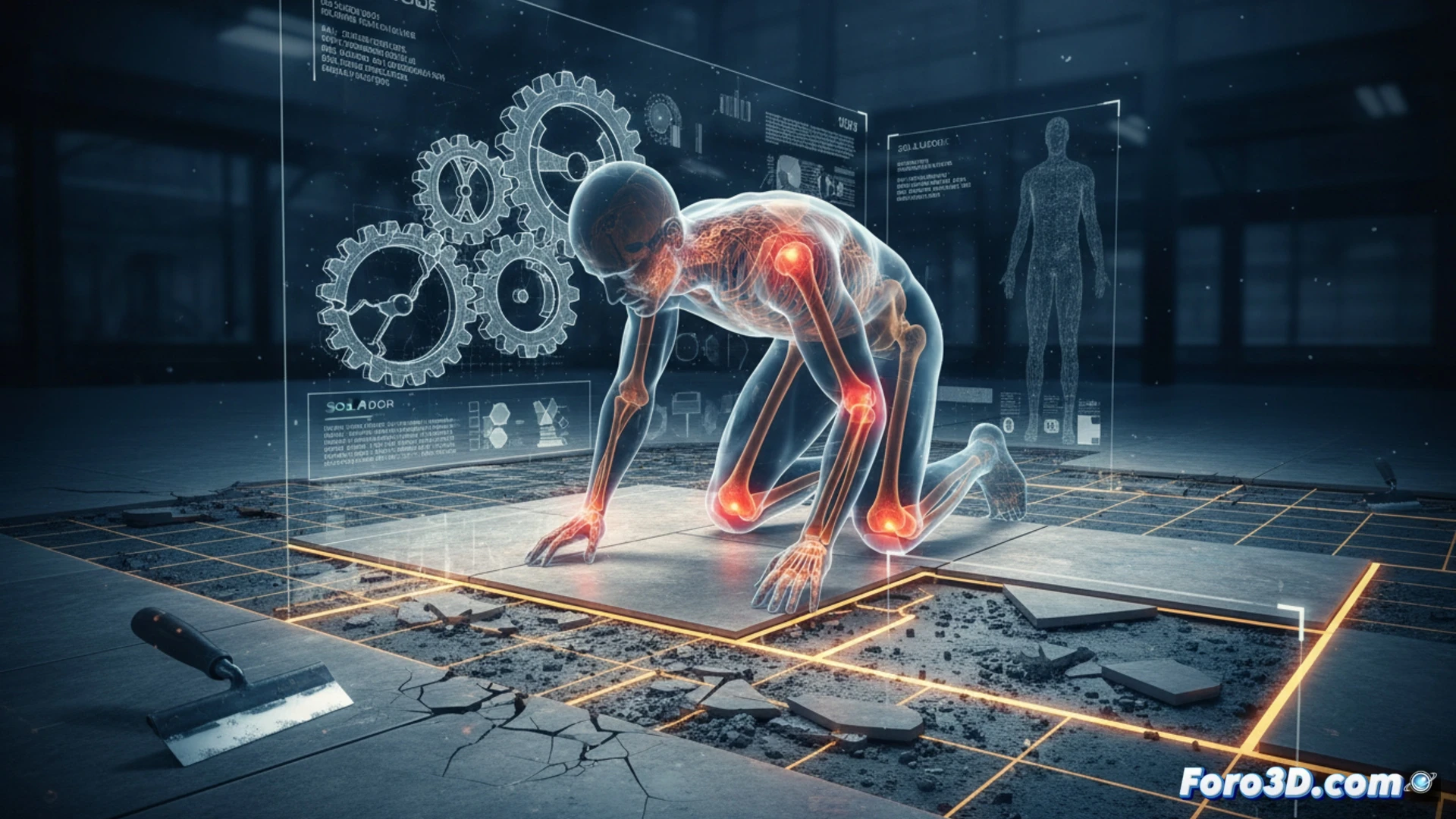
Simulation of stresses in tools and ceramic surfaces 🛠️
When modeling in 3D software the behavior of a tile cutter subjected to repetitive cycles of pressure and cutting, it is observed how the blade edge undergoes micro-deformations that accelerate its wear. Similarly, cement adhesives, when modeled as viscoelastic materials, show a progressive loss of cohesion under constant compressive and vibration loads. Tiles, for their part, exhibit cracking patterns that begin at the edges and propagate towards the center when the forced postures of the tile layer are simulated, generating points of localized stress that replicate real installation conditions. These visualizations make it possible to predict failures before they occur on site.
Biomechanics and fatigue: the link between the body and materials 🧍♂️
The simulation should not be limited to inanimate objects. By integrating biomechanical models of the knees and back into the 3D environment, it is revealed how the forced postures of the tile layer generate asymmetric loads on tools and tiles. For example, when simulating prolonged kneeling, the pressure on the tile increases by 40% at the support edge, doubling the risk of fatigue fracture. This approach demonstrates that occupational safety and material durability are two sides of the same coin, and that anticipating fatigue from virtual design can reduce accidents and replacement costs.
How can 3D simulation of material fatigue in the tools and postures of the tile layer predict and prevent occupational injuries before they manifest?
(PS: Material fatigue is like yours after 10 hours of simulation.)