The collapse of a telecommunications mast due to rime ice accumulation is not a sudden failure, but the culmination of a fatigue process induced by asymmetric loads. The combination of non-uniform ice and wind gusts generates cyclic stresses that degrade the steel until fracture. This article analyzes how MecaStack and SAP2000 tools allow modeling this phenomenon, offering structural engineers a predictive approach to prevent accidents in extreme climates.
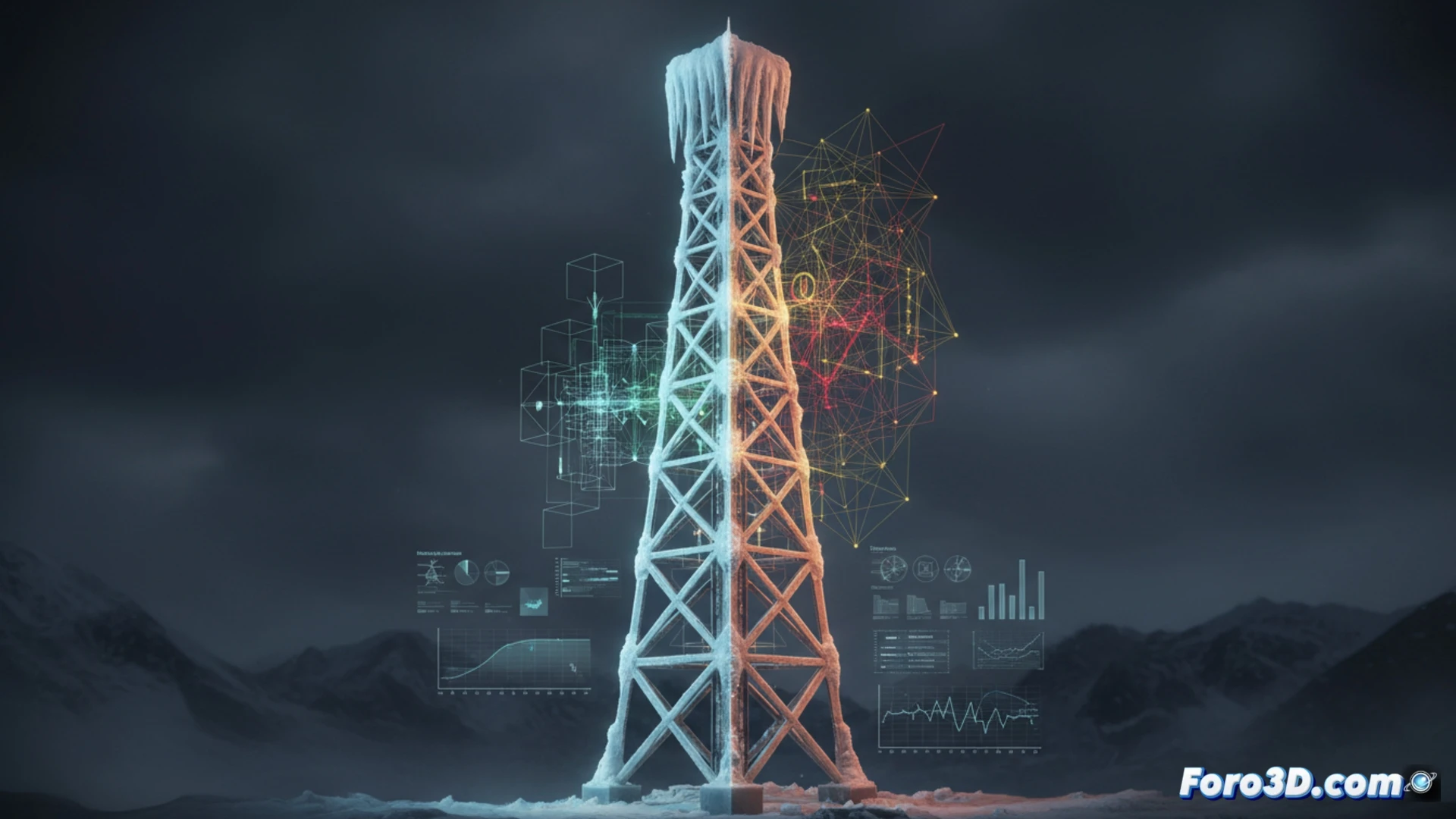
BIM workflow: from Tekla Structures to dynamic analysis 🏗️
The process begins in Tekla Structures, where the mast is modeled with geometric precision and details of bolted connections. This BIM model is exported to MecaStack, which calculates the asymmetric distribution of rime ice considering wind direction and structure rotation. Subsequently, SAP2000 receives the resulting loads to perform a non-linear dynamic analysis. The key is to simulate the partial shedding of ice, which causes a mass imbalance and generates time-varying bending moments. This phenomenon, difficult to capture without a detailed BIM model, is the main trigger for fatigue in base welds.
Lessons for design against climatic fatigue ⚡
The simulation reveals that the critical point is not the maximum ice load, but the frequency of stress cycles during mixed ice and wind storms. Engineers must reconsider traditional safety factors, as rime ice fatigue accelerates crack propagation in stress concentration zones. Incorporating fatigue analysis in MecaStack and SAP2000, complemented by Tekla Structures visualization, allows designing masts with greater resistance to degradation. The lesson is clear: fatigue simulation must be integrated from the conceptual phase of the project, not as a final verification.
What modeling strategies in MecaStack and SAP2000 allow for more precise differentiation between damage from cyclic wind fatigue and that caused by progressive rime ice accumulation in telecommunications masts?
(PS: Material fatigue is like yours after 10 hours of simulation.)