The trade of bricklaying exposes workers to constant mechanical and physical risks: falls from scaffolding, overexertion from heavy loads, and vibrations from pneumatic hammers. These repetitive forces not only affect the human body but also progressively degrade metal structures. Through material fatigue simulation, we can model in 3D how scaffolding deteriorates under cyclic stress, identifying critical failure points before an accident occurs.
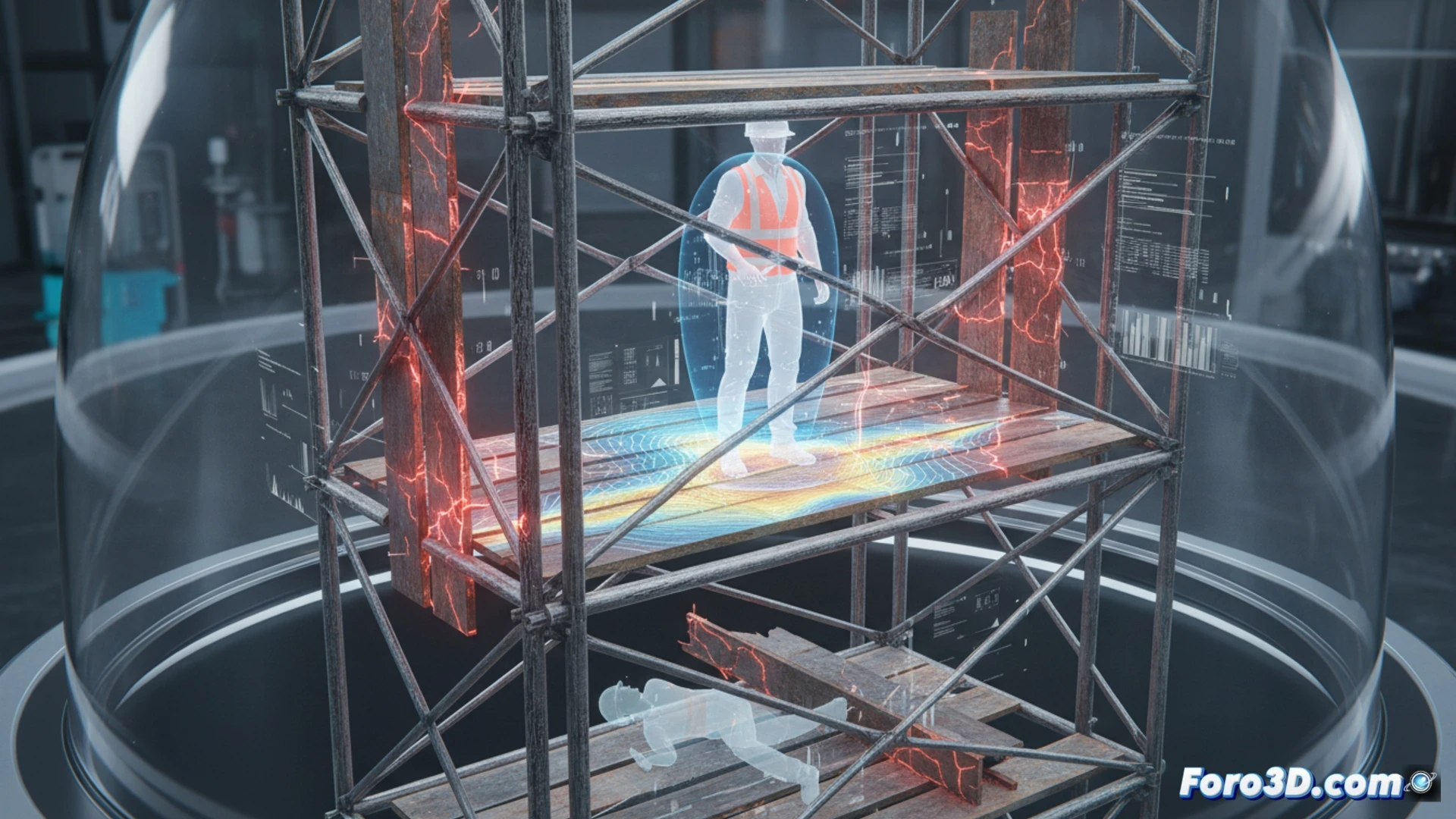
3D Modeling of Cyclic Loads and Vibrations in Metal Structures 🔧
To visualize degradation, a digital twin of the scaffolding is built, where variable loads are applied that mimic the weight of materials, the impact of tools, and the vibrations of pneumatic hammers. Finite element software allows calculating the accumulated stress in joints and supports. By simulating hundreds of cycles, it is observed how the metal suffers microcracks that propagate, especially in weld zones. Additionally, the abrasive effect of silica dust is incorporated, modeling how these particles accelerate wear in joints and bearings, reducing the equipment's service life.
Visual Prevention: Safety Thresholds between New and Deteriorated Scaffolding ⚠️
The final comparative animation shows a new scaffolding and one with advanced fatigue simulation in parallel. The deteriorated model exhibits visible deformations and red zones indicating critical stress, while the new one remains within safe ranges (green). This graphical representation allows prevention technicians to establish component replacement thresholds and schedule inspections, transforming abstract fatigue data into a clear visual warning to avoid structural collapses.
How can 3D material fatigue simulation predict the exact failure point in a tubular scaffolding before an accident occurs.
(PS: Material fatigue is like yours after 10 hours of simulation.)