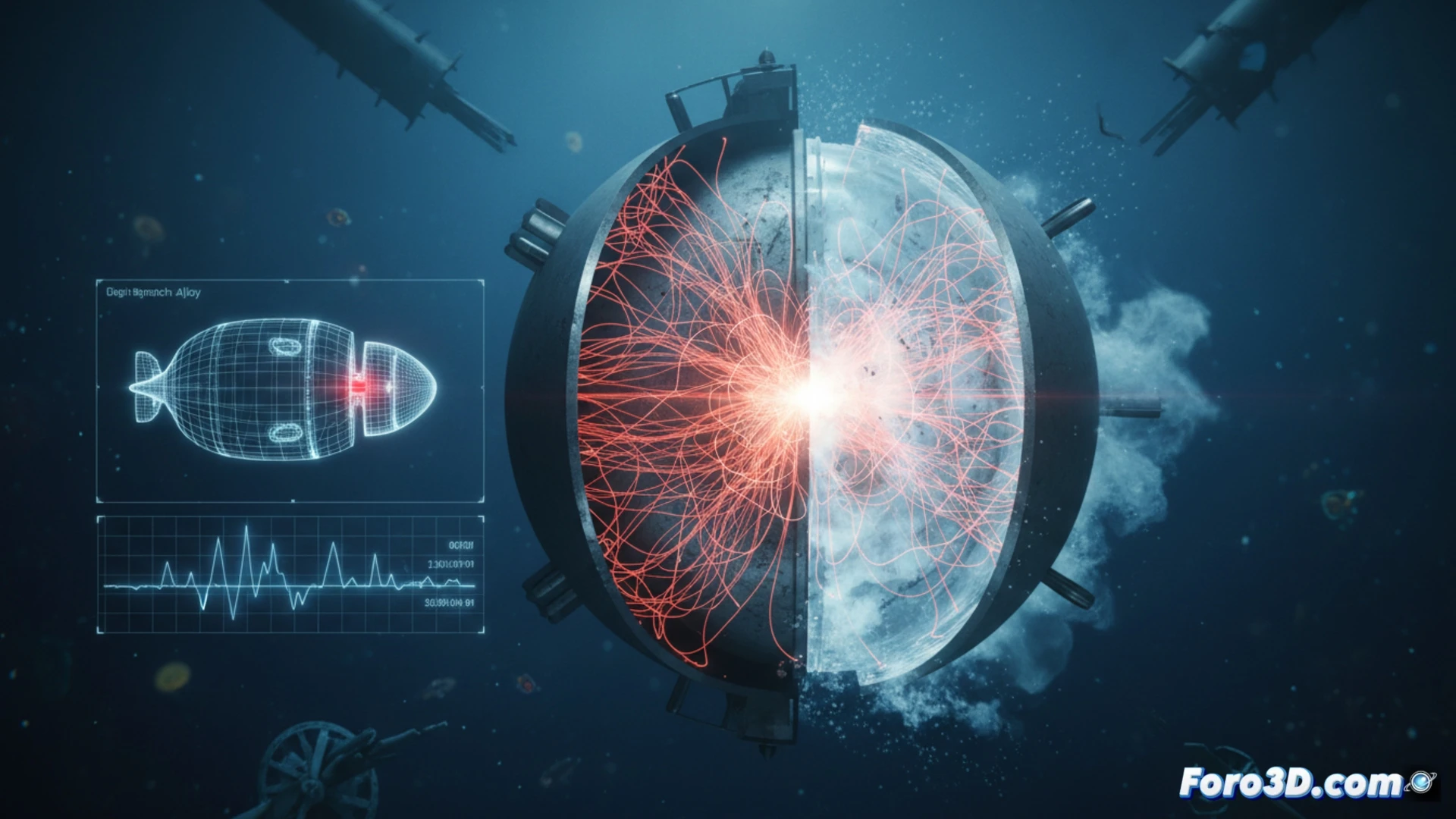
The tragedy of the deep-sea exploration submersible left a puzzle of titanium and acrylic fragments scattered on the seabed. Far from being an end, this marked the beginning of a digital forensic investigation. Thanks to underwater photogrammetry and finite element analysis (FEA), engineers managed to virtually reconstruct the hull and isolate the root cause of the collapse: localized micro-fatigue at the heterogeneous material joint.
Forensic workflow: From debris to meshing in Ansys 🔍
The process began with ROVs equipped with high-resolution cameras capturing the wreckage. These images were processed in Agisoft Metashape to generate a dense point cloud of the fragmented hull. Subsequently, CloudCompare was used to align and clean the model, removing oceanic noise. The cleaned model was exported to Ansys Mechanical, where a refined tetrahedral mesh was generated. The simulation applied cyclic pressure loads equivalent to the submersible's previous dives. The result was an extreme stress concentration at the acrylic-titanium interface, exceeding the fatigue limit of the composite material. The microcrack, invisible to the naked eye, was revealed in the Von Mises stress gradient.
Lessons from the interface: The Achilles' heel of engineering ⚙️
This case demonstrates that material fatigue does not forgive dissimilar joints. The stiffness difference between acrylic and titanium created a cyclic stress concentration point that, over time, nucleated a catastrophic crack. Visualization in Blender allowed the failure to be presented clearly to the scientific community. The lesson is clear: in extreme environments, FEA simulation is not a luxury but a necessity to validate every design joint before the first dive.
Would you validate with destructive testing?