A competitive skier suffered a spiral tibial fracture after a fall where the bindings did not release. The failure, initially attributed to human error, was investigated using 3D scanning with the Artec Space Spider and biomechanical simulation in Madymo. The real cause was a microscopic defect in the internal spring, detected by Micro-CT, which prevented torsional release. This case demonstrates how material fatigue can compromise safety in high-performance equipment. 🎿
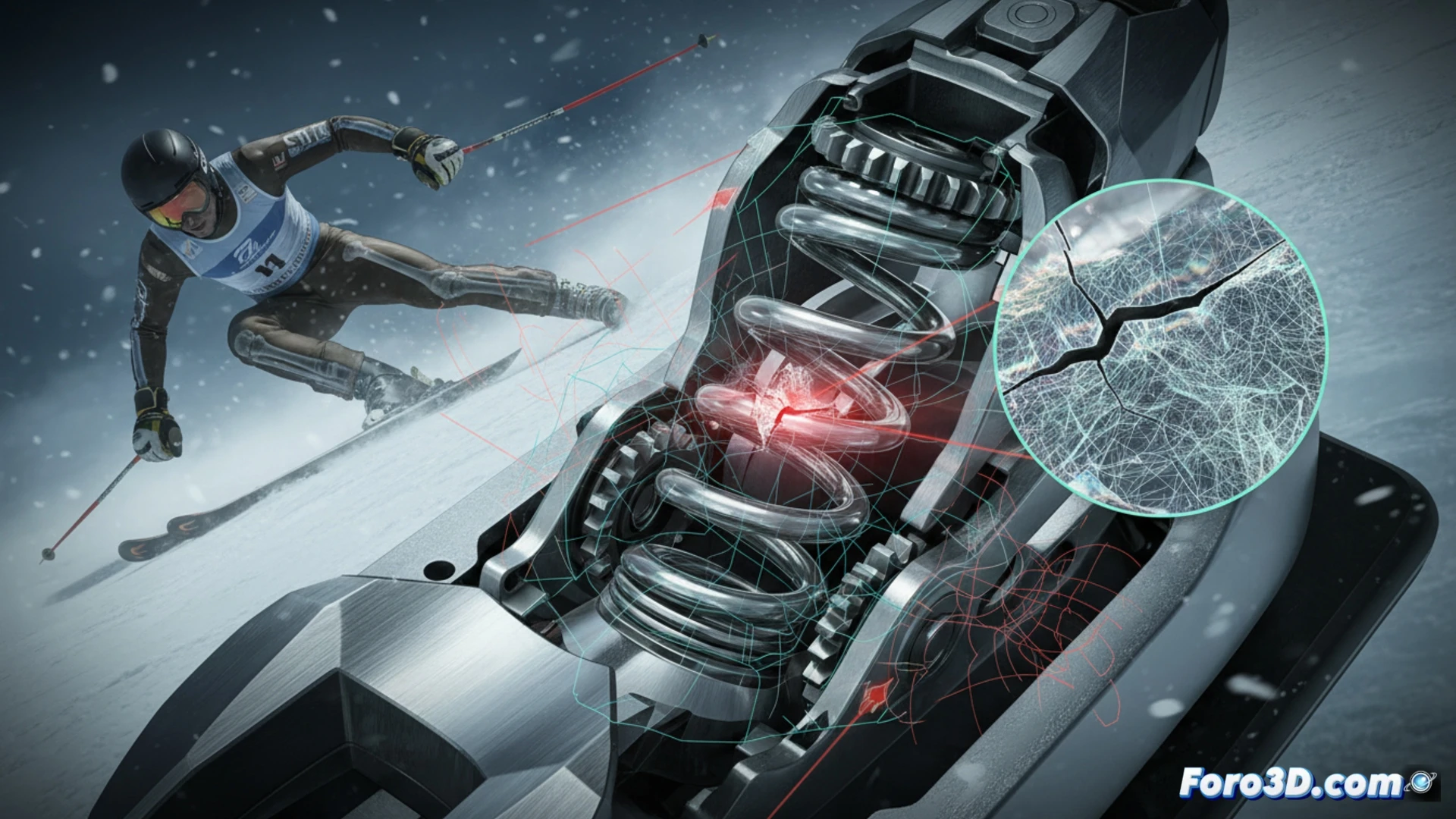
Recreation of Torsion Vectors with Ansys and OpenSim 🔧
The technical process combined high-precision scanning of the boot and binding to generate a digital twin. On this mesh, a finite element simulation was run in Ansys, modeling the spring's behavior under cyclic loads. OpenSim calculated the muscle and external force vectors during the fall, while Madymo recreated the impact kinematics. The results showed that at specific torsion angles (between 15 and 25 degrees), the defective spring exhibited anomalous stiffness, preventing lateral release and transferring all the energy to the tibia.
Lessons on Safety and Component Validation ⚠️
This incident underscores the need to integrate fatigue simulation into certification standards for sports equipment. A spring that appears functional in static tests can hide internal microcracks that are only detectable through Micro-CT and dynamic finite element analysis. Ansys's ability to predict failure points under repetitive torsional stress not only explains the accident but provides a critical tool for redesigning safer bindings, where release is predictable even after hundreds of use cycles.
Which design parameters in the release mechanism of a ski binding could be related to material fatigue and how could this failure be detected before an accident like the one described occurs?
(PS: Material fatigue is like yours after 10 hours of simulation.)