The promise of 6G communications hit a critical obstacle when a graphene antenna prototype failed in orbit. Forensic analysis using multibody simulation in MSC Adams and modeling in Siemens NX revealed that the material's extreme flexibility, far from being an advantage, generated localized fatigue in the ejection guides. This technical article breaks down how the viscoelastic behavior of graphene caused a catastrophic entanglement, offering vital lessons for advanced materials simulation. 🛰️
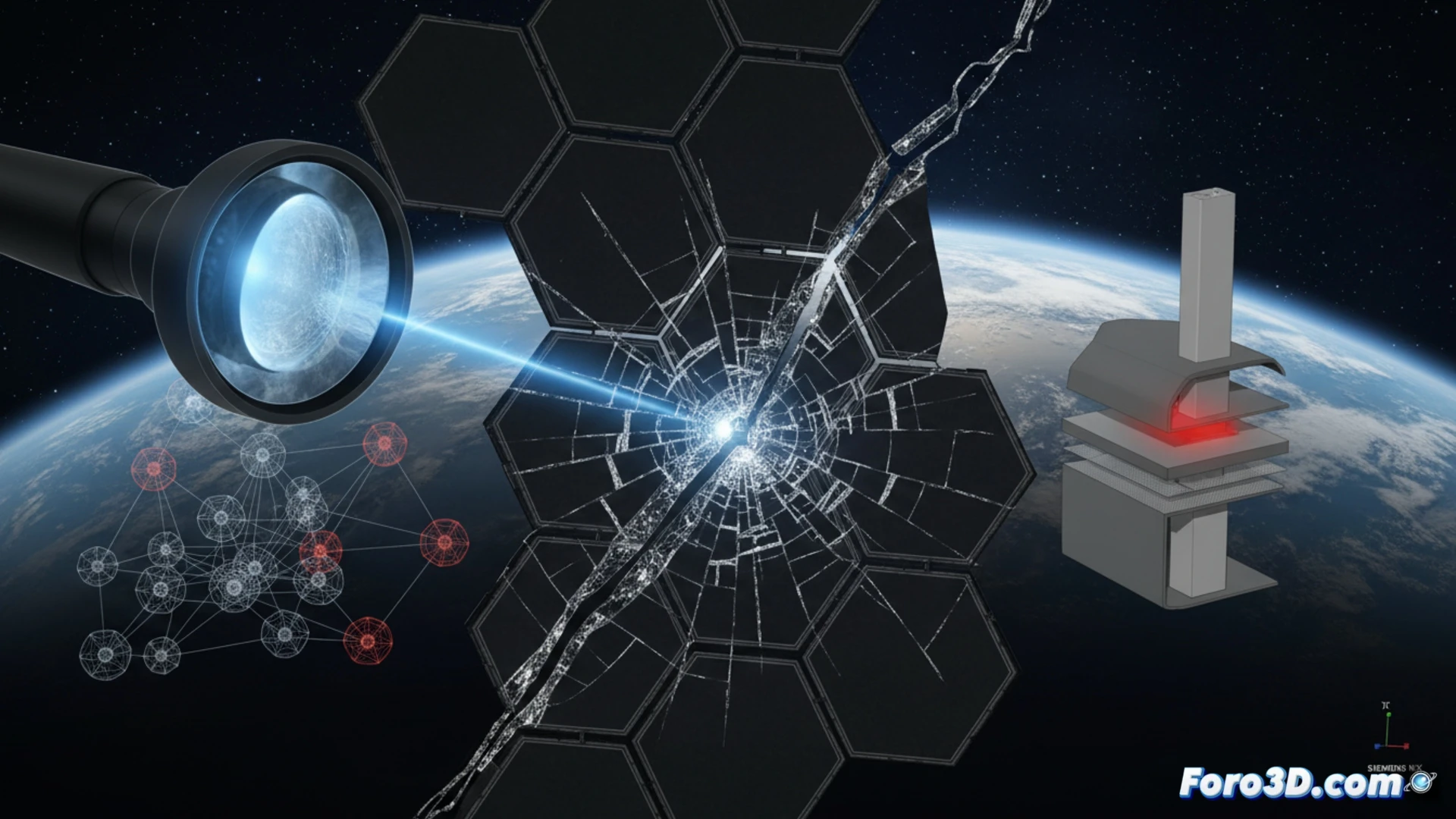
Modeling the Guide-Antenna Interaction in Siemens NX and MSC Adams 🔧
The 3D reconstruction of the deployment mechanism was carried out in Siemens NX, where the monatomic thickness of graphene was defined as a flexible body with nonlinear damping properties. When exporting the model to MSC Adams, frictional contacts were implemented between the ejection guides and the antenna surface. The results showed that, during ejection, the low bending stiffness of graphene allowed the antenna folds to vibrate out of phase with the guiding mechanism. Instead of sliding, the material undulated and snagged on the micrometric tolerances of the guides, generating cyclic stress peaks that exceeded the material's fatigue limit in less than three deployment cycles.
Lessons for Fatigue Simulation in 2D Materials 💡
This failure demonstrates that traditional fatigue simulations, designed for rigid materials like aluminum, are not transferable to graphene. The material's extreme flexibility requires contact models that consider elastic instability and localized buckling. For future designs, simulation in Adams must include virtual structural dampers and guiding topologies with larger curvature radii. The lesson is clear: in space, a material that is too flexible can be more dangerous than one that is too rigid.
What role does the orientation of graphene domains play in the nucleation of microcracks under thermomechanical cycles in orbital vacuum, and how does this failure mechanism differ from those observed in traditional metallic materials for space applications?
(PS: Material fatigue is like yours after 10 hours of simulation.)