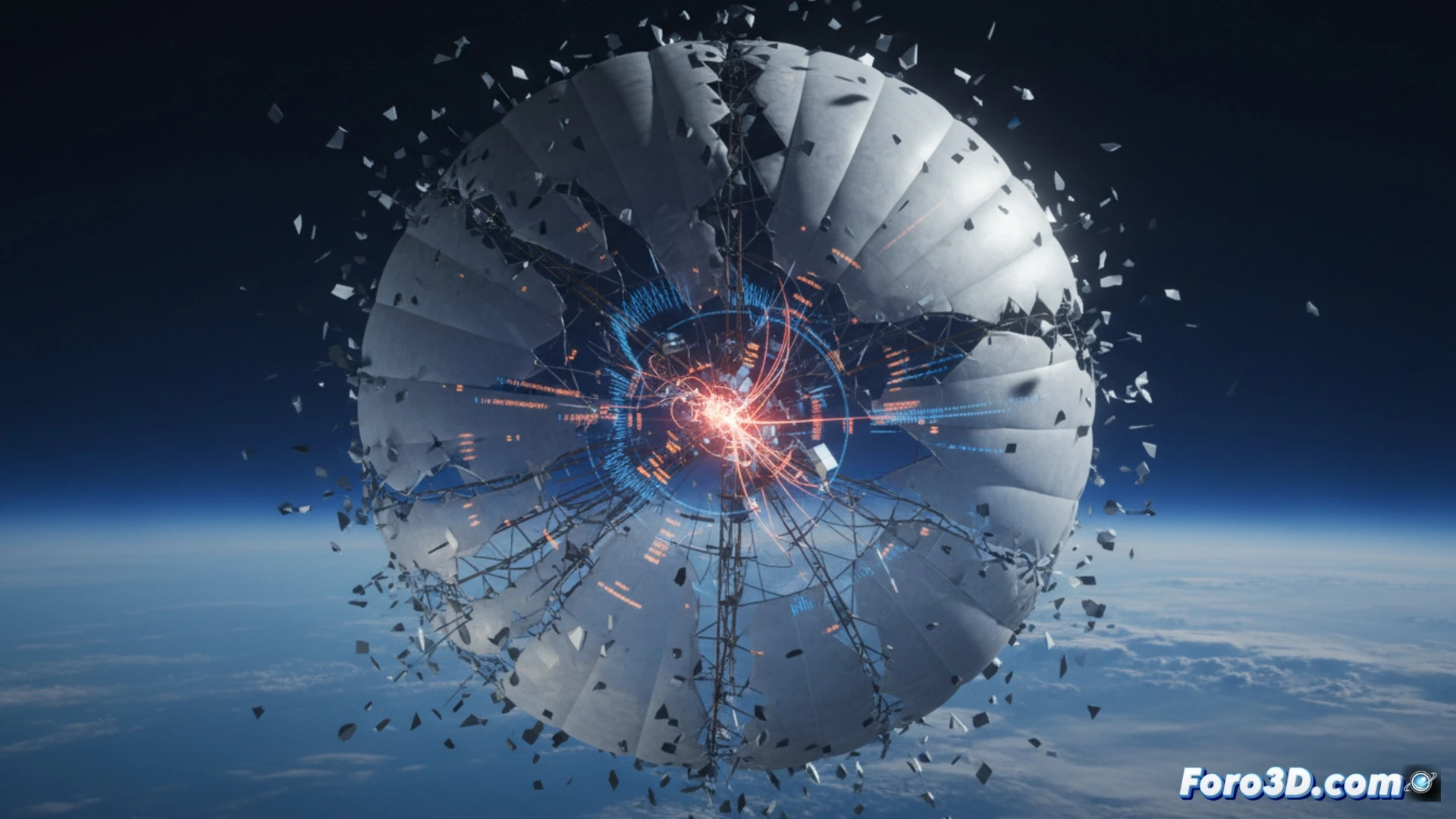
A telecommunications balloon operating at 20 km altitude collapsed catastrophically. The initial expert report pointed to a pressure failure, but 3D analysis revealed a more subtle cause: a micro-bend in the embedded optical fiber. This deformation generated a false pressure reading, leading the system to over-inflate beyond the membrane's strength. The digital reconstruction of the accident became a case study on material fatigue in extreme environments.
Forensic reconstruction: from debris to digital twin 🛰️
The forensic team used RealityCapture to digitize the scattered balloon debris, creating a precise high-resolution mesh. This point cloud was imported into Siemens NX to model the original membrane and embedded optical fiber sensors. In NX, material fatigue under cyclic stress conditions was simulated, correlating degradation with observed fracture patterns. In parallel, sensor signals were processed in MATLAB, where spectral analysis identified an anomalous pattern of localized optical attenuation. This pattern confirmed the presence of the micro-bend, a microscopic inflection point that distorted the internal pressure measurement, triggering the failure.
Lessons from a microscopic failure with stratospheric consequences 🔍
The case demonstrates that fatigue simulation should not only focus on the structural material but also on the integrity of embedded sensors. A micro-bend, imperceptible to the naked eye, was the critical point that led to a total collapse. For the 3D simulation industry, this accident underscores the need to model the interaction between the sensor and the host material, integrating optical signal analysis as an additional parameter in fatigue studies. The boundary between sensor failure and structural failure is thinner than commonly believed.
How they simulated in the lab the micro-bend cycle that generated the catastrophic failure in the balloon's optical fiber at 20 km altitude
(PS: Material fatigue is like yours after 10 hours of simulation.)