On March 14, a training hyperbaric chamber collapsed during an orbital ascent simulation. Although there were no casualties, the implosion destroyed two quartz viewports and deformed the Viton rubber sealing ring. The forensic team used 3D reconstruction to determine whether a microscopic defect in the Viton was the starting point of the catastrophic failure.
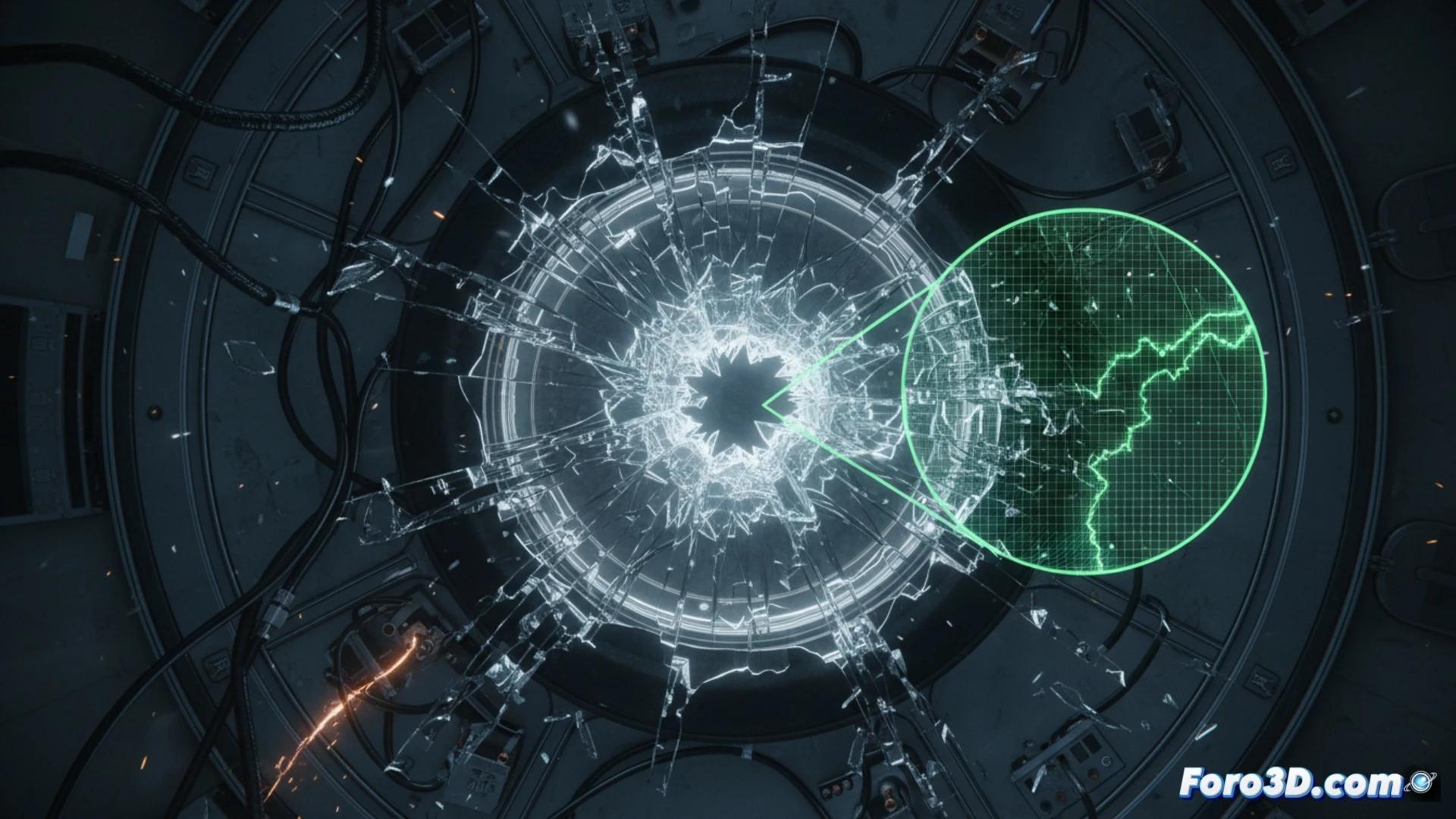
Forensic workflow: from point cloud to finite element simulation 🔍
The process began with photogrammetric scanning of the damaged chamber using RealityCapture, generating a high-density point cloud that captured the radial cracks in the quartz and the plastic deformation of the Viton. In Rhino, the critical components were modeled: the quartz viewports as isotropic solids and the Viton gasket as a hyperelastic material with an initial notch of 15 microns. The simulation in Ansys Mechanical applied a differential pressure cycle from 8 to 120 atmospheres. The results showed that the stress concentration at the Viton notch exceeded the fatigue limit at 1,200 cycles, propagating a crack that, upon reaching the quartz, caused the sudden implosion.
Lessons for fatigue simulation in extreme environments ⚙️
This case demonstrates that 3D reconstruction not only documents the failure but also allows validating microscopic hypotheses against macroscopic data. The integration of scanning, modeling, and FEA revealed that the initial defect in the Viton was the catalyst, not the quartz. For simulation engineers, it underscores the need to include virtual defects in fatigue models and to calibrate the properties of composite materials under extreme pressure cycles.
Considering the cyclic fatigue of quartz and the degradation of Viton under extreme pressurization conditions, how could the interaction between the fragility of the ceramic material and the loss of elasticity of the sealant cause a catastrophic failure in the hyperbaric chamber, and which simulation parameters should be reviewed to prevent similar collapses in future orbital training?
(PS: Material fatigue is like yours after 10 hours of simulation.)