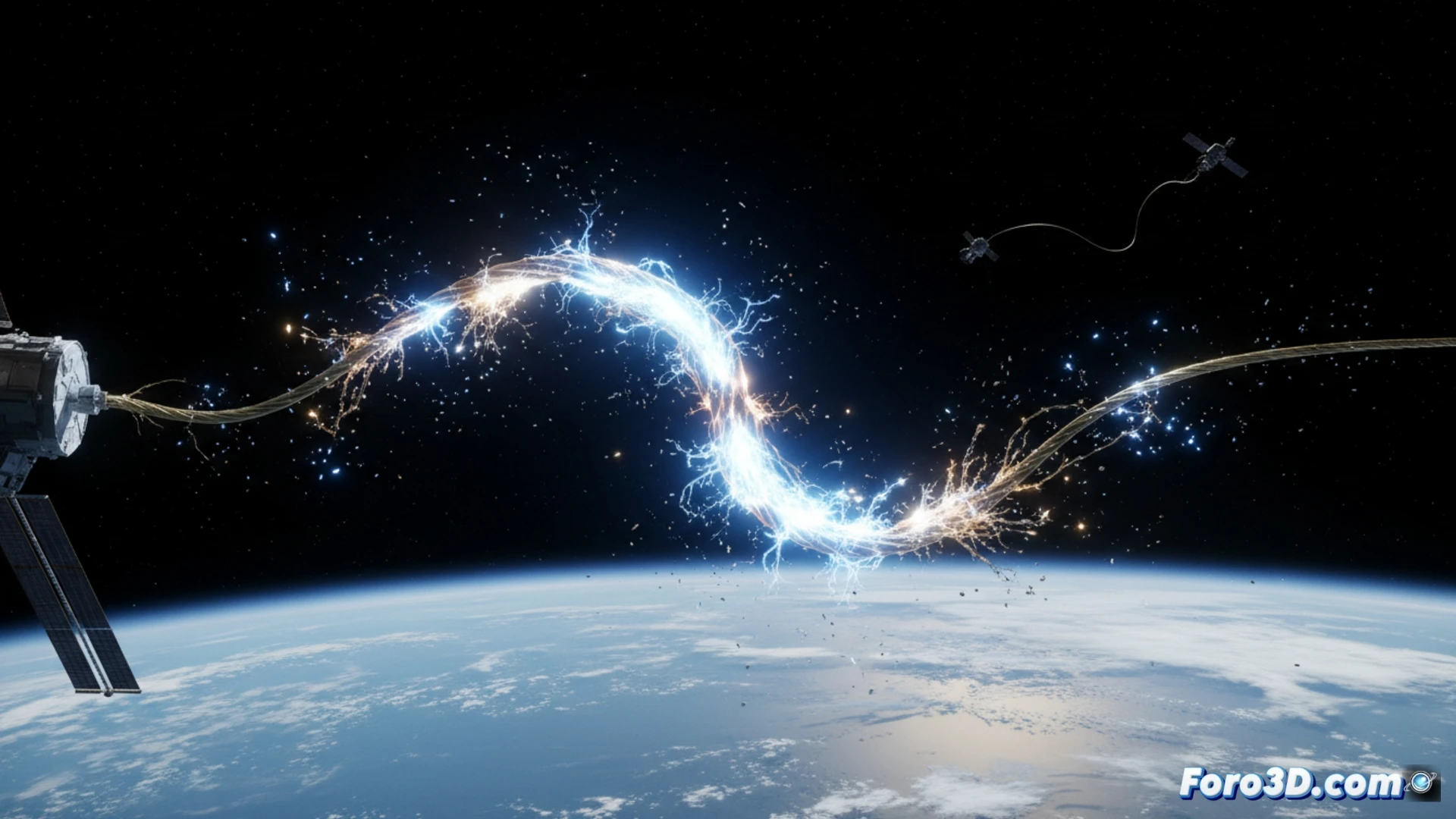
On October 15, an orbital power generation experiment in low Earth orbit failed when a 20-kilometer conductive aramid fiber cable broke. The mission, designed to test power transfer between two connected satellites, ended with the abrupt separation of the modules. Subsequent analysis revealed that a plasma discharge, induced by the cable's interaction with Earth's magnetic field, melted the fiber at a critical point, triggering a whiplash effect that propagated the fracture along the structure.
Multiphysics Modeling: Whiplash Dynamics and Thermal Degradation in MSC Adams and Python 🛰️
To understand the failure, our team replicated the scenario in a 3D simulation environment. Using MSC Adams, we modeled the cable as an assembly of 10,000 flexible segments with viscoelastic properties, subjected to differential orbital tension and system rotation. The whiplash dynamics, characterized by shock waves traveling at 2 km/s, were solved using a flexible body solver. In parallel, a Python script simulated the plasma discharge as a localized thermal event, applying a heat flux of 500 kW/m2 in the region of highest electric field. Combining this data allowed us to identify the exact point where thermal fatigue exceeded the tensile strength of the aramid, resulting in catastrophic rupture.
Visualizing the Fracture Point: Lessons for Space Material Design 🔬
The final visualization in Blender was key to communicating the failure. We rendered the cable with a progressive damage map, where areas of highest fatigue appeared in intense red tones, up to the melting point. The animation showed how the plasma, similar to an electric arc, eroded the fiber in microseconds, followed by the whiplash tearing the remaining strands. This representation not only documents the accident but establishes a simulation protocol for future designs: tethered cables must include sacrificial layers against plasma and an active damping system to suppress the whiplash effect before damage becomes irreversible.
In the context of the October 15 orbital tethered system failure, how would you computationally model the interaction between plasma-induced electrical charges and the cyclic fatigue of the conductive aramid cable to predict the material's lifespan?
(PS: Material fatigue is like yours after 10 hours of simulation.)